
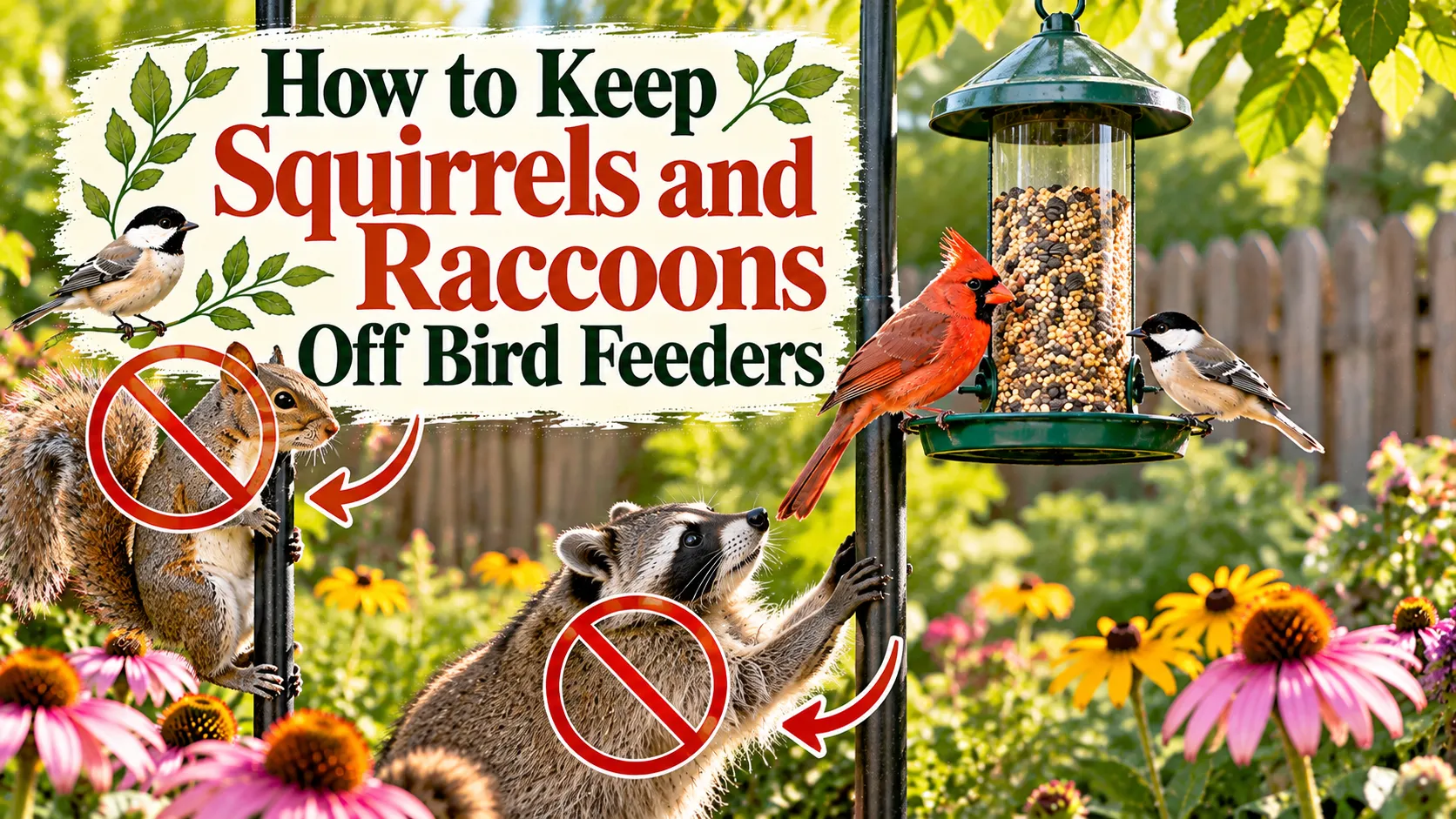
To keep squirrels off a bird feeder, mount it on a metal pole with a baffle about 4 to 5 feet off the ground, keep the pole at least 8 to 10 feet from any tree, fence, roof or other point a squirrel can jump from, and use a feeder that closes or cages out heavier animals. Capsaicin treated food, the heat compound in hot peppers, can add some protection, but treat it as a supplement rather than a fix.
You don’t need to remove squirrels to protect your seed. They are native animals with an ecological role, including as food for hawks and owls, according to Audubon. Audubon’s expert advice describes squirrels as strong climbers and jumpers, and says that if you take those abilities away, they have little left to work with. Maryland’s Department of Natural Resources describes squirrels as persistent, so expect repeated attempts.
Start with placement
Feeder placement does more than any product. Keep the pole at least 8 to 10 feet from trees, buildings, fences and other solid structures, according to Audubon. Maryland advises placing feeders well away from trees, fences and wires. Any deck rail, fence or branch near the feeder is a possible launch point.
Choose the right baffle
A pole baffle is the most dependable option. Audubon describes two common types, cylindrical and wrap around, and says metal works best. The baffle should sit about 4 to 5 feet off the ground. If it is too low, squirrels can jump onto it and use it as a launch pad. If it is too high, they may jump straight from the pole onto the feeder. Eli Haislip, who has worked for ten years at a bird feeding supply store and was interviewed by Audubon, says a tape measure is the best tool against squirrels, so measure carefully before you install a baffle.
Feeders that resist squirrels
If you cannot place a pole safely, Audubon’s next best option is a weight activated feeder. When a squirrel lands on the perch, its weight pulls down a shroud that blocks the feeding ports, while small birds can still feed. Audubon stresses that the feeder must hang farther from the pole or trunk than a squirrel can reach. Otherwise, the squirrel can pull the feeder close enough to feed without triggering the shroud.
Caged feeders keep squirrels from reaching the seed. Audubon points out the trade off: the same cage also keeps out larger birds. Choose a design that suits the birds you want to attract. For how these feeder styles compare, see the separate feeder guide.
Food deterrents: what the evidence supports
Food can help, but only as a supplement to hardware.
Capsaicin. A 1995 study by the USDA National Wildlife Research Center tested capsaicin on gray squirrels. On seed, free ranging squirrels showed an avoidance response that increased with the amount of pepper. On sunflower hearts, all three capsaicin levels were avoided about equally. Suet worked at lower concentrations than seed in that study.
The study tested gray squirrels only, so its results may not apply to other mammals. Research on wild chili peppers by Tewksbury and Nabhan (2001) found that birds ate capsaicin laced fruit and passed the seeds, while small mammals avoided it. That work looked at wild chilies and lab birds, not feeders, so treat it as background rather than a guarantee for your feeder. Choose products made for wild birds, and follow their labels.
Avoid pepper repellent sprays near feeders. Maryland’s Department of Natural Resources warns that pepper based deer repellents can have a negative effect on birds.
Safflower. Many squirrels avoid safflower seed. The University of Kentucky Cooperative Extension reports that squirrels will not eat it, but experiences vary, so do not rely on safflower alone. The Extension lists cardinals, mourning doves, woodpeckers, blue jays, tufted titmice and finches among the birds that eat it.
Raccoons and rats
Raccoons are clever, opportunistic feeders. Maryland’s wildlife guidance describes them as responsible for most human wildlife conflicts in the state. Its advice is practical:
- Use a thin cast iron pole no greater than half an inch thick. Raccoons find these difficult to climb, but the pole must be firmly set in the ground so a raccoon cannot tip it over.
- Hanging a feeder on a thin wire strung between two trees can deter raccoons. Squirrels can still walk the wire, so combine this with a pole or cage where possible.
- If a raccoon visits, take the feeder down for at least a week.
Maryland also says feeding raccoons is discouraged, given the rabies risk. In 2010, raccoons accounted for more than 60 percent of rabies cases in the state.
Rats are a separate problem. If you see rats eating leftover seed, Maryland advises you to stop putting out bird food immediately. Birds will adjust, and the rats are the bigger threat to you and your neighbors. Keep feeding areas clean.
What not to do
Do not use rodent poisons. The UNH Extension reports that rodenticides harm birds and other non target wildlife, including predators that eat poisoned rodents. Its advice is non chemical control: remove food sources such as bird feeders and pet food, and use barriers and prevention.
This article does not recommend electric deterrents or glue products. The sources reviewed for it do not support them.
Trapping and relocation: check your state
Trapping and moving wildlife is regulated, and the rules differ from state to state. Some states allow relocating squirrels and raccoons without a permit under conditions. Colorado’s rule requires advance notice to the state wildlife division, the landowner’s permission, and release within a set distance of the capture site. Louisiana’s rule allows relocation without a permit under conditions in the rule, including landowner permission. These examples do not apply everywhere.
This article does not recommend relocating animals. Before trapping, contact your state wildlife agency. In Maryland, the Nuisance Wildlife Hotline is 1-877-463-6497, Monday to Friday, 8 a.m. to 5 p.m.
Keep the feeder clean
Spilled and spoiled seed is a hazard in its own right. The Pennsylvania Game Commission recommends cleaning feeders with soap and water, then disinfecting with a 10 percent household bleach solution, allowing 10 minutes of contact time, rinsing, and air drying. It advises cleaning at least weekly, or more often when a feeder is soiled.
Checklist
- Place the pole at least 8 to 10 feet from trees, fences, roofs and other jump points.
- Install a metal baffle with its top about 4 to 5 feet off the ground.
- Choose a weight activated or caged feeder, and hang it out of a squirrel’s reach.
- Use capsaicin treated food as a supplement, and follow the label.
- Avoid pepper repellent sprays near feeders.
- Stop putting out bird food if rats eat spilled seed.
- Take feeders down for at least a week if raccoons visit.
- Do not use rodent poisons.
- Check your state’s rules before trapping or moving any animal.
- Clean feeders at least weekly.
Sources and further reading
- How to Stop Squirrels From Raiding Your Bird Feeders — Audubon
- Living with Wildlife — Maryland Department of Natural Resources
- Directed deterrence by capsaicin in chillies — Tewksbury and Nabhan, Nature (2001)
- Capsaicin-treated seed and squirrels — USDA National Wildlife Research Center (1995)
- Wildlife-Safe Alternatives to Harmful Rodent Poisons — UNH Extension (2025)
- Game Commission Lifts Recommendation to Cease Feeding Birds — Pennsylvania Game Commission (2021)
- Feeding Birds — University of Kentucky Cooperative Extension, Daviess County (2024)
- Colorado Code of Regulations 406-17, live capture and relocation
- Louisiana Administrative Code 76:V.125, Control of Nuisance Wild Quadrupeds