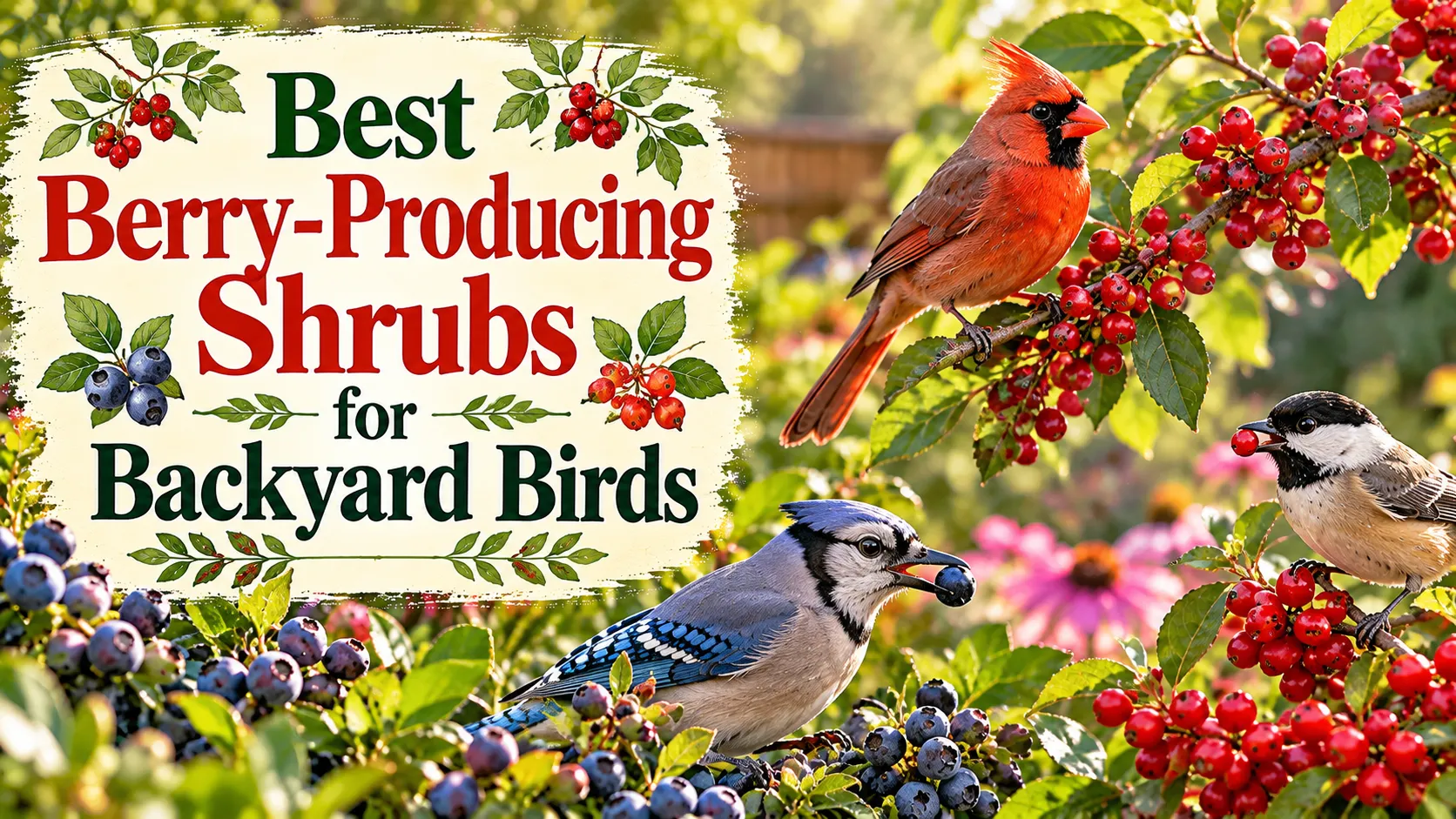
Native berry shrubs do something a feeder cannot: they give migrating songbirds the high fat fruit they need to refuel during fall stopovers, and they keep fruit hanging through winter for residents like cedar waxwings, mockingbirds, and robins. Research in the northeastern United States found that native shrub fruits contained far more fat and energy than the fruits of common invasive species, and that migrants consumed native dogwood fruit faster than invasive fruit (Smith, DeSando and Pagano 2013). Below are five native shrubs you can buy as live plants, chosen by the distinct seasonal role their fruit plays for birds, plus three western species worth seeking out at a local nursery. For how these shrubs fit a whole garden plan, see our complete guide to choosing plants for birds and butterflies.
Why native berries matter more than you might think
Not all berries are equal. A factsheet by Smith and McWilliams sorts native shrub fruit into three roles that matter for birds (Smith and McWilliams 2015):
High fat refueling fruit. Species like arrowwood viburnum and spicebush produce fruit with enough lipid content that migrating songbirds can rebuild fat reserves at stopover sites. In the Rochester, NY study, native fruits ranged from about 7% to nearly 49% fat, while every invasive fruit tested had less than 1% fat.
Carbohydrate complement fruit. Shrubs like serviceberry and dogwood bear fruit that rounds out a migrant’s diet with sugars and water. These species often fruit earlier in the season, feeding birds before the high fat species peak.
Persistent winter fruit. Hollies, bayberry, and certain viburnums hold their fruit well into winter. Fewer migrants eat these waxy or less palatable berries, but they become critical food for overwintering birds once other sources are gone.
The practical advice from that factsheet: plant at least two species from the “highly recommended” tier plus species from the other lists, so your yard covers the full migration and overwintering window. For how berries fit alongside feeders, nest boxes and water, see our guide to feeding and nesting habitat for backyard birds.
Arrowwood viburnum (Viburnum dentatum)
Arrowwood Viburnum
A dense native viburnum with dark blue fruit from late summer into fall, among the most valuable native berries for fall migrants. Ships as an established container plant.
Key specifications
- Sunlight
- Full sun
- Use
- Outdoor
- Color
- Green
- Weight
- 5 pounds
Pros
- Native viburnum with high value fall fruit
- Ships as an established container plant
- Handles full sun
Cons
- Viburnum leaf beetle can damage it in parts of the Northeast
- Fruits best in full sun with consistent moisture
Arrowwood viburnum is one of the most valuable native berry shrubs for fall migrants. At a southern New England stopover site, it was consumed at the highest rate of any fruit tested and had the highest total antioxidant content (Bolser et al. 2013). The Smith and McWilliams factsheet places it in the “highly recommended” category for migrant habitat.
This is a dense, multi stemmed shrub that grows 3 to 10 feet tall and produces clusters of dark blue fruit from August through November. Its native range stretches from Maine to Florida and west to Iowa and eastern Texas, according to the USDA NRCS Plant Guide. It tolerates a range of soils and light conditions, though it fruits most heavily in full sun with consistent moisture.
The Florida Foliage listing ships a #3 container, which is a well established plant that should begin producing fruit within a couple of seasons. One limitation to watch for: viburnum leaf beetle has spread through parts of the Northeast and can damage arrowwood, though it prefers other viburnum species as hosts. If you are in an affected area, monitor for larvae in spring and prune infested twigs.
Planting basics. Full sun to partial shade. Moist, well drained soil preferred, but tolerates clay. Space 6 to 10 feet apart for a hedgerow. Water regularly during the first growing season.
Red osier dogwood (Cornus sericea ‘Bailey’s’)
Red Osier Dogwood 'Bailey's'
A cold tolerant native dogwood with white fruit in late summer and vivid red winter stems. Suited to moist and wet ground where other shrubs struggle.
Key specifications
- Sunlight
- Partial shade
- Special feature
- Bright red stems, cold tolerant
- Bloom period
- Spring to summer
- Hardiness zones
- 3, 5, 6, 7, 8
- Weight
- 15 pounds
Pros
- Broad native range across much of North America
- Bright red winter stems
- Thrives in moist to wet soil
Cons
- Brand listings exclude shipment to several western states and Hawaii
- Needs stem thinning to keep winter color
Red osier dogwood gives you one of the broadest native ranges of any berry shrub on this list. The USDA NRCS Plant Guide records it from California and Alaska across to the eastern United States, making it one of the few cross regional natives. Its white fruit clusters ripen in late summer, and some fruit persists into early winter. The guide lists a long roster of bird species that eat the berries, including wood ducks, eastern bluebirds, and several thrush species.
The Green Promise Farms listing ships a #3 gallon ‘Bailey’s’ cultivar, selected for compact growth and vivid red winter stems. It naturally grows in moist areas like streambanks, wetland edges, and swampy ground, so it is a strong choice if you have a low or wet spot in your yard that other shrubs struggle with. It handles partial shade well.
Planting basics. Full sun to partial shade. Prefers moist to wet soil. USDA Zones 3 through 8. Thin older stems at ground level every few years to maintain vigorous red winter color. Space 6 to 8 feet apart.
Winterberry (Ilex verticillata)
Winterberry
A deciduous native holly grown for dense red berries that persist through winter, feeding birds when other food is gone. Ships as three plants.
Key specifications
- Sunlight
- Partial sun
- Color
- Red and green
- Style
- Winterberry plants to grow
- Weight
- 1 pound
Pros
- Red berries persist through the coldest months
- Native holly that feeds overwintering birds
- Tolerates partial shade
Cons
- Dioecious, so a male pollinator nearby is needed for fruit
- Listing does not specify plant sex
Winterberry is the shrub to plant if your yard goes empty in winter. Unlike most hollies, it drops its leaves in fall, leaving behind dense clusters of bright red berries that persist through the coldest months. Cedar waxwings, robins, and mockingbirds rely on this persistent fruit when other food sources have been exhausted or buried by snow.
Its native range spans from Nova Scotia to the Florida Panhandle and west to Minnesota, southeastern Missouri, and eastern Texas, according to the Lady Bird Johnson Wildflower Center. It thrives in acidic, moist soil and tolerates partial shade, conditions that make it a natural fit for woodland edges and rain garden borders.
The CZ Grain listing ships three plants, but read the warning below before ordering.
Planting basics. Full sun to partial shade. Acidic, consistently moist soil. Space 5 to 8 feet apart. Place the male pollinator nearby for effective pollination.
Spicebush (Lindera benzoin)
Spicebush
A shade tolerant native understory shrub whose glossy red fruit is among the fattiest available to fall migrants. Ships as two plants.
Key specifications
- Sunlight
- Partial sun
- Style
- Spicebush live plants to grow
- Color
- Red
- Weight
- 1 pound
Pros
- Performs in shade where few berry shrubs do
- High fat fruit for fall migrants
- Aromatic leaves smell like allspice when crushed
Cons
- Dioecious, so only females fruit and a male is needed nearby
- Listing does not specify plant sex
Spicebush is the understory specialist on this list, a shade tolerant native shrub whose glossy red drupes are among the fattiest fruits available to fall migrants. A northeastern study cited in the USDA NRCS Plant Guide found about 48% fat content in spicebush fruit, and the guide lists more than 20 bird species that eat it. Wood thrushes, a species of conservation concern that forages in forest understory, are particularly associated with spicebush fruit during fall migration.
Its native range covers eastern Texas, Oklahoma, and Kansas east to the Atlantic coast and north to Maine. It grows 6 to 12 feet tall in the understory of deciduous forests, making it one of the few berry shrubs that actually performs well in shaded yards, under mature trees, along the north side of a house, or at a woodland edge.
The CZ Grain listing ships two plants. Like winterberry, spicebush is dioecious.
Planting basics. Partial shade to full shade. Moist, rich soil preferred, but adaptable. Space 6 to 10 feet apart. Aromatic leaves and twigs: a crushed leaf smells like allspice.
American beautyberry (Callicarpa americana)
American Beautyberry
A southeastern native shrub with vivid purple berry clusters that wrap the stems in fall and persist after the leaves drop. Ships as a starter plant.
Key specifications
- Sunlight
- Full sun
- Use
- Outdoor
- Color
- Green
- Style
- 1 plant
- Weight
- 5 pounds
Pros
- Unmistakable purple berry clusters
- Fruit persists after leaf drop
- Native to the Southeast
Cons
- Starter size, so allow two to three seasons to fruit
- Suited to southeastern gardens
American beautyberry is unmistakable: tight clusters of vivid purple berries wrap around the stems in fall, drawing quail, mockingbirds, robins, towhees, and thrashers. The USDA NRCS Plant Guide notes that the fruit ripens from August through September and persists after the leaves drop, making the clusters highly visible to birds.
This is a southeastern native, ranging from Virginia south to Florida and west to Texas and Oklahoma, according to the NRCS guide and UF/IFAS Extension. It grows 3 to 6 feet tall and wide, with an open, arching habit that works well at a woodland edge or as a loose informal hedge.
The Florida Foliage listing ships a 4 inch pot, which is a starter size plant. Expect it to take two to three growing seasons to reach fruiting maturity. The upside is the low entry cost. If you want faster coverage, order several and space them in a group.
Planting basics. Full sun to partial shade. Well drained soil. USDA Zones 6 through 10. Cut back to 6 inches in late winter to encourage dense new growth and heavier fruiting. Space 4 to 6 feet apart.
Berry shrubs for western gardens
Amazon’s live plant selection for western native berry shrubs is thin. We could not find reliably available listings for the species below, but all three are worth sourcing from a local native plant nursery or a regional mail order grower. Your state’s Native Plant Society or the National Wildlife Federation’s Native Plant Finder can point you to suppliers.
Saskatoon serviceberry (Amelanchier alnifolia). Native from the Pacific coast of Alaska and British Columbia down to California and east to Utah, Colorado, Iowa, and Minnesota. Fruit ripens in June through August, the earliest of any shrub on this page, providing carbohydrate rich berries just as breeding birds are feeding nestlings. The USDA NRCS Plant Guide notes that cultivars sold under this name may be hybrids, so confirm the source if native genetics matter to you.
Toyon (Heteromeles arbutifolia). A California native evergreen shrub whose red berries persist through winter, filling a niche similar to winterberry in the East. The NRCS Plant Guide documents its importance to birds in the California floristic province. Sometimes called Christmas berry or California holly.
Silver buffaloberry (Shepherdia argentea). Native to the northern Great Plains and westward to California, Arizona, New Mexico, and Oklahoma. Fruit ripens in late summer and can persist into spring. The NRCS Plant Guide lists songbirds and sharp tailed grouse among its wildlife users. It is dioecious and thorny, with a suckering growth habit, so give it room and plant a male nearby.
Shrubs to avoid
Several widely sold ornamental shrubs produce berries that birds eat but that either harm them directly or damage the ecosystems they depend on. If any of these are in your yard, consider replacing them with a native from this guide.
Nandina (Nandina domestica). Also called heavenly bamboo. Testing by the University of North Carolina’s North Carolina Botanical Garden found that nandina leaves and green fruits are highly cyanogenic. Ripe red berries release cyanide more slowly and lose toxicity over time, but the risk is real, especially for cedar waxwings, which swallow large quantities of fruit in a single feeding bout. Nandina is classified as invasive in North Carolina and other southeastern states.
Japanese barberry (Berberis thunbergii). Listed as an invasive shrub by the University of Maryland Extension. Beyond displacing native fruit sources, research has linked Japanese barberry thickets to humid microclimates that may increase tick populations, a concern in the northeastern US. Several states have banned or restricted its sale.
Autumn olive (Elaeagnus umbellata). Another invasive listed by UMD Extension. Autumn olive fixes nitrogen, altering soil chemistry in ways that favor other invasive species over natives. Birds spread its seeds widely, and it can take over open fields and forest edges. Its fruit is carbohydrate rich but low in the fat that migrants need. Bush honeysuckle species share a similar problem: Maryland Extension notes their berries lack the fat birds require for long distance migration.
Planting for year round coverage
A single shrub species will not feed birds through every season. The Smith and McWilliams factsheet recommends planting at least two species from the “highly recommended” list plus additional species from other tiers to cover the full migration and overwintering window. Here is one way to think about it:
Late summer (July to September): Red osier dogwood and American beautyberry begin fruiting first, giving early migrants and breeding birds fresh fruit.
Fall migration (September to November): Arrowwood viburnum and spicebush peak as fall migrants pass through. Their high fat fruit is the most valuable at this stage.
Winter (December to March): Winterberry holds its fruit through the coldest months, feeding cedar waxwings, robins, and overwintering sparrows when everything else is gone.
Do I need a male and female plant for every berry shrub?
Only for dioecious species, those that have separate male and female plants. On this list, winterberry and spicebush are dioecious: you need at least one male nearby for the females to set fruit. Arrowwood viburnum, red osier dogwood, and American beautyberry have both male and female parts in each flower, so a single plant can fruit on its own, though multiple plants improve pollination.
How long until a new shrub produces berries?
A shrub shipped in a #3 container (about 3 gallons) is typically 2 to 3 years old and may fruit within a season or two of planting. Smaller starter pots may take two to three additional growing seasons. Seed grown plants can take considerably longer. Winterberry grown from seed may take years to fruit, which is why we recommend buying established live plants rather than seeds.
Can I grow these shrubs in containers?
Most can survive in large containers for a few years, but berry production will be lower than in the ground, and roots are more vulnerable to freezing in winter. If container growing is your only option, winterberry and American beautyberry are the most adaptable of the five. Use a pot at least 20 inches wide and insulate it in winter.
Will berry shrubs attract unwanted animals?
Deer browse some species, especially arrowwood viburnum. Spicebush is more deer resistant because of its aromatic foliage. Squirrels and raccoons may eat some fruit, but they rarely strip a healthy shrub bare. The biggest competition for the berries is other birds, which is the whole point.
Sources and further reading
- Lipid, Sugar, and Waterborne Metabolite Content of Fruits (Smith, DeSando and Pagano 2013, Northeastern Naturalist)
- Recommended Plantings for Migratory Songbird Habitat Management (Smith and McWilliams 2015, URI/RIT Factsheet)
- Birds Select Fruits with More Anthocyanins and Phenolic Compounds (Bolser et al. 2013, Wilson Journal of Ornithology)
- Arrowwood Viburnum Plant Guide (USDA NRCS)
- Red Osier Dogwood Plant Guide (USDA NRCS)
- Winterberry Holly (Lady Bird Johnson Wildflower Center)
- Spicebush Plant Guide (USDA NRCS)
- American Beautyberry Plant Guide (USDA NRCS)
- American Beautyberry (Lee County Extension, UF/IFAS)
- Saskatoon Serviceberry Plant Guide (USDA NRCS)
- Toyon Plant Guide (USDA NRCS)
- Silver Buffaloberry Plant Guide (USDA NRCS)
- Testing Nandina Berries for Toxicity (UNC North Carolina Botanical Garden)
- Invasive Shrub Control (University of Maryland Extension)
- Migratory Birds Like Native Berries Best (Audubon)
- 11 Native Shrubs That Make Your Yard a Wonderland for Birds (Audubon)