
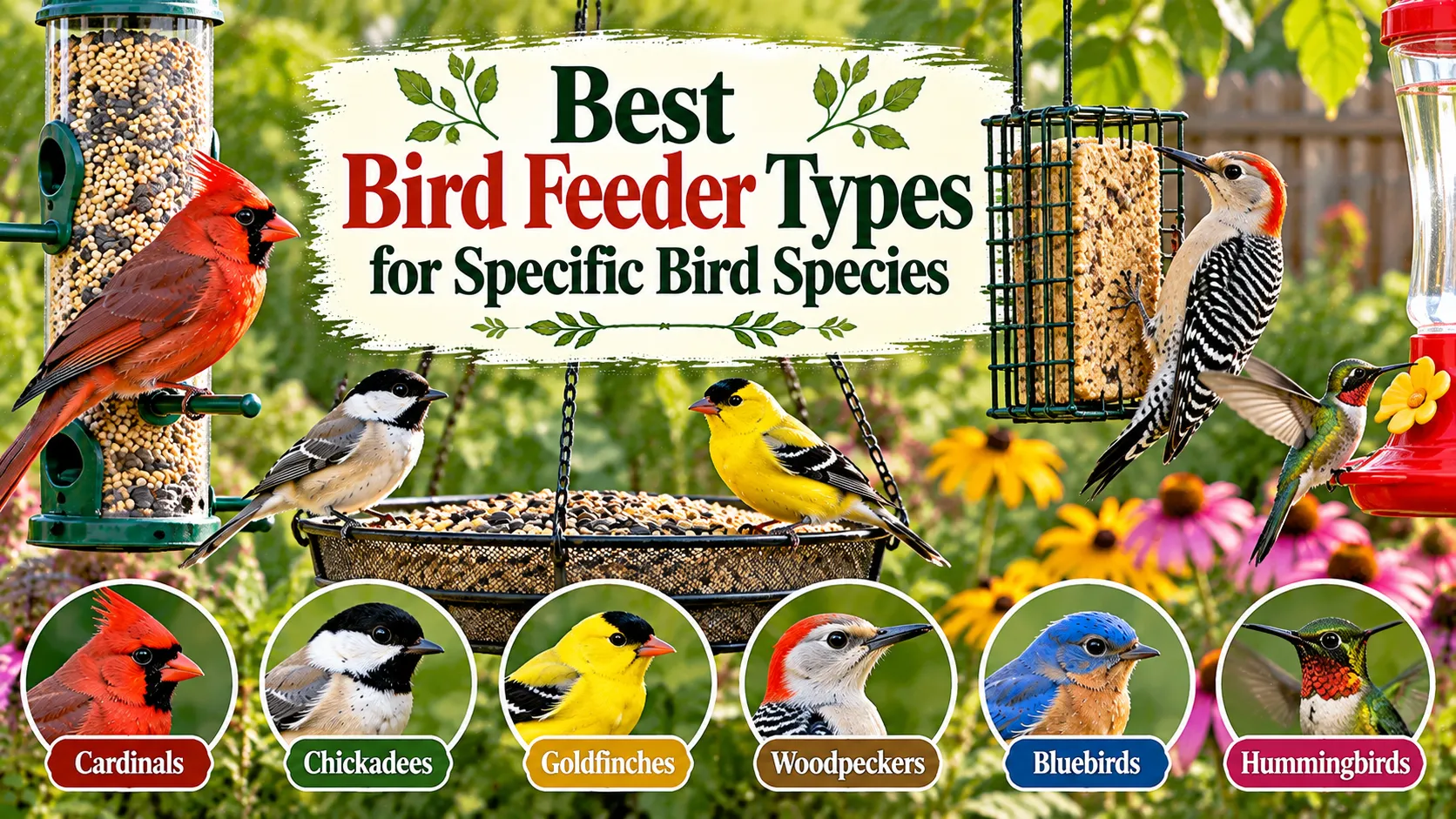
Most feeders marketed as “universal” end up favoring a handful of species and frustrating the rest. A tube feeder with short perches works well for finches and chickadees but can crowd out a cardinal. A platform feeder that juncos and doves love also catches rain and droppings. The fastest way to attract a specific bird is to start with how it actually feeds, clinging, perching, or foraging on the ground, and pick the feeder built for that posture.
Small clinging birds: chickadees, titmice, nuthatches
Chickadees and titmice are some of the easiest backyard birds to attract, and they’ll use almost any small feeder stocked with sunflower seed, suet, or peanuts (Cornell Lab). Nuthatches feed the same way, often upside down.
A tube feeder with small ports and short perches is the right fit here. Metal port hardware resists squirrel damage, and a feeder that comes apart without tools makes the frequent cleaning these birds need easier to keep up with.
Brome Squirrel Buster Standard
A four port tube feeder with a weight activated shroud that closes the seed ports under a squirrel, plus metal perches and exposed metal parts that resist chewing.
Key specifications
- Capacity
- 1.3 lb (3/4 qt)
- Ports
- 4
- Material
- Metal, plastic, resin
- Dimensions
- 5 x 5 x 13.25 in
- Cleaning
- Dismantles by hand, no tools
Pros
- Weight activated shroud closes the seed ports under a squirrel
- Metal perches and exposed parts resist chewing
- Ventilated seed chamber helps keep seed fresh
Cons
- Only 1.3 lb capacity, so frequent refills at a busy station
- Four feeding positions only, so ports can crowd
- Squirrel defense depends on correct hanging distance and baffles
A window feeder is a good alternative for close viewing of these same species, and it keeps seed off the ground directly below a window.
Nature's Way Clear View Window Feeder
A two cup clear window feeder that mounts with four suction cups and has a removable, drainage oriented tray for easier cleaning and refilling.
Key specifications
- Capacity
- 2 cups
- Dimensions
- 6.75 H x 9.25 W x 5 D in
- Weight
- 0.75 lb
- Mounting
- 4 suction cups
- Material
- UV stabilized plastic
- Cleaning
- Removable seed tray
Pros
- No drill window mounting suits rentals, apartments and balcony doors
- Removable tray simplifies cleaning and refilling
- Channeled, perforated tray moves water away from seed
Cons
- Small 2 cup capacity empties quickly with regular visitors
- No full roof, so wind driven rain can still wet seed
- Window mount only, not a freestanding or pole feeder
Finches: goldfinch and pine siskin
Goldfinches and pine siskins favor nyjer seed, which needs a feeder with very small feeding ports, because a standard tube feeder’s openings are too large and waste the seed. For more on matching seed type to feeder, see choosing bird seed (FeederWatch).
Aspects 428 Quick Clean Nyjer Tube Feeder
A ten port nyjer tube feeder with a large reservoir and a tool free removable base for cleaning.
Key specifications
- Capacity
- 1.75 qt
- Ports
- 10
- Material
- Zinc die cast, polycarbonate, stainless hardware
- Cleaning
- Removable base, no tools
Pros
- Ten ports reduce queueing compared with four port tubes
- A 1.75 qt reservoir is large for a finch feeder
- Tool free removable base makes cleaning easier
Cons
- No built in squirrel protection, so placement and baffles are required
- Fine nyjer seed can spill and waste easily
- Port dimensions are not published, so small bird fit is not confirmed
Cardinals and jays
Cardinals aren’t picky. Cornell’s guidance is direct: nearly any feeder will attract a Northern Cardinal within its range, though they show a strong preference for sunflower seed (All About Birds). What matters more than feeder type is perch room, cardinals are a larger bird and need somewhere to comfortably land and sit while they eat.
A feeder with wide perches and a roof to keep seed dry suits both cardinals and jays, who also take peanuts readily.
Woodlink Absolute II
An all metal, double sided feeder with two counterbalanced perches that can be set to exclude heavier animals, supplied with a hanging rod, five foot pole kit and ground socket.
Key specifications
- Capacity
- Up to 12 lb
- Material
- All metal
- Perches
- Two counterbalanced, adjustable
- Cleaning
- Roof swings up for filling and cleaning
- Mounting
- Hanging rod, 5 ft pole kit, bracket, ground socket
Pros
- Up to 12 lb capacity suits high traffic yards
- Adjustable perches can be set to exclude heavier animals
- Includes hanging rod, five foot pole kit, bracket and ground socket
Cons
- Heavy when full, so handling and mounting are harder
- Higher cost than basic feeders
- Protection depends on placement, since squirrels can bypass the perch
Woodpeckers
Downy Woodpeckers are the woodpecker most likely to visit a backyard feeder. They prefer suet but will also take black oil sunflower seed, millet, peanuts, and chunky peanut butter, and will occasionally drink from oriole or hummingbird feeders (All About Birds). Hairy and Red bellied Woodpeckers use suet the same way. Pileated Woodpeckers visit feeders only occasionally, their primary food is carpenter ants and wild fruit, not feeder food. Northern Flickers rarely visit feeders at all; they feed mainly on ants dug from the ground, so a feeder isn’t the way to attract one (All About Birds).
A suet cage with bottom access lets woodpeckers, nuthatches, and chickadees cling and feed from underneath.
Birds Choice SNUDD Upside Down Suet Feeder
A recycled poly lumber upside down suet feeder that holds four suet cakes and feeds clinging birds from underneath.
Key specifications
- Capacity
- 4 suet cakes
- Design
- Bottom access, roofed
- Material
- Recycled poly lumber
Pros
- Bottom access suits woodpeckers, nuthatches and chickadees
- Holds four cakes, so fewer refills
- Recycled poly lumber resists cracking, splitting and fading
Cons
- Squirrel resistant, not squirrel proof
- Underside only access excludes birds that prefer to feed beside food
- Suet still softens and spoils in heat
For jays specifically, a peanut feeder with a metal mesh body works well alongside a hopper or platform.
Woodlink Caged Screen Feeder
A compact caged mesh feeder for black oil sunflower seed or peanuts, with a metal cage that blocks larger animals from reaching the food.
Key specifications
- Dimensions
- 5.5 x 5.5 x 16.5 in
- Weight
- 2 lb
- Body
- Caged metal mesh
Pros
- Compact footprint fits small yards and crowded stations
- Light at 2 lb, easy to hang and move
- The cage restricts direct access by larger animals
Cons
- Material, capacity and mesh size are not fully published
- Refilling is reported as awkward
- Small size suggests frequent refills
Ground feeders: doves, juncos, sparrows
Doves, juncos, and sparrows often won’t use a hanging feeder at all, and do best at a platform or low tray where they can forage the way they would naturally (FeederWatch).
Woodlink Audubon 3 in 1 Platform Feeder
A cedar platform feeder with a powder coated screen base that can be hung, pole mounted or set on the ground, with a removable screen base for drainage and cleaning.
Key specifications
- Capacity
- 3 lb
- Material
- Cedar with powder coated screen base
- Mounting
- Hang, pole mount or ground
- Cleaning
- Removable screen base
Pros
- Three mounting options: hang, pole mount or ground
- A 3 lb capacity holds seed or mealworms
- Removable screen base aids drainage and cleaning
Cons
- Open design exposes seed to rain, wind and spoilage
- Large visitors like squirrels and pigeons can reach an open platform
- Capacity listings conflict at 3 lb and 5 lb, so check the exact listing
Hummingbirds and orioles
Hummingbirds need a dedicated nectar feeder, not a modified seed feeder. Cornell’s guidance is to mix sugar and water at a ratio of about one part sugar to four parts water, skip any red dye, and choose a feeder that’s easy to take apart for cleaning.
Aspects HummZinger HighView 429
A twelve ounce hummingbird nectar feeder with four ports, a built in ant moat and a removable cover for cleaning.
Key specifications
- Capacity
- 12 oz
- Ports
- 4
- Features
- Built in ant moat, removable cover
- Material
- UV stabilized polycarbonate
Pros
- Built in ant moat helps keep ants out of the nectar
- Removable cover makes the feeder easy to clean
- Four ports let several hummingbirds feed
Cons
- A 12 oz capacity needs frequent refilling in hot weather
- Nectar must be changed every few days
- It serves hummingbirds only, not seed eating birds
Orioles take a different approach: halved oranges, small amounts of jelly, and a dedicated sugar water feeder.
Birds Choice Oriolefest NP1009
A twelve ounce oriole feeder that offers nectar, jelly and orange halves at once, with a clear bowl and a rain cover.
Key specifications
- Capacity
- 12 oz
- Feeds
- Nectar, jelly, orange halves
- Features
- Clear bowl, rain cover
Pros
- Three oriole foods in one unit
- Clear bowl makes the nectar level easy to see
- Rain cover helps protect the food
Cons
- A 12 oz nectar capacity empties quickly with several orioles
- Wasps and yellow jackets may reach the jelly or drown in nectar
- Jelly cups are small
Placement and squirrels
Placement matters as much as feeder choice. The American Bird Conservancy, which has logged nearly 11,000 reports of banded bird collisions since 1922, more than 900 in the last five years alone, is direct about this: unless your windows have been treated to prevent collisions, there’s no safe distance to place a feeder from the glass. Treating the window itself, with film, decals, or external screening, matters more than how far away a feeder sits.
Squirrels will test almost any feeder. The feeders above vary in how well they resist squirrels, from the weight adjustable mechanisms on the Absolute II to standard tube and platform designs that offer no resistance at all. For placement, baffles, and food deterrents, see our guide to keeping squirrels and raccoons off bird feeders.
Cleaning and when to take feeders down
Clean seed feeders about every two weeks, and more often during wet weather or heavy use (Cornell Lab). If you notice sick or dead birds at a feeder, take it down, clean the area with a dilute bleach solution, and wait before putting it back out.
One feeder won’t do it all
A yard that wants a variety of species usually ends up with two or three feeder types running at once, a tube or window feeder for small clinging birds, a platform or hopper style feeder for cardinals and jays, and a suet cage for woodpeckers. Once you’ve matched feeders to the species you want, a decent pair of binoculars for backyard birdwatching makes it much easier to see who’s actually showing up to eat.
Sources and further reading
- How to Choose the Right Kind of Bird Feeder — All About Birds, Cornell Lab of Ornithology
- Feeder Types — Project FeederWatch
- Food Types — Project FeederWatch
- Northern Cardinal Overview — All About Birds, Cornell Lab of Ornithology
- Downy Woodpecker Overview — All About Birds, Cornell Lab of Ornithology
- Northern Flicker Overview — All About Birds, Cornell Lab of Ornithology
- Baltimore Oriole Overview — All About Birds, Cornell Lab of Ornithology
- How to Clean Your Bird Feeder — All About Birds, Cornell Lab of Ornithology
- Avian Mycoplasmosis — Pennsylvania Game Commission
- Conjunctivitis in Finches (Mycoplasmosis) — Wisconsin DNR
- Human Salmonellosis Outbreak Linked to Salmonella Typhimurium Epidemic in Wild Songbirds, United States, 2020–2021 — Emerging Infectious Diseases, CDC
- When Window Collisions Hit Home — American Bird Conservancy