
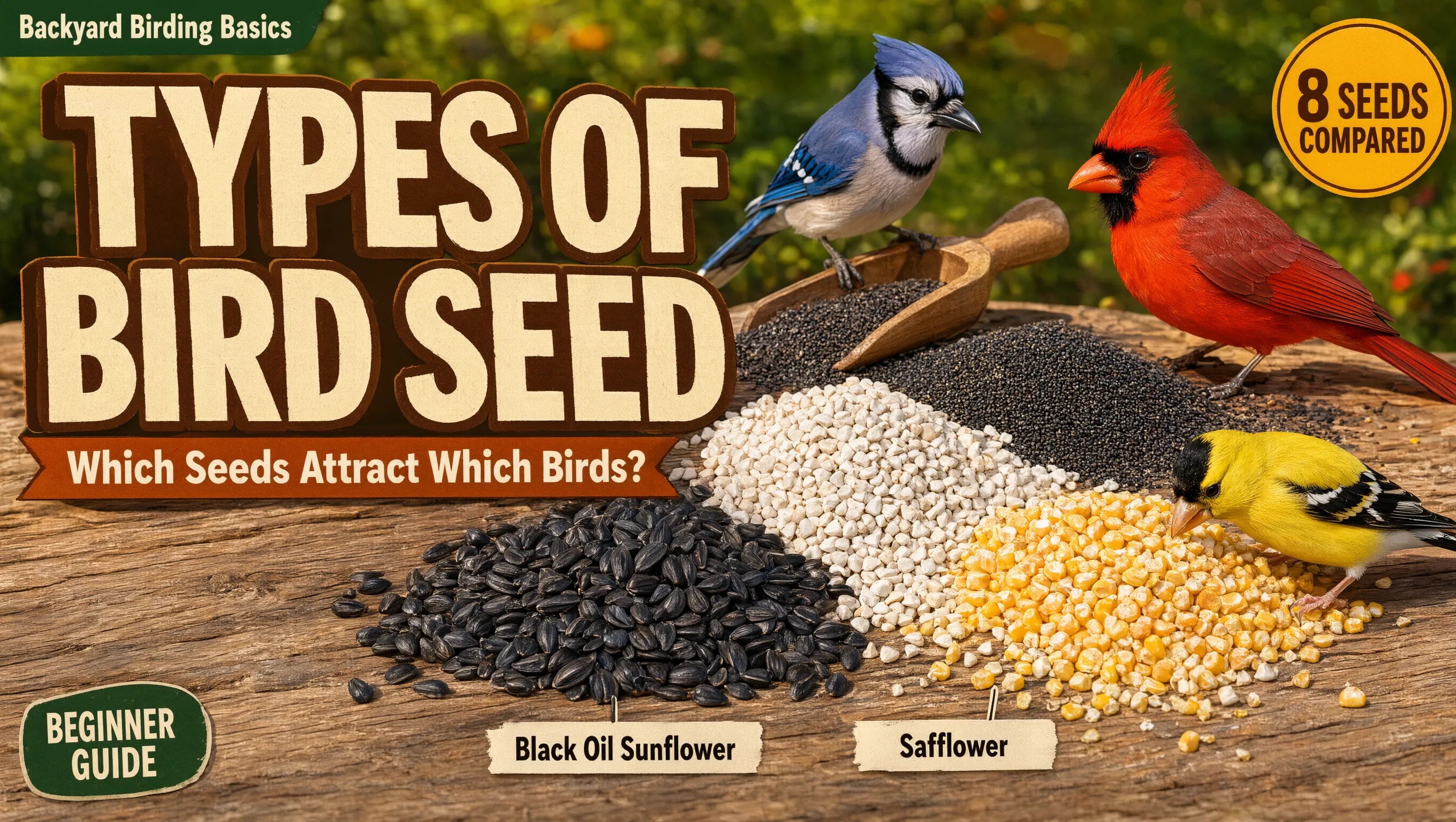
You have filled the feeder. Three days later, half the seed is scattered on the ground, sprouting weeds beneath the tray, and the only birds visiting are House Sparrows.
The problem is rarely the birds. It is the seed, or more precisely, a mismatch between the nutritional profile of the seed, the mechanical design of the feeder, and the species you are trying to attract.
This bird seed guide breaks down the nutritional biology behind every major seed variety, explains which species respond to which foods and why, and walks you through specific product recommendations so you can cut waste, deter nuisance animals, and build a feeding station that targets the birds you want to see.
This guide covers common backyard species across the United States and Canada, including Northern Cardinals, American Goldfinches, chickadees, Downy and Pileated Woodpeckers, Blue Jays, and juncos. Seed preferences may differ for species outside this range.
| Product | Best for | Key feature | Details |
|---|---|---|---|
| Kaytee Wild Bird Black Oil Sunflower Food, 5 lb | Universal starter seed for 40 plus feeder species | 5 lb bag | Check price on Amazon (opens in a new tab) |
| Audubon Park Cardinal Blend Wild Bird Food, 4 lb | Cardinals without subsidizing squirrels and grackles | 4 lb bag | Check price on Amazon (opens in a new tab) |
| Kaytee Ultimate No Mess Wild Bird Seed, 9.75 lb | Budget friendly lower waste feeding | 9.75 lb bag | Check price on Amazon (opens in a new tab) |
| Woodlink Audubon Tails Up Nyjer Thistle Finch Feeder, 17.25 inch | Goldfinch only feeding through inverted ports | 1.25 lb nyjer | Check price on Amazon (opens in a new tab) |
| Birds Choice Suet Feeder with Tail Prop and Roof | Woodpeckers that need tail support | One standard suet cake | Check price on Amazon (opens in a new tab) |
| C and S Peanut Butter Delight No Melt Suet Dough, 11.75 oz | Year round suet that holds shape in heat | 11.75 oz cake | Check price on Amazon (opens in a new tab) |
| Perky-Pet Red Cardinal Feeder, 2.5 lb | Multi species feeding from a circular tray | 2.5 lb seed | Check price on Amazon (opens in a new tab) |
Why Nutritional Biology Matters When Choosing Bird Seed
Birds are not indiscriminate eaters. They assess the caloric return of every seed they encounter, weighing the energy cost of cracking a shell against the lipid and protein payoff inside. Research from the Cornell Lab of Ornithology confirms that birds can detect underdeveloped or stale seeds and will discard them rather than waste energy processing an empty hull.
Their nutritional needs shift dramatically by season:
- Winter: Fat is the critical macronutrient. Birds must maintain body temperature in freezing conditions, which demands concentrated caloric fuel. Seeds with high lipid content (30 to 40% fat) are essential for survival.
- Spring and summer: Protein becomes dominant. Breeding females need protein for egg production. Nestlings require it for rapid tissue growth. Molting birds need protein and carotenoid pigments to regenerate feathers.
- Fall migration: Carbohydrate and fat loads fuel long distance flight preparation.
Understanding this cycle explains why a single all purpose seed approach fails. A winter feeding strategy built around high fat sunflower seed serves a fundamentally different biological purpose than a summer strategy emphasizing protein rich suet and hulled kernels.
The Core Seed Varieties: Nutritional Profiles Explained
Black Oil Sunflower vs Striped Sunflower
This is the most common comparison in backyard bird feeding, and the physical differences dictate which birds can access the food.
Black oil sunflower (BOSS) is the most widely preferred seed among backyard species. Its advantages are threefold:
- Thin shell: Virtually all seed eating birds, from the smallest chickadee to the largest grosbeak, can crack it. This universal accessibility makes BOSS the foundation of any feeding station.
- High fat content: Ranging from 28% to 40%, BOSS delivers the concentrated energy birds need for thermoregulation.
- High protein: Typically 15 to 25%, supporting feather maintenance and immune function.
Cornell Lab of Ornithology data confirms that BOSS is preferred by over 40 feeder species, including cardinals, finches, chickadees, nuthatches, titmice, jays, sparrows, and woodpeckers.
Striped sunflower seed is physically larger with a significantly thicker, harder shell. This creates a natural filtering effect:
- Small beaked birds (goldfinches, house finches) struggle to open them.
- Larger, stronger beaked species (cardinals, Blue Jays, Evening Grosbeaks, Tufted Titmice) handle them easily.
- Some bully birds like House Sparrows are deterred by the extra effort required.
When to choose which: If you want maximum species diversity, use black oil sunflower. If you want to exclude smaller birds and focus on larger species, or reduce House Sparrow dominance, striped sunflower is the strategic choice.
| Attribute | Black Oil Sunflower | Striped Sunflower |
|---|---|---|
| Shell thickness | Thin, brittle | Thick, hard |
| Fat content | 28 to 40% | About 24% |
| Protein content | 15 to 25% | About 16.5% |
| Best for | All species (40 plus) | Larger birds, excluding small finches |
| Feeder type | Hopper, tube, platform | Hopper, platform with wide perches |
Kaytee Wild Bird Black Oil Sunflower Food, 5 lb
100 percent black oil sunflower seed, triple cleaned to cut harvest debris. Thin hulls and high oil content suit hopper, tube, and platform feeders. Made in the USA.
Key specifications
- Size
- 5 lb bag
- Contents
- 100 percent black oil sunflower
- Feeders
- Hopper, tube, platform
Pros
- Triple cleaned for less debris
- Thin hulls most beak sizes can crack
- High fat for winter energy
Cons
- Hulls pile up under feeders without regular raking
Safflower Seed for Cardinals
Safflower occupies a unique strategic position in backyard feeding. It is a favorite of Northern Cardinals, grosbeaks, chickadees, nuthatches, and doves, but it is largely rejected by European Starlings, Common Grackles, blackbirds, and squirrels.
The mechanism is dual:
- Physical barrier: The thick, hard shell is difficult for many species to crack.
- Chemical deterrent: Safflower has a naturally bitter taste that squirrels and bully birds find unpalatable.
This makes safflower the ideal seed when your goal is to attract cardinals without subsidizing aggressive competitors. Cardinals, with their large, powerful conical bills, crack safflower shells effortlessly.
Safflower works best in hopper or platform feeders where cardinals can perch comfortably. Tube feeders with narrow perches are unsuitable for cardinals regardless of seed type.
Audubon Park Cardinal Blend Wild Bird Food, 4 lb
Two ingredient blend of black oil sunflower and safflower with zero fillers. No corn, milo, or millet. Safflower deters squirrels and grackles while cardinals feed freely.
Key specifications
- Size
- 4 lb bag
- Contents
- Black oil sunflower plus safflower
- Fillers
- None
Pros
- Safflower deters squirrels, starlings, and grackles
- Strong cardinal, grosbeak, and dove appeal
- No filler seed wasted on the ground
Cons
- Small finches may ignore the safflower portion
Nyjer (Thistle): Best Seed for Goldfinches
Despite the common name thistle seed, nyjer is not related to thistle plants in the United States. It is the seed of Guizotia abyssinica, a plant native to Africa, and it is heat treated during import to prevent germination.
Nyjer is the strongly preferred seed of American Goldfinches, Pine Siskins, and Common Redpolls. Its appeal lies in its extraordinary oil content (30 to 40% fat), which provides the dense energy these small, highly active birds require to sustain their rapid flight patterns and high metabolic rate.
Two critical factors determine the effectiveness of nyjer:
- Freshness: The heat treatment process that makes nyjer shelf stable also begins degrading its oils immediately. Stale nyjer loses much of its appeal, and goldfinches will often pass it over in favor of fresher options. Buy nyjer in small quantities, no more than a two to three month supply, and store it in a sealed container away from heat and light.
- Specialized hardware: Nyjer seeds are tiny and slender. Standard feeder ports allow them to pour out freely, creating massive waste. Nyjer must be offered in tube feeders with very small ports or in mesh sock feeders that allow finches to cling and feed while preventing spillage.
Woodlink Audubon Tails Up Nyjer Thistle Finch Feeder, 17.25 inch
Polypropylene tube with six perches and 1.25 lb nyjer capacity. The upside down feeding design suits the goldfinch ability to feed inverted, a behavior most competitor species cannot copy.
Key specifications
- Capacity
- 1.25 lb nyjer
- Perches
- Six upside down ports
- Body
- Polypropylene tube
Pros
- Inverted ports exclude House Sparrows and larger birds
- Sized for clinging finches and siskins
- Light body hangs from any shepherd hook
Cons
- Smooth plastic perches can feel slippery, light sanding improves grip
White Proso Millet and Ground Feeders
White proso millet is the preferred seed for ground foraging species: juncos, native sparrows, Mourning Doves, towhees, and quail. It provides accessible carbohydrates for species that naturally forage on open ground.
Millet is best scattered directly on the ground beneath a platform feeder or offered in a low tray feeder. It should never be a primary component in a tube feeder blend, as most perching birds ignore it and it simply falls to the ground as waste.
No Mess Bird Seed Blends: How They Work and What to Look For
No mess blends solve a specific problem: the accumulation of discarded seed shells beneath feeders, which creates muddy patches, inhibits plant growth, attracts rodents, and produces unwanted volunteer seedlings.
A true no mess blend contains only hulled seeds, seeds whose inedible outer shells have been mechanically removed. Every component is 100% edible, meaning zero waste hits the ground. Common ingredients include hulled sunflower hearts or chips, shelled peanuts or peanut pieces, hulled white proso millet, and chopped tree nuts.
How to read a bird seed label critically:
Not all products marketed as no mess deliver on the promise. The ingredient list is the definitive test. If you see any of the following, the product is not a true premium no mess blend:
- Cracked corn: A filler with aflatoxin risk in humid conditions.
- Canary grass seed: Primarily eaten by House Sparrows, not target songbirds.
- Red milo or sorghum: Rejected by virtually all desirable backyard species.
- Wheat or oats: Low nutritional value, ignored by most songbirds.
Kaytee Ultimate No Mess Wild Bird Seed, 9.75 lb
Marketed as 100 percent edible with hulled sunflower, millet, and peanuts. Note the label also lists cracked corn and canary grass seed, so it reduces shell waste but is not a true premium no mess blend.
Key specifications
- Size
- 9.75 lb bag
- Contents
- Hulled sunflower, millet, peanuts, plus corn and canary grass seed
- Feeders
- Hopper, tube, platform
Pros
- Less shell waste than standard blends
- Widely available at a low price
- Hulled sunflower suits all beak sizes
Cons
- Cracked corn brings aflatoxin risk in humid weather
- Canary grass seed mainly attracts House Sparrows
Suet Feeder Guide for Woodpeckers
Suet, rendered beef fat, is the highest density energy food available to backyard birds, delivering up to 90% of its caloric value as fat. It is among the most effective foods for attracting woodpeckers, nuthatches, and chickadees.
Why Woodpeckers Need Tail Prop Feeders
Woodpeckers possess a unique anatomical adaptation: stiff, chisel like tail feathers that function as a structural brace. When foraging on vertical tree trunks, a woodpecker presses its tail firmly against the bark to create a stable tripod of support, two feet plus the tail. This frees the body to lean back and strike or probe with its bill.
At a suet feeder, this same behavior applies. A woodpecker attempting to feed from a flat, unsupported suet cage will struggle to maintain position. A feeder with a horizontal tail prop, a flat board or bar extending below the suet cake, allows the woodpecker to brace its tail naturally, creating the leverage needed to feed comfortably. Project FeederWatch participant data consistently shows that woodpeckers preferentially visit tail prop suet feeders over standard cage designs.
Choosing the Right Suet Cake
- Raw suet melts above 90 degrees and becomes rancid quickly. Use only in cold weather.
- Rendered suet cakes have been processed to remove impurities, raising the melting point and extending shelf life. Suitable for spring and fall.
- No melt suet dough uses rendered fats or vegetable shortening as a base, remaining stable to 100 degrees. This is the appropriate suet for summer feeding.
Birds Choice Suet Feeder with Tail Prop and Roof
Recycled poly lumber feeder made in Wisconsin with a horizontal tail prop bar, a rain shielding roof, and rust resistant hardware. Holds one standard suet cake and resists cracking, splitting, and fading.
Key specifications
- Capacity
- One standard suet cake
- Body
- Recycled poly lumber with roof
- Hardware
- Aluminum hinges, stainless screws
Pros
- Tail prop lets woodpeckers brace naturally
- Roof keeps rain off the suet
- Weatherproof body for year round use
Cons
- Single cake capacity needs frequent refills in busy yards
C and S Peanut Butter Delight No Melt Suet Dough, 11.75 oz
Rendered beef suet dough with peanuts, corn, oats, and soy oil. The no melt formula stays stable to 100 degrees so it suits summer feeding. Fits standard suet cages, and peanut appeal extends beyond woodpeckers to nuthatches and chickadees.
Key specifications
- Size
- 11.75 oz cake
- Base
- Rendered beef suet with peanuts
- Stability
- No melt to 100 degrees
Pros
- Holds shape through summer heat
- Peanuts broaden appeal past woodpeckers
- Fits any standard suet cage
Cons
- Contains corn, store cool and dry and discard on off odor
Backyard Bird Seed Chart
Use this quick reference chart to match seed type to target species and feeder hardware.
| Seed or Food | Primary Target Species | Secondary Species | Best Feeder Type | Key Advantage |
|---|---|---|---|---|
| Black oil sunflower | Chickadees, finches, nuthatches, titmice | Cardinals, jays, woodpeckers, sparrows | Hopper, tube, platform | Universal appeal, thin shell, high fat |
| Striped sunflower | Cardinals, Blue Jays, grosbeaks | Tufted Titmice | Hopper, platform | Excludes small birds, deters some bully birds |
| Safflower | Northern Cardinals, grosbeaks | Chickadees, nuthatches, doves | Hopper, platform | Deters squirrels, starlings, grackles |
| Nyjer (thistle) | American Goldfinches, Pine Siskins | Common Redpolls | Mesh sock, small port tube | High oil, excludes sparrows through inverted feeding |
| White proso millet | Juncos, native sparrows | Mourning Doves, towhees | Ground scatter, low tray | Ground forager specialist |
| Suet (rendered) | Downy, Hairy, Pileated Woodpeckers | Nuthatches, chickadees | Tail prop cage | Highest caloric density, winter survival |
| Suet (no melt dough) | Woodpeckers, nuthatches | Chickadees, titmice | Tail prop cage, log feeder | Summer safe, holds shape in heat |
| Hulled sunflower chips | All seed eating species | Goldfinches, kinglets | Tube, hopper, platform | Zero waste, accessible to all beak sizes |
| Peanuts (shelled) | Blue Jays, woodpeckers, nuthatches | Cardinals, chickadees | Platform, tube, mesh | High protein plus fat, useful all year |
Buying Criteria: What to Check Before You Buy
When evaluating any bird seed or feeder product, apply these evidence based criteria:
- Read the ingredient list in order. Ingredients are listed by descending weight. If the first two items are not a preferred seed or nut, the product is filler heavy.
- Check the guaranteed analysis. Look for crude fat above 20% and crude protein above 15% for premium nutrition. Blends below 10% protein are predominantly filler.
- Reject vague labeling. Terms like grain products or mixed nuts obscure filler content. Reputable brands list every ingredient individually.
- Match feeder to species. Cardinals need wide perches. Goldfinches need small ports or mesh. Woodpeckers need tail props. No single feeder serves all species optimally.
For a feeder that suits cardinals and mixed flocks feeding together, one widely available option is the circular tray feeder below. Note its limitation honestly: the diamond mesh passes only small seeds, so birds feed mainly from the tray where seed collects.
Perky-Pet Red Cardinal Feeder, 2.5 lb
All metal circular feeder with a 360 degree tray, collapsible design, and drain holes. Suits cardinals and mixed flocks feeding together.
Key specifications
- Capacity
- 2.5 lb seed
- Body
- All metal with drain holes
- Tray
- 360 degree circular tray
Pros
- Tray suits cardinals and ground style feeders
- All metal resists squirrel chewing
- Drain holes shed rainwater
Cons
- Diamond mesh too small for whole sunflower, birds feed from the tray
Safety, Storage and Feeder Hygiene
Ignoring safety protocols can transform a well intentioned feeding station into a disease vector or a source of lethal toxins.
Aflatoxin: The Hidden Risk in Birdseed
Aflatoxins are toxic byproducts produced by Aspergillus mold species that thrive in warm, humid conditions. They cause fatal liver damage in birds. Research from the Cornell Lab of Ornithology confirms that aflatoxin is particularly prevalent in cracked corn, raw peanuts, and any seed that has been exposed to moisture.
Prevention protocol:
- Never buy seed in bulk quantities you cannot use within four to six weeks, especially during summer.
- Store all seed in airtight, rodent proof containers in a cool, dry location below 80 degrees.
- Inspect seed before every refill. Discard any seed that is clumped, discolored, or has an off odor.
- Avoid blends containing cracked corn during humid months.
- Clean feeders immediately if you discover moldy seed.
Disease Prevention: Cleaning Schedule
When birds congregate at feeders, pathogens spread rapidly through fecal contamination of food and perches. Two diseases of particular concern at backyard feeding stations are Salmonellosis and Mycoplasmal Conjunctivitis (House Finch Eye Disease).
Cornell recommended cleaning protocol:
- Frequency: Clean seed feeders every two weeks minimum. Clean more often during heavy use, rainy weather, or if you observe sick birds.
- Disassemble: Take the feeder completely apart.
- Scrub: Wash all components with hot, soapy water and a stiff brush to remove debris and biofilm.
- Disinfect: Soak all parts in a solution of one part household bleach to nine parts water for 10 minutes.
- Rinse thoroughly: Remove all traces of bleach.
- Air dry completely: Moisture promotes mold and bacterial growth. Never refill a damp feeder.
Ground maintenance: Rake up accumulated hulls, droppings, and spilled seed beneath feeders weekly. This debris harbors pathogens and attracts rodents.
Squirrel Deterrence Without Harm
If squirrels are depleting your seed supply, the most effective non lethal strategies are:
- Use safflower based blends. Squirrels reject the bitter taste.
- Install a weighted baffle on the feeder pole.
- Hang feeders away from jump points such as tree limbs, fences, and roof edges.
- Use hot pepper treated suet. Capsaicin deters mammals but does not affect birds.
Avoid glue based deterrents, which can trap and injure birds.
Frequently Asked Questions
What is the best single seed to attract the most bird species?
Black oil sunflower seed is the most widely preferred seed for backyard birds. Its thin shell suits over 40 species, and its high fat content of 28 to 40% provides energy all year.
What is the best seed for goldfinches?
Nyjer is the top choice for American Goldfinches for its 30 to 40% oil content. It must be fresh and served in a small port or mesh sock feeder. Hulled sunflower chips are a reliable alternative that suits more species.
What seed do cardinals prefer?
Northern Cardinals prefer black oil sunflower, safflower, and striped sunflower. Safflower is strategic because its hard shell and bitter taste deter squirrels, starlings, and grackles while cardinals crack it easily.
Do I need a special feeder for woodpeckers?
Yes. Woodpeckers brace with stiff tail feathers, so a suet feeder with a horizontal tail prop bar lets them feed comfortably. Without one, woodpeckers often abandon the feeder.
What is a no mess bird seed blend?
A true no mess blend contains only mechanically hulled seeds such as hulled sunflower, shelled peanuts, and hulled millet, so nothing falls as waste. Some products marketed as no mess still contain cracked corn or canary grass seed.
How do I keep squirrels away from my bird feeder?
Offer safflower based blends, install a weighted baffle on the feeder pole, hang feeders away from jump points, and use hot pepper treated suet. Capsaicin deters mammals without affecting birds.
How often should I clean my bird feeder?
At minimum every two weeks, weekly during heavy use or rainy weather. Wash with hot soapy water, soak 10 minutes in one part bleach to nine parts water, rinse, and air dry fully before refilling.
Can I feed birds in summer?
Yes with adjustments. Switch to no melt suet dough, offer seed in smaller quantities to prevent spoilage, clean feeders more often, and skip cracked corn and raw peanuts in humid months.
Sources
- Cornell Lab of Ornithology: All About Birds feeding and seed guidance - Research on seed preferences, nutritional needs, and feeder practices for backyard species.
- Project FeederWatch: Feeding birds and disease prevention guidance - Participant data on feeder visitation patterns and recommended cleaning protocols for healthy feeding stations.