
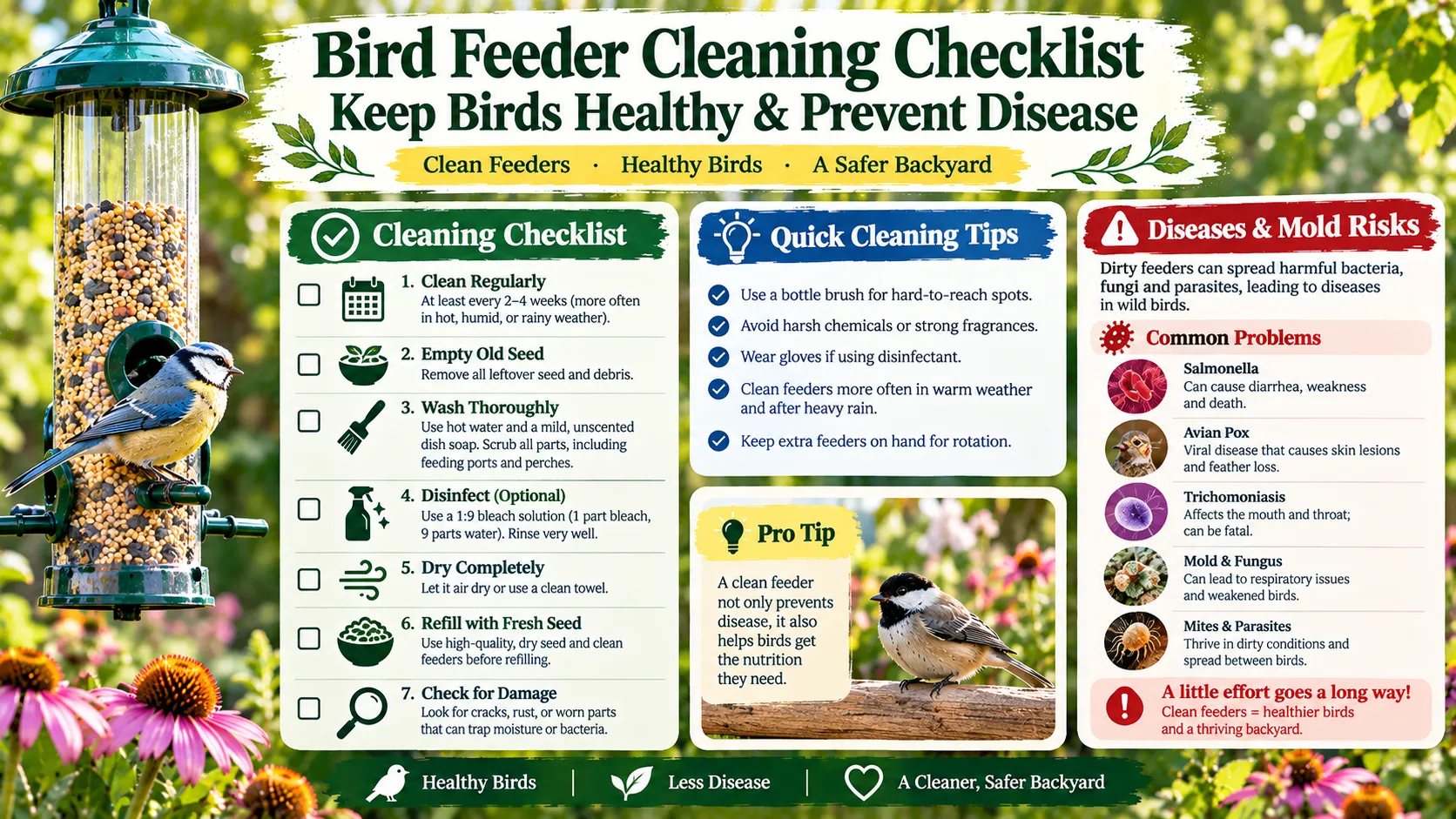
Clean seed feeders about every two weeks, and sooner when birds look sick, after wet weather, or during heavy use. Take the feeder apart if you can, scrub off debris, soak it for 10 minutes in 1 part household bleach to 9 parts water, rinse well, and let it dry completely before refilling. In a laboratory study from Kutztown University, reported by Project FeederWatch, a bleach soak reduced Salmonella on feeders more than scrubbing with soap and water alone. The study measured bacteria on feeders, not disease in birds, so cleaning lowers risk but does not guarantee that birds stay healthy.
Why feeder cleaning matters
Feeders bring birds close together, and disease passes through droppings and contaminated food. Idaho Fish and Game lists five diseases linked to feeders: salmonellosis, trichomoniasis, aspergillosis, avian pox and mycoplasmosis, which trace to the USGS National Wildlife Health Center. A University of Maine Extension bulletin lists the same five.
Salmonellosis is often fatal in songbirds, and there is no treatment for it in wild birds. Mold on wet seed can cause aspergillosis, a fatal respiratory disease. Mycoplasmal conjunctivitis, the swollen eye disease, is mainly a finch disease, and it spreads at feeders, where discharge can collect on tube feeder openings.
This article does not cover avian influenza. Check your state wildlife agency for current guidance.
How often to clean
The usual baseline is about once every two weeks, and Clemson Extension gives the same minimum. Clean more often during heavy use, wet or humid weather, or when birds are sick. Some agencies advise weekly cleaning during an outbreak, and others advise monthly cleaning. Use the shorter interval when your feeders are busy.
The cleaning checklist
- Wear gloves. Wear gloves while cleaning, and wash your hands afterward.
- Empty the feeder. Discard any seed that is wet or moldy (Idaho Fish and Game). Store seed in a waterproof, rodent proof container.
- Take the feeder apart where you can. Several sources recommend this so every surface can be scrubbed. For hopper and platform feeders that do not come apart, scrub every reachable surface.
- Scrub off debris first. Remove debris with a brush before disinfecting. Feeders with debris keep more bacteria after cleaning. A lab study found that feeders with debris still held enough Salmonella to risk transmission after a soap only wash.
- Soak for 10 minutes in bleach. Use 1 part household bleach to 9 parts water, about 10%. The NC Wildlife Resources Commission recommends this dilution, and the FeederWatch study tested the 10 minute soak. Some older guides, including a University of Maine Extension bulletin, give 2 to 3 minutes, but the tested method is 10 minutes.
- Rinse thoroughly. Rinse off all bleach before refilling.
- Dry completely. Let the feeder dry completely before refilling. Never refill a damp feeder (FeederWatch recommends drying before adding seed).
Feeder specific notes
Tube feeders are a particular risk for finch eye disease, because discharge collects on the ports. Clean the ports carefully. Wooden feeders are harder to disinfect. If you are choosing a new feeder and easy cleaning matters, see our guide to feeders that are easier to clean.
Clean up under the feeder
Clear hulls, droppings and spilled seed from the ground. Extension guidance ranges from every few days to a monthly sweep. Clear more often when the feeder is busy. Do not scatter seed on the ground, because birds catch diseases while feeding together. If animals are adding to the mess, see our guide to keeping squirrels off bird feeders.
Sick birds and when to take feeders down
Sick birds may look thin, fluffed up or depressed, have swollen eyelids, have trouble passing waste, or be lethargic and easy to approach. Those are among the signs of salmonellosis. If you see sick birds, take the feeders down, clean them thoroughly, and wait at least two weeks before putting them back. Where salmonellosis is suspected, the NC Wildlife Resources Commission advises removing feeders for two to three weeks.
Removal is a response to disease, not a routine step. An Iowa State researcher cautioned against removing feeders, and recommended disinfecting them regularly. Cleaning alone cannot fully stop spread at a site where birds feed, because disease is shed in droppings and some birds carry it.
Handling dead birds
Wear gloves, bury the bird or double bag it before putting it in the trash, and wash your hands with soap and warm water. Pets that eat dead or dying songbirds may be at risk.
Common mistakes
- Using vinegar instead of bleach. Vinegar does not destroy bacteria, mold or yeast. Use bleach on seed feeders.
- Waiting for sick birds before cleaning. Cleaning is a prevention step, so do it regularly even when birds look healthy.
- Refilling a damp feeder. Moisture is what lets mold grow on seed.
- Leaving seed on the ground. Scattered food attracts rodents, and spilled seed grows mold.
For the bird bath, which needs its own routine, see our guide to keeping bird bath water clean and mosquito-free. For the seed you put in the feeder, including storage and choice, see our bird seed guide.
Sources and further reading
- Preventing disease: What is the best way to clean your bird feeders? — Project FeederWatch, Cornell Lab of Ornithology
- How to Clean Your Bird Feeder — All About Birds, Cornell Lab of Ornithology
- Washing Bird Feeders — HGIC, Clemson Cooperative Extension
- Salmonellosis likely linked to bird feeders — N.C. Wildlife Resources Commission
- Clean Bird Feeders to Prevent Disease — Idaho Fish and Game
- Cleaning Bird Feeders Can Prevent Disease — Idaho Fish and Game
- Conjunctivitis in finches — Wisconsin Department of Natural Resources
- Keeping Your Yard Safe for Birds, Bulletin #7145 — University of Maine Cooperative Extension
- Salmonellosis — Pennsylvania Game Commission
- Moisture in feeders can cause deadly disease among birds — KATV (SC DNR)
- Iowa State University research news on feeders and finch disease
- Keep feeders clean to reduce chance of disease in backyard birds — Arkansas Game and Fish Commission