
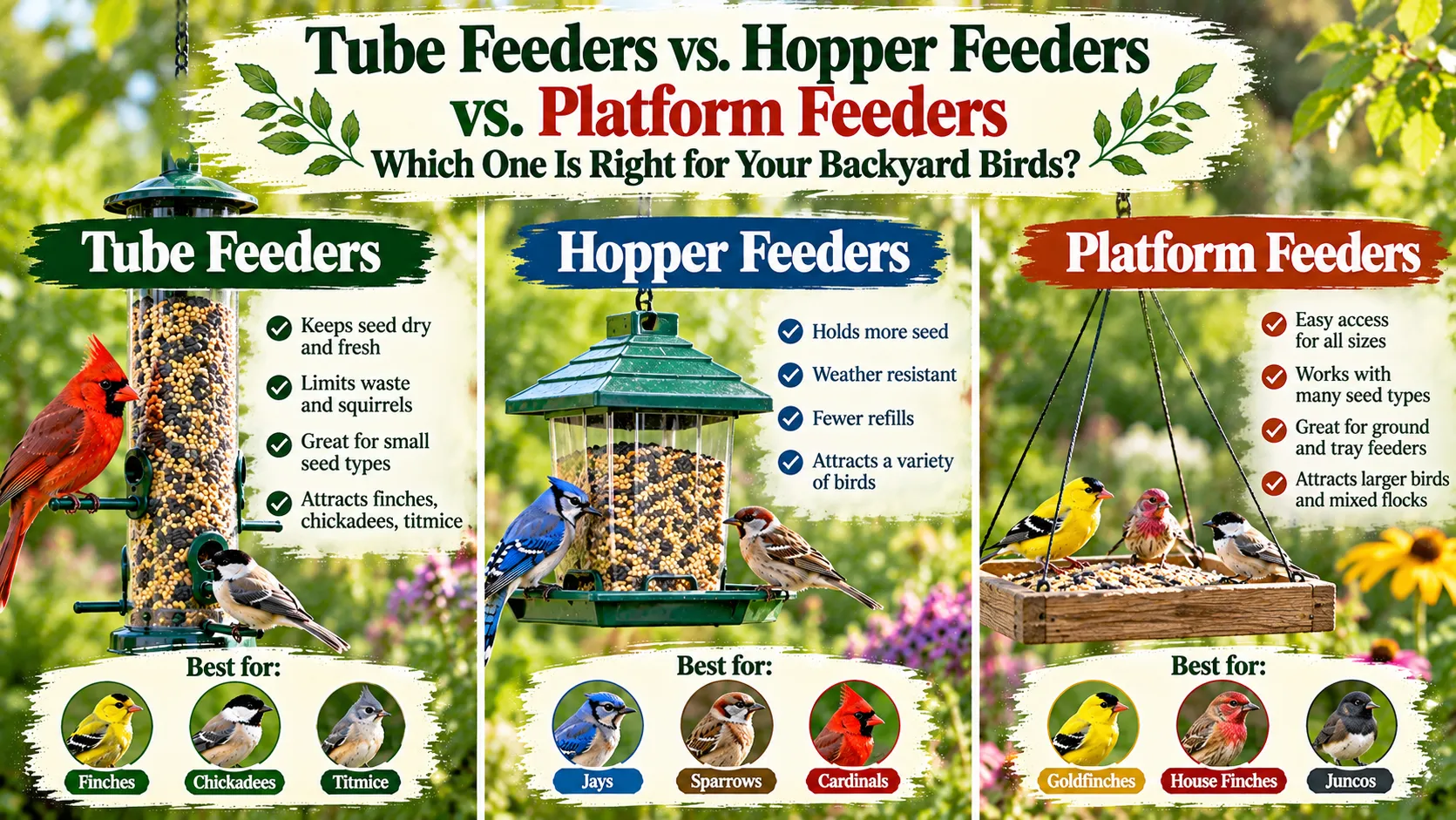
A tube feeder keeps seed driest and resists squirrels best when it has metal ports, but it’s built for small birds. A hopper feeder holds the most seed and sheds weather well, though most hopper designs don’t resist squirrels on their own. A platform feeder reaches the widest range of species, including ground feeders like doves and juncos, but it’s the style most consistently linked to disease spread through droppings on shared food. None of the three wins outright, the right one depends on which problem you’re solving.
Mechanics and seed delivery
A tube feeder is a hollow cylinder, usually plastic or metal, with multiple feeding ports and perches set along its length. A hopper feeder is built around an enclosed reservoir: walls and a roof form a chamber that releases seed into a feeding tray by gravity as birds empty it. A platform feeder is simply an open, flat surface. The Perky-Pet Red Cardinal Feeder is a fully open, roofless circular tray, while some platforms add a roof, like the Woodlink Audubon pick below (Project FeederWatch; UF/IFAS Extension).
Check before buying a tube feeder: many models have some seed sitting below the lowest feeding port, where birds can never reach it. That unused seed can sit and mold if it gets damp. Cornell’s guidance says this is common, though not universal, and recommends blocking off that section of the tube (Cornell Lab).
The mechanics also decide seed fit. Nyjer seed is tiny and needs a feeder with very small ports, because a standard tube’s openings are too large and waste it. The Aspects 428 Quick Clean, for instance, uses ten narrow ports sized specifically for nyjer, rather than the wider openings on a general purpose tube feeder. Hoppers and platforms can hold mixed seed and larger items like peanuts or safflower, since the opening and perch size matter more than the reservoir shape (FeederWatch; UF/IFAS Extension). For the full breakdown of which seed suits which birds, see our bird seed selection guide.
Species and feeding postures
Each style naturally favors certain feeding postures. Tube feeders suit small clinging birds, such as chickadees, titmice and finches, that can balance on short perches. Hopper feeders attract a broader range, including larger birds like cardinals and jays that need more perch room. Platform feeders are the only style that reliably reaches ground foragers like doves, juncos and sparrows, which often won’t use a hanging feeder at all.
This comparison covers the feeder styles, not a full species breakdown. For that, see our guide to matching feeders to the birds you want to attract.
Weather resistance, drainage and spoilage
Hoppers and tubes both keep seed noticeably drier than an open platform, since the roof or cylinder shields it from rain and snow. Seed left exposed on an uncovered platform has nowhere to drain, and prolonged dampness can ruin it, leading to sprouting, mold, or outright rot (Cornell Lab; FeederWatch).
Which is why regular cleaning matters more than style alone, covered next.
Squirrel resistance
Squirrel resistance comes from specific features, not from the feeder style itself. A tube feeder with metal ports resists chewing better than plastic, and a weight activated shroud, like the one on the Brome Squirrel Buster Standard, closes the feeding ports when a squirrel’s weight lands on the perch (Audubon; Cornell Lab).
Hopper feeders are often assumed to be squirrel resistant simply because of their size and weight, but Cornell’s guidance is blunt on this point: a typical hopper design doesn’t keep squirrels out on its own (Cornell Lab). A hopper only resists squirrels when it has an added mechanism, an adjustable weight activated perch, a locking roof, or both, the same category of feature that makes a tube feeder resistant, just applied to a different housing.
Open platform feeders offer the least structural resistance of the three; an uncovered tray has nothing built in to stop a squirrel from climbing on and feeding freely (Cornell Lab).
Whatever feeder you choose, be skeptical of “squirrel proof” claims, since even FeederWatch cautions that squirrels often find a way into feeders marketed that way. For placement, baffles and food based deterrents that work alongside any of these styles, see our guide to keeping squirrels off bird feeders.
Squirrel Buster Standard (tube)
Brome Squirrel Buster Standard
A four port tube feeder with a weight activated shroud that closes the seed ports under a squirrel, plus metal perches and exposed metal parts that resist chewing.
Key specifications
- Capacity
- 1.3 lb (3/4 qt)
- Ports
- 4
- Material
- Metal, plastic, resin
- Dimensions
- 5 x 5 x 13.25 in
- Cleaning
- Dismantles by hand, no tools
Pros
- Weight activated shroud closes the seed ports under a squirrel
- Metal perches and exposed parts resist chewing
- Ventilated seed chamber helps keep seed fresh
Cons
- Only 1.3 lb capacity, so frequent refills at a busy station
- Four feeding positions only, so ports can crowd
- Squirrel defense depends on correct hanging distance and baffles
Woodlink Absolute II (hopper)
The Absolute II is a hopper feeder at its core, a roofed, enclosed seed reservoir, with an added weight activated mechanism: two counterbalanced perches that can be set to exclude birds or squirrels above a chosen weight.
Woodlink Absolute II
An all metal, double sided feeder with two counterbalanced perches that can be set to exclude heavier animals, supplied with a hanging rod, five foot pole kit and ground socket.
Key specifications
- Capacity
- Up to 12 lb
- Material
- All metal
- Perches
- Two counterbalanced, adjustable
- Cleaning
- Roof swings up for filling and cleaning
- Mounting
- Hanging rod, 5 ft pole kit, bracket, ground socket
Pros
- Up to 12 lb capacity suits high traffic yards
- Adjustable perches can be set to exclude heavier animals
- Includes hanging rod, five foot pole kit, bracket and ground socket
Cons
- Heavy when full, so handling and mounting are harder
- Higher cost than basic feeders
- Protection depends on placement, since squirrels can bypass the perch
Woodlink Original Absolute Squirrel-Resistant Feeder, Heritage Farms (hopper)
Where the Absolute II is double sided with two perches, this is the single sided original: one counterbalanced perch, 15 lb capacity rather than 12 lb, and a footprint suited to mounting against a wall or fence where a double sided feeder can’t hang freely. The exclusion mechanism works the same way, the perch closes access to seed under a squirrel’s weight.
Woodlink Absolute Squirrel Resistant Feeder (Heritage Farms)
A single sided, all metal squirrel resistant hopper with one counterbalanced perch and a locking top. The perch closes access to the seed under a squirrel weight, and the reservoir holds up to 15 lb of mixed seed.
Key specifications
- Capacity
- Up to 15 lb
- Material
- Powder coated steel
- Perch
- One counterbalanced, adjustable
- Top
- Locking
- Mounting
- Hang or mount against a wall or fence
Pros
- Up to 15 lb capacity is larger than the double sided model
- A squirrel weight on the perch closes access to the seed
- Locking top and a single sided footprint suit a wall or fence
Cons
- One feeding perch, so fewer birds feed at once
- Heavy when full at up to 15 lb
- Exclusion depends on correct perch adjustment and placement
Woodlink Audubon 3 in 1 Platform Feeder
Woodlink Audubon 3 in 1 Platform Feeder
A cedar platform feeder with a powder coated screen base that can be hung, pole mounted or set on the ground, with a removable screen base for drainage and cleaning.
Key specifications
- Capacity
- 3 lb
- Material
- Cedar with powder coated screen base
- Mounting
- Hang, pole mount or ground
- Cleaning
- Removable screen base
Pros
- Three mounting options: hang, pole mount or ground
- A 3 lb capacity holds seed or mealworms
- Removable screen base aids drainage and cleaning
Cons
- Open design exposes seed to rain, wind and spoilage
- Large visitors like squirrels and pigeons can reach an open platform
- Capacity listings conflict at 3 lb and 5 lb, so check the exact listing
Cleaning and disassembly
| Style | What the evidence supports |
|---|---|
| Tube | Empty old seed before refilling, since seed left in the tube isn’t simply topped up (Cornell Lab). Look for a feeder that disassembles without tools. |
| Hopper | Documented as harder to clean than a tray or platform feeder, due to the enclosed construction (Cornell Lab; Mississippi State Extension). We did not find a source comparing hopper cleaning difficulty directly to tube feeders. |
| Platform | Generally the easiest to clean, especially with a removable screen or tray base. |
One material note worth flagging: sources disagree on wooden feeders. FeederWatch advises against using wooden feeders at all, since they can’t be thoroughly washed, while UF/IFAS Extension gives cleaning instructions specifically for them. Many hopper feeders, including some budget models, use wood or part wood construction. If hygiene is a priority, an all metal or powder coated hopper like the two above sidesteps the question.
Whatever style you choose, clean it roughly every two weeks, more often during heavy use, wet weather, or if you see a sick bird, with a ten minute soak in a dilute bleach solution (Cornell Lab). For the step by step, see our step by step cleaning checklist.
Cost and value
We don’t track prices on this site, so instead of dollar figures, think in terms of construction complexity:
- Basic feeders, a single material with no exclusion mechanism, are the simplest tube and platform designs.
- Feature added feeders, multi material builds with a weight activated or locking mechanism, like the two hopper picks above, cost more to manufacture and typically cost more to buy, in exchange for structural squirrel resistance you’d otherwise have to add yourself with baffles and placement.
Neither tier is inherently the better value. A basic platform feeder is the right spend if you want ground feeders and have no squirrel pressure. A feature added hopper is the right spend if squirrels are the actual problem you’re solving.
Sources and further reading
- Feeder Types — Project FeederWatch
- Feeding Birds — Project FeederWatch
- How to Choose the Right Kind of Bird Feeder — All About Birds, Cornell Lab of Ornithology
- How to Clean Your Bird Feeder — All About Birds, Cornell Lab of Ornithology
- WEC162/UW192: Attracting Backyard Birds — Bird Feeder Selection, UF/IFAS Extension
- How to Choose a Bird Feeder — Mississippi State University Extension
- Due to Bird Salmonella Outbreak, Utahns Asked to Clean Bird Feeders — Utah Division of Wildlife Resources
- Human Salmonellosis Outbreak Linked to Wild Songbirds, United States — Emerging Infectious Diseases, CDC
- House Finch Conjunctivitis — New York State DEC
- Avian Mycoplasmosis — Pennsylvania Game Commission
- Conjunctivitis in Finches (Mycoplasmosis) — Wisconsin DNR
- Avian Salmonellosis Fact Sheet — Canadian Wildlife Health Cooperative
- How to Stop Squirrels From Raiding Your Bird Feeders — Audubon