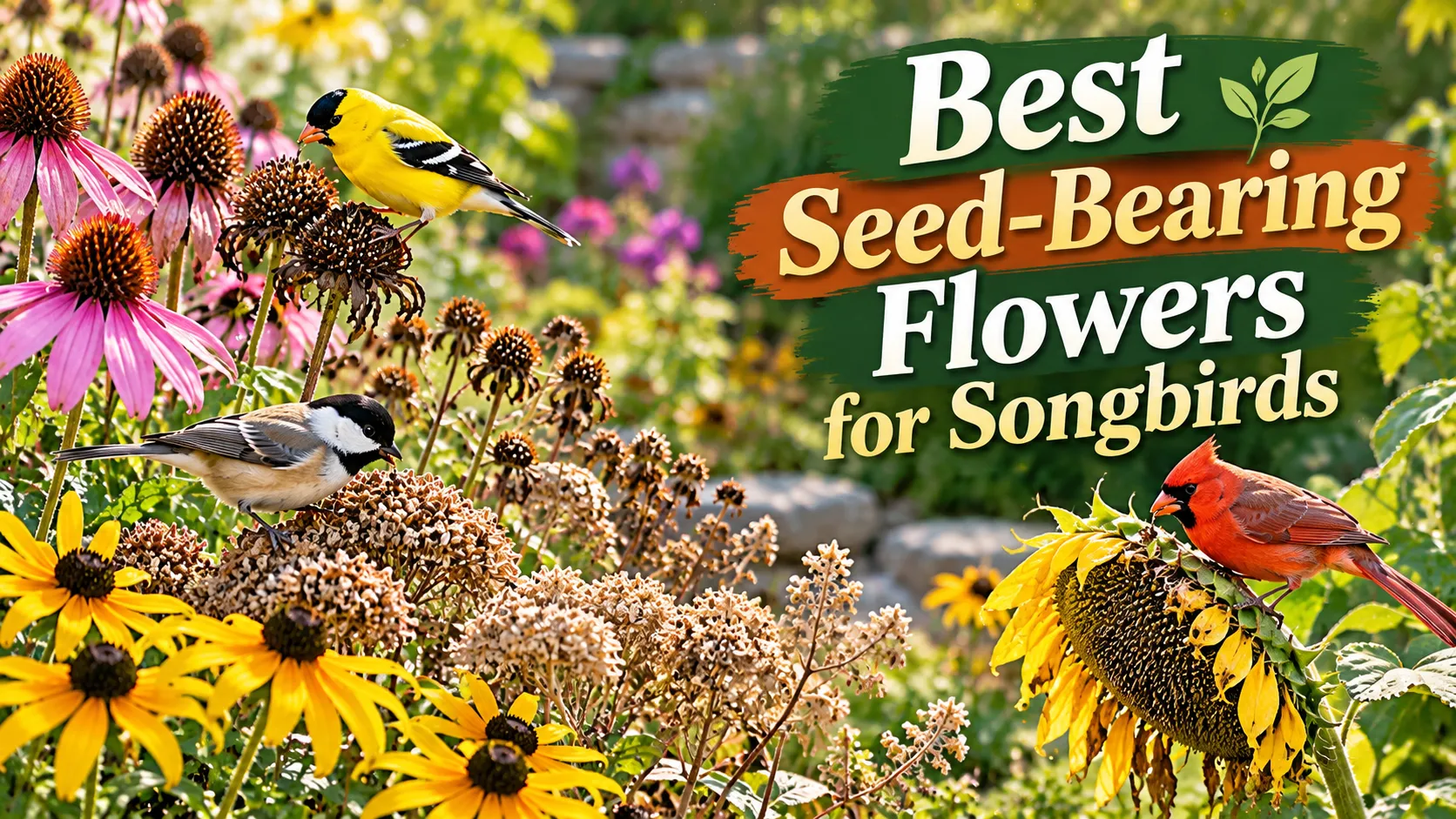
The best seed bearing flowers for songbirds include common sunflowers, purple coneflowers, black eyed Susans, dense blazing stars, New England asters, and wrinkleleaf goldenrod. Their mature flower heads produce seeds that birds can eat directly, especially from late summer into fall. Leaving some heads standing gives birds a chance to forage after the flowers fade.
Not every seedhead lasts through winter, and a flower that attracts birds does not necessarily produce seeds they eat. The choices below have documented seed food value, with growing conditions and limits relevant to US gardens. Cornell Lab of Ornithology specifically recommends retaining faded coneflowers, black eyed Susans, and sunflowers for seed eating birds.
Quick comparison: which seed bearing flowers suit your garden?
| Flower | Best garden fit | Documented seed eaters |
|---|---|---|
| Common sunflower (Helianthus annuus) | Full sun; space for tall annuals | Seed eating birds |
| Purple coneflower (Echinacea purpurea) | Sunny or partly shaded, well drained beds | American Goldfinches |
| Black eyed Susan (Rudbeckia hirta) | Sunny beds where some self seeding is acceptable | American Goldfinches |
| Dense blazing star (Liatris spicata) | Sunny beds with average to moist soil | Goldfinches (species unspecified) |
| New England aster (Symphyotrichum novae-angliae) | Larger beds with moist, well drained soil | Songbirds (species unspecified) |
| Wrinkleleaf goldenrod (Solidago rugosa) | Moist to wet sites in sun or light shade | Songbirds (species unspecified) |
These are planting options, not ranked products. The bird groups reflect available species level evidence; visitors will vary by garden. Check local native status and mature plant size before buying.
Best seed bearing flowers for songbirds
Common sunflower (Helianthus annuus): for large, accessible seedheads
Sow common sunflower after frost danger passes. This annual needs full sun and well drained soil; tall varieties may need shelter or support. Birds can feed from the heads once seeds mature. NC State Extension’s sunflower profile documents the seed food benefit and warns that sunflowers may self sow.
Sunflower seedheads are easy to recognize. But mammoth varieties need space: their tall, heavy heads can lean or fall in wind.
Growing fit: Full sun; room for mature height; spring sowing after the last frost.
Seed season: Mainly after summer flowering, commonly in fall. Some seeds may remain available later if heads stay intact.
Keep in mind: Choose a seed producing variety. Pollen free cut flower cultivars may depend on pollen from other sunflowers to set seed, so do not assume they perform like seed producing varieties. Oregon State Extension explains pollen producing and pollen free varieties, while Ask Extension explains the possibility of cross pollination.
Purple coneflower (Echinacea purpurea): for goldfinches and perennial beds
Purple coneflower produces a raised central cone that holds developing seeds after its petals fade. American Goldfinches eat the seeds, according to NC State Extension. Instead of removing every spent flower, leave several mature cones on the plant.
This perennial grows in full sun to partial shade and prefers well drained soil. It suits mixed borders and naturalized plantings where it is regionally appropriate.
Growing fit: Full sun to partial shade; well drained soil; space for a roughly three to four foot plant.
Seed season: Mature heads follow summer flowering and may remain into fall or winter.
Keep in mind: The seed benefit documented for the species should not be assumed equally for every double flowered or highly modified cultivar.
Black eyed Susan (Rudbeckia hirta): for fall seed and self seeding color
Black eyed Susan may be biennial or a short lived perennial. It often persists by self seeding rather than through long lived individual plants. NC State Extension identifies American Goldfinches as seed eaters in fall.
Grow it in sun or partial shade and well drained soil. Its modest footprint suits mixed borders as well as informal drifts. Leaving some dark, mature centers standing provides feeding opportunities, while removing others can help manage volunteer seedlings.
Growing fit: Sunny to partly shaded beds; adaptable, reasonably drained soil.
Seed season: Primarily late summer and fall.
Keep in mind: It can spread by seed. Removing every spent flower also removes potential bird food.
Dense blazing star (Liatris spicata): for vertical flowers and goldfinch seed use
Dense blazing star produces narrow, upright flower spikes above grasslike foliage. The blooms support pollinators; later, goldfinches eat the seeds, as NC State Extension notes.
This perennial is especially suited to sunny areas with average to moist, well drained soil. It is not interchangeable with every Liatris species: the documented bird use evidence and growing advice here refer to L. spicata.
Growing fit: Full sun; more consistent moisture than many dry prairie wildflowers need.
Seed season: After the summer flower spikes mature, generally in fall.
Keep in mind: Tall stems can flop. Its underground planting structures are corms, not ordinary loose seeds; both seeds and corms can be used to establish plants.
New England aster (Symphyotrichum novae-angliae): for late season diversity
New England aster flowers in late summer and fall, then produces small seeds. NC State Extension’s species account identifies songbirds and small mammals as seed consumers.
New England aster needs room for a tall, bushy perennial and reasonably moist, fertile soil. Its late flowers provide nectar; its mature seeds offer a separate food source.
Growing fit: Full sun; moist, well drained soil; space for a plant that may reach several feet tall.
Seed season: Fall, with some seed potentially visible into winter.
Keep in mind: Its small seeds can disperse in the wind. Do not promise that standing stems will hold a reliable seed supply all winter.
Wrinkleleaf goldenrod (Solidago rugosa): for fall seed and a less dry site
Goldenrods differ by species. For documented songbird seed use, consider wrinkleleaf goldenrod, Solidago rugosa. NC State Extension reports that songbirds eat its seeds.
It flowers in late summer to fall and grows in sun or light shade with moist to wet soil. Its seeds provide seasonal food, not a guaranteed supply throughout winter.
Growing fit: Full sun to light shade; moist to wet soil. Avoid presenting it as a general purpose drought tolerant goldenrod.
Seed season: Fall, after flowering.
Keep in mind: Check the exact species and local suitability when buying; an unlabeled “goldenrod” product may be a different Solidago.
Other seed bearing flowers worth considering
These plants may also provide seeds, but their regional fit or bird use evidence is more limited than that of the six main options.
Lanceleaf coreopsis (Coreopsis lanceolata)
NC State Extension identifies its seeds as bird food. Lanceleaf coreopsis likes sun and well drained ground, including sandy or rocky soils. It can self seed aggressively, making it more suitable for naturalized areas than tightly controlled borders. The source does not name particular bird species, and this is not primarily a winter seed choice.
Blanketflower (Gaillardia aristata)
This perennial suits sunny, relatively dry sites. NC State Extension states that birds are attracted to its seedheads. The available evidence does not name the songbird species or establish winter seed persistence. Consider it where its northern Great Plains or Pacific Northwest regional range and growing requirements fit.
Cup plant (Silphium perfoliatum)
Goldfinches eat cup plant seeds, according to NC State Extension. But this tall plant spreads readily and can be difficult to remove. Reserve it for a large, suitable naturalized planting rather than a small flower bed.
Planting products matched to these flowers
These options cover two packet sizes of mammoth sunflower seed, purple coneflower seed, and blazing star corms. No brand has demonstrated better germination or greater bird attraction here. Choose by species, planting material, and quantity, then check the package and availability before ordering.
Sow Right Seeds Mammoth Sunflower: for a starter sized sunflower planting
Product: Standard Mammoth sunflower (Helianthus annuus) seed packet.
Best for: Gardeners trying tall, seed producing sunflowers who do not need a bulk packet.
Key specification: Sow Right Seeds describes its standard packet as containing about 70 seeds; its Mammoth sunflowers can reach 8 to 12 feet tall. Packet weight and contents may vary between packaging revisions.
Why consider it: A standard packet suits a smaller planting. Independent horticultural evidence, rather than brand claims, supports the species’ value as bird food.
Limitation: These are large plants, not compact border flowers. Allow adequate space and consider exposure to strong wind.
Sow Right Seeds Mammoth Sunflower
A standard Mammoth sunflower seed packet for gardeners trying tall, seed producing sunflowers without buying in bulk. Plants can reach 8 to 12 feet tall, and their mature heads feed seed eating birds.
Key specifications
- Seed count
- About 70 seeds
- Type
- Heirloom Mammoth sunflower
- Height
- 8 to 12 feet
Pros
- Standard packet suits a smaller planting
- Mammoth heads are easy for birds to use
- Seed producing variety, not a pollen free cut flower
Cons
- Large plants need room and wind shelter
- Packet contents vary between packaging revisions
Home Grown Mammoth Sunflower: for planting a larger patch
Product: Mammoth sunflower (Helianthus annuus) bulk seed packet.
Best for: Gardeners planning several rows or a larger sunflower patch.
Key specification: The identified listing describes approximately 520 Mammoth sunflower seeds. The larger quantity does not establish better seed quality or wildlife benefits.
Why consider it: The bulk quantity suits a larger planned planting without multiple small packets.
Limitation: The seeds grow the same tall type of annual planting, requiring full sun, space, and regular care during establishment. A large packet is unnecessary for a few plants.
Home Grown Mammoth Sunflower
A bulk Mammoth sunflower packet for several rows or a larger patch. The larger quantity does not establish better seed quality or wildlife value.
Key specifications
- Seed count
- About 520 seeds
- Type
- Heirloom Mammoth sunflower
- Height
- 8 to 12 feet
Pros
- Bulk quantity suits a large planned planting
- Fewer packets to buy
Cons
- Unnecessary for a few plants
- Same tall annual care needs as a small packet
Sow Right Seeds Purple Coneflower: for establishing perennials from seed
Product: Standard purple coneflower (Echinacea purpurea) seed packet.
Best for: Gardeners prepared to raise perennial coneflowers from seed instead of buying established plants.
Key specification: The manufacturer’s purple coneflower listing identifies E. purpurea. The matched standard packet variant is distinct from the manufacturer’s jumbo option.
Why consider it: The listed species is the one for which Extension documents American Goldfinch seed use.
Limitation: Seed establishment takes time. Do not assume a full seed crop or flowering in the first season, and verify regional suitability.
Sow Right Seeds Purple Coneflower
A standard purple coneflower seed packet. The species is the one Extension documents for American Goldfinch seed use. Seed establishment takes time.
Key specifications
- Species
- Echinacea purpurea
- Format
- Standard seed packet
- Flower color
- Purple
Pros
- Listed species matches the documented goldfinch seed use
- Perennial that returns once established
Cons
- Seed establishment takes time
- May not flower in the first season
Marde Ross and Company Purple Blazing Star: for planting corms
Product: Purple blazing star (Liatris spicata) corms.
Best for: Gardeners choosing underground planting material rather than starting blazing star from seed.
Key specification: The identified listing describes five purple L. spicata corms. Although marketed as bulbs, Liatris is grown from corms; the item is not a seed packet.
Why consider it: The listed species matches the blazing star evidence above. No advantage over other sellers’ planting material has been established.
Limitation: Verify the exact species, corm count and availability at purchase. Choose a site with the appropriate full sun and soil moisture conditions.
Marde Ross and Company Purple Blazing Star
Five purple dense blazing star corms for gardeners who prefer planting material over seed. Blazing star grows from corms, not true bulbs, despite how it is sometimes marketed.
Key specifications
- Species
- Liatris spicata
- Format
- Five corms
- Flower color
- Purple
Pros
- Listed species matches the blazing star evidence
- Corms establish faster than seed
Cons
- Marketed as bulbs but Liatris grows from corms
- Verify species, corm count and availability at purchase
How to choose seed bearing flowers for your region
Check regional suitability before choosing a seed packet. A flower native to one part of the United States may be introduced or poorly suited elsewhere. Cornell’s bird friendly habitat guidance recommends locally native plants suited to a property’s light and soil; check your state or regional Extension recommendations and native plant resources before describing a species as locally native. For the broader question of choosing plants for birds and butterflies, see our complete guide to choosing plants for birds and butterflies.
Then match four practical factors:
- Sunlight. Sunflowers favor full sun. Coneflowers and some other selections tolerate partial shade, but flowering and seed production depend on suitable light.
- Soil moisture. Dense blazing star and New England aster generally suit moister sites than drought adapted blanketflower.
- Space. Tall sunflowers, asters, and cup plants can crowd paths and small beds. Consider their mature size before sowing.
- Spread. Black eyed Susan, lanceleaf coreopsis, and cup plant may volunteer or spread. Leave room for that behavior or manage surplus seedlings.
If a seller offers an unspecified “wildflower mix,” check the full species list. Pollinator value alone does not establish that every included flower supplies seeds eaten by songbirds.
When to leave flower seedheads for birds in fall and winter
Leave at least some healthy, mature heads after flowering, particularly during fall. Cornell recommends this for sunflowers, coneflowers, and black eyed Susans, and Audubon notes that leaving wildflower seeds can support birds through winter.
To retain seedheads without neglecting plant health:
- Let selected flowers finish blooming and set seed instead of deadheading every spent head.
- Wait for seeds to develop before expecting birds to feed.
- Leave some standing heads after the growing season, while accepting that rain, snow, wind, and foraging birds may remove seeds quickly.
- For diseased sunflowers, follow Oregon State Extension’s end of season disease guidance rather than leaving affected plants indiscriminately; other plant diseases may need species specific advice.
- Control unwanted seedlings where vigorous self sowers are unsuitable for the space.
Seedheads and stems serve different functions. Mature heads offer possible bird food; old or cut stems can also provide nesting sites for certain bees. NC State Extension’s stem management guidance describes cutting some first winter perennial stems to roughly 12 to 24 inches to create future nesting opportunities, while avoiding disturbance of older stems that may already be occupied. That research comes from North Carolina gardens, so it is not a universal calendar for every region.
Keep healthy seedheads where practical, and manage stems with nesting wildlife in mind.
Can seed bearing flowers replace bird feeders?
They add natural foraging opportunities, but a small flower patch cannot be assumed to replace feeder food or supply a fixed share of birds’ diets. Availability varies by plant, season, weather, and how quickly seeds are eaten or dispersed.
Flowers provide seed when it matures; feeders let you replenish purchased food. For feeding stations, see the separate guide to choosing birdseed for feeders. Garden grown seeds and packaged mixes are not interchangeable. To see how flowers, feeders, nest boxes and water fit together, see our guide to building a full backyard feeding and nesting plan.
Frequently asked questions
Which flowers attract American Goldfinches for seeds?
NC State Extension identifies American Goldfinches eating purple coneflower and black eyed Susan seeds; its dense blazing star account says goldfinches without specifying which species. Sunflower heads are also used by seed eating birds, although individual visits vary by location.
Should I deadhead coneflowers if I want to feed birds?
Not all of them. Leave several healthy, mature heads in place after flowering so seeds are available. Remove selected heads if you need to control self sowing or manage a plant health problem.
Will seed bearing flowers feed birds all winter?
Some standing heads may offer seeds into winter, but there is no guarantee. Wind dispersed seeds, wet weather, damaged stems, and bird feeding can all shorten the available period.
Are all these flowers native throughout the United States?
No. Species vary in their natural ranges and garden requirements. Confirm local native status and planting suitability instead of relying on a national plant list or a seller’s “native wildflower” label.
Are wildflower seed mixes as useful as planting individual species?
They can help if the species match your region and goals. But generic mixes may favor flowers chosen for blooms or pollinators. For bird seed, look for identified species with documented seed use.
How we chose these flowers and planting products
We checked flower selections against Cornell, Audubon, and species level NC State Extension guidance, distinguishing direct seed use from pollinator value. Products were matched by species, use case, and planting material, not customer ratings or claimed germination performance. We did not test seeds, corms, or plants ourselves.
Start with one regionally suitable perennial, such as purple coneflower or black eyed Susan. Add sunflowers if you have room. Leave some mature heads standing, note which birds visit, and use those observations to plan next year’s planting. For a full set of native perennials that feed wildlife across the seasons, see our guide to native perennials for year round wildlife gardening.
Sources and further reading
- How to Provide Seeds and Shelter for Backyard Birds (Cornell Lab of Ornithology)
- To Help Birds This Winter, Go Easy on Fall Yard Work (National Audubon Society)
- Helianthus annuus (NC State Extension Plant Toolbox)
- Echinacea purpurea (NC State Extension Plant Toolbox)
- Rudbeckia hirta (NC State Extension Plant Toolbox)
- Liatris spicata (NC State Extension Plant Toolbox)
- Symphyotrichum novae-angliae (NC State Extension Plant Toolbox)
- Solidago rugosa (NC State Extension Plant Toolbox)
- Coreopsis lanceolata (NC State Extension Plant Toolbox)
- Gaillardia aristata (NC State Extension Plant Toolbox)
- Silphium perfoliatum (NC State Extension Plant Toolbox)
- Garden Cleanup for Pollinators: Trim Perennial Stems in Their First Winter (NC State Extension)
- Grow Your Own Sunflowers (Oregon State University Extension)
- Seedless Sunflowers (Ask Extension expert response)
- Mammoth Sunflower Seeds (Sow Right Seeds manufacturer specifications)
- Mammoth Sunflower Seeds (Home Grown manufacturer specifications)
- Purple Coneflower Seeds (Sow Right Seeds manufacturer specifications)