
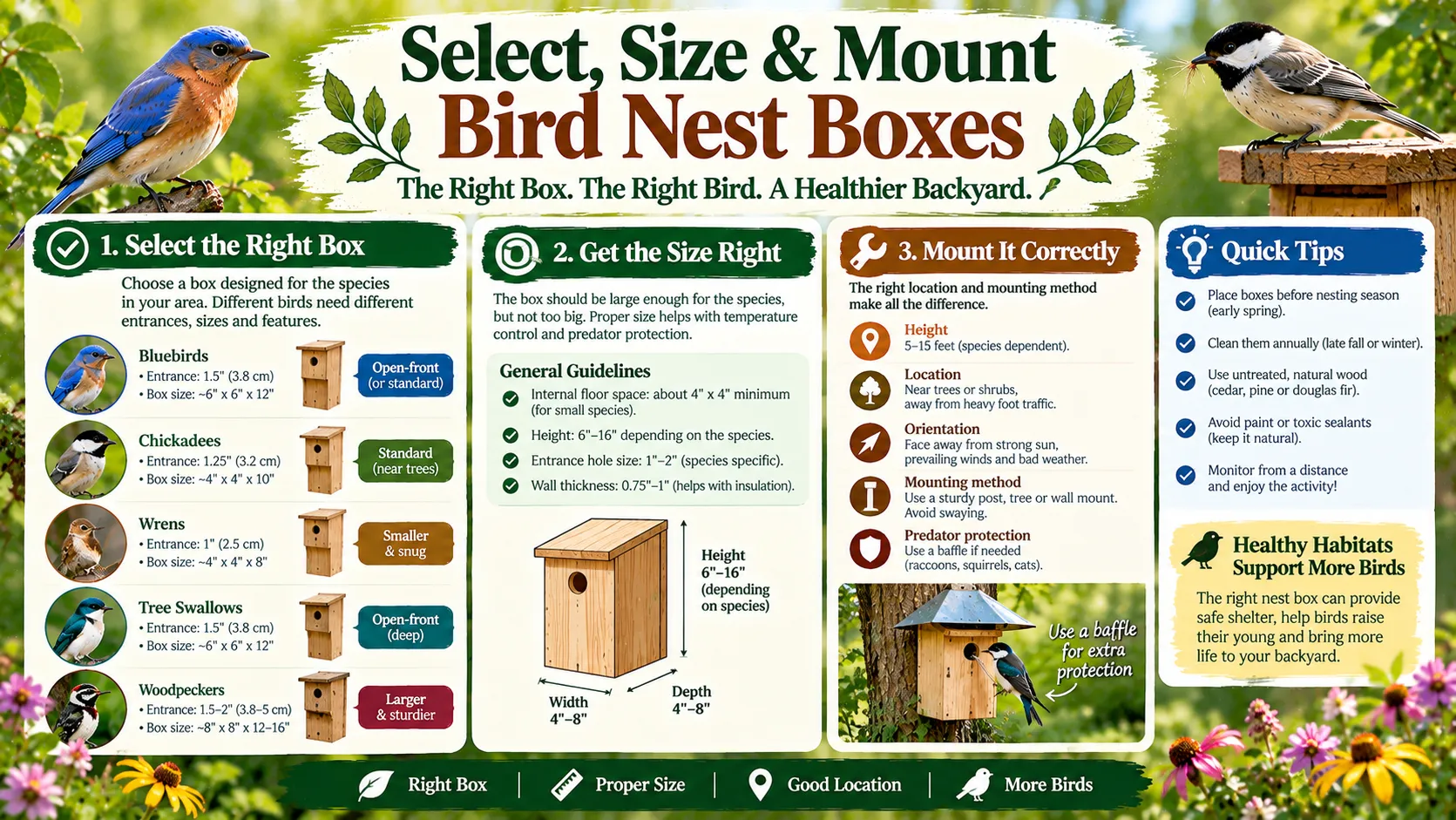
Most nest boxes that go unused fail for one of three reasons: the entrance hole is the wrong size, the box is mounted where predators can reach it, or the habitat around it doesn’t suit the target species. Getting those three things right matters more than how the box looks.
The specifications in this guide come from NestWatch, Cornell Lab of Ornithology’s nest box program, supplemented by USFWS nest box data. NestWatch covers 54 species with downloadable construction plans. This page focuses on the most common backyard cavity nesters and the decisions that apply to all of them.
Start with the species you want
Every decision flows from one question: which bird do you want in the box?
Cavity nesting birds are particular about interior space. A chickadee won’t nest in a box built for a Screech Owl, and a bluebird can’t squeeze into a wren box. The entrance hole is the gatekeeper. Too small and your target bird can’t enter. Too large and you invite competitors and predators that would otherwise be excluded.
Before you build or buy, check which cavity nesters are present in your area. NestWatch’s Right Bird, Right House tool lets you filter by region and habitat. Then match your box to the specifications for that species.
Nest box dimensions by species
The table below covers the most common backyard cavity nesters in the United States. All measurements come from NestWatch species pages and USFWS nest box data.
| Species | Entrance hole | Floor (inside) | Box depth (inside) | Mounting height |
|---|---|---|---|---|
| House Wren | 1″ | 5½ × 5½″ | 8″ | 5 to 10 ft |
| Black capped Chickadee | 1⅛″ | 5½ × 5½″ | 8″ | 5 to 15 ft |
| Tufted Titmouse | 1¼″ | 5½ × 5½″ | 8″ | 5 to 15 ft |
| White breasted Nuthatch | 1¼″ | 5½ × 5½″ | 8″ | 5 to 20 ft |
| Tree Swallow | 1⅜″ | 5½ × 5½″ | 9″ | 5 to 6 ft |
| Eastern Bluebird | 1½″ | 5½ × 5½″ | 9″ | 4 to 6 ft |
| Eastern Screech Owl | 3″ | 9⅝ × 11¼″ | 17⅜″ | 10 to 30 ft |
Carolina Chickadees use the same box specifications as Black capped Chickadees. Western and Mountain Bluebirds use a slightly larger entrance hole of 1 9/16″ to accommodate their somewhat larger body size. That size is at the starling exclusion threshold, so Western and Mountain Bluebird boxes may not reliably keep starlings out the way an Eastern Bluebird box does.
A few things worth noting about these numbers:
Hole size is precise and matters. A 1⅛″ chickadee hole excludes House Sparrows, which need at least 1¼″. A 1½″ bluebird hole excludes European Starlings, which need at least 1 9/16″. That fraction of an inch is doing real work.
Orientation varies by species. There is no universal “face north or east” rule. NestWatch recommends facing bluebird boxes east toward open habitat, Tree Swallow boxes south or east, nuthatch boxes south, and chickadee and titmouse boxes away from prevailing wind. Screech Owl and wren boxes can face any direction.
Spacing prevents territorial conflict. Wrens defend a large area around their box and will fill nearby boxes with dummy “stick nests” to claim territory. NestWatch recommends placing boxes intended for other species at least 100 feet from wren boxes and in more open habitat that wrens find less attractive. Bluebird boxes should be spaced at least 300 feet apart. Chickadee pairs need about 650 feet.
If both bluebirds and Tree Swallows are present, pairing two boxes about 15 to 20 feet apart can reduce competition between them. Place paired sets at least 300 feet from the next pair.
Add wood shavings for some species. Chickadees and nuthatches benefit from about an inch of untreated wood shavings on the box floor. Screech Owls need more, two to three inches, because they do not add their own nesting material.
Features of a good nest box
Whether you build or buy, NestWatch’s Features of a Good Birdhouse checklist is the standard to check against. A nest box should be functional, not decorative. Here is what matters.
Untreated wood. Cedar, pine, or cypress. No paint, stain, or pressure treatment inside or out. For larger boxes like Screech Owl boxes, untreated exterior grade plywood works. Use galvanized screws, not nails or staples, because nails loosen over time and let water in.
Thick walls. At least ¾″ thick to insulate properly. Boards sold as 1″ are actually ¾″, which is the right thickness.
Drainage. At least four holes (⅜″ to ½″) in the floor, or cut the corners of the floorboard at an angle. A recessed floor, set at least ¼″ up from the bottom edges, keeps the nest above any water that collects.
Ventilation. Two holes of ⅝″ diameter near the top of each side wall, four total. These let hot air escape without creating a draft across the nest.
Sloped roof. Overhanging the front by 2 to 4 inches and the sides by 2 inches. This sheds rain and makes it harder for predators to reach in from above. Shallow cuts under the roof edges act as gutters to channel water away from the walls.
Rough or grooved interior walls. The inside face below the entrance hole should be rough or scored with shallow horizontal grooves so fledglings can climb out. Smooth interior walls can trap young birds. Tree Swallows especially benefit from a fledgling ladder, a series of horizontal cuts or a strip of ¼″ hardware cloth stapled to the interior wall below the hole.
Hinged side with a latch. One wall should swing open for cleaning and monitoring. A simple nail or hook keeps it closed during nesting.
No perch. An exterior perch is unnecessary for cavity nesters and gives predators and House Sparrows a place to stand while they harass the occupants.
Entrance guard. An optional but useful addition: a wood block about 1 inch thick with a hole matching the entrance, screwed over the front panel. This reinforces the entrance against woodpeckers and squirrels that might try to enlarge the hole. A metal plate with a matching hole works the same way, as Oregon State Extension recommends.
Mounting: pole, tree, or wall
How and where you mount the box has as much effect on nesting success as the box itself.
Pole mounting is the safest default
NestWatch recommends mounting nest boxes on a smooth metal pole, galvanized pipe or PVC, with a predator baffle installed below the box. Smooth metal gives climbing predators nothing to grip. A baffle below the box stops anything that does make it partway up the pole.
This combination is the single most effective thing you can do to protect a nest. It applies to bluebirds, Tree Swallows, titmice, and most other common backyard species.
Tree and post mounting
Trees, wooden fence posts, and utility poles all give climbing predators, such as raccoons, snakes, cats and chipmunks, easy access to the box. NestWatch’s predator FAQ is direct: trees and fence posts provide footholds for climbers and rough surfaces for snakes.
That said, some species prefer boxes in or near trees. Chickadees and nuthatches favor wooded settings and will nest in boxes on trees or buildings. White breasted Nuthatches and Eastern Screech Owls can be mounted on live trees. House Wrens accept tree, building, and pole mounts. If you do mount on a tree, wrap a sheet metal guard at least 30 inches wide around the trunk below the box to slow predators, and accept that predation risk is higher than on a baffled pole.
Height and orientation
Mount the box at the height listed for your target species. For most backyard songbirds, that’s 4 to 15 feet. Screech Owls need 10 to 30 feet.
Face the entrance in the direction NestWatch recommends for your species. Where no specific direction is given, facing away from prevailing wind and afternoon sun is a reasonable default. Make sure the box is not positioned where driving rain can blow directly into the entrance.
Keep the box clear of dense brush immediately below it, which gives predators cover. Elsewhere in the yard, fruiting shrubs and other native plantings are a useful complement, giving adults and fledglings cover and food nearby; see our guide to berry shrubs for backyard birds. Position it where you can reach it for monitoring and cleaning.
Predators and nest site competitors
Nest boxes are easier for predators to find than natural cavities, and some predators will return to the same box year after year. Predator and competitor management separates a successful nest box from a feeding station for raccoons.
Climbing predators
Snakes, raccoons, cats, and chipmunks are the main climbing threats. NestWatch describes three proven baffles:
Cone baffle. A metal collar about 3 feet in diameter, mounted on the pole below the box. It blocks most climbers.
Stovepipe baffle. An 8 inch diameter metal pipe, 24 to 36 inches long, mounted loosely on the pole so it wobbles when a predator grabs it. NestWatch considers this perhaps the most effective design, and it works against both mammals and snakes.
Noel guard. A wire mesh tube attached to the entrance hole. It prevents predators from reaching into the box. NestWatch recommends using it in combination with a pole baffle, or on boxes mounted to trees where a pole baffle isn’t an option.
No baffle is 100% effective, but any baffle is far better than none. Install the baffle before you put the box on the pole, and make sure it sits at least four feet off the ground. Keep the box far enough from nearby trees, fences, and structures that a predator can’t jump sideways onto the box.
House Sparrows and European Starlings
House Sparrows and European Starlings are introduced species that aggressively compete with native cavity nesters. Both will take over occupied boxes, destroying eggs and killing nestlings and adults in the process.
Starlings are the easier problem to solve. They cannot fit through an entrance hole smaller than 1 9/16″. If your target species uses a smaller hole, and most backyard songbirds do, the hole size alone excludes starlings.
House Sparrows are harder. They can squeeze through holes as small as 1¼″, which means most songbird boxes are vulnerable. NestWatch is clear that no completely sparrow proof nest box exists. The most effective passive measures are:
- Placement. House Sparrows strongly prefer areas near human habitation and buildings. Moving boxes into more natural, open areas reduces sparrow pressure.
- Timing. Sparrows don’t migrate. Plugging the entrance hole until your migratory species returns in spring prevents sparrows from claiming the box first.
- Hole size. A 1⅛″ chickadee hole does exclude House Sparrows. If you’re targeting chickadees, this solves the problem.
- Active monitoring. Removing sparrow nesting material repeatedly can discourage them, though a displaced sparrow may attack nearby native nests. NestWatch describes several active management methods, including egg oiling and trapping, for monitors who want to take a more hands on approach.
House Wrens
House Wrens are native and protected, but they are aggressive nest site competitors. Males defend multiple cavities within their territory and will fill nearby boxes with “stick nests” to prevent other birds from using them. Both sexes may destroy the eggs or nestlings of other cavity nesters.
The best defense is spacing and habitat. Place boxes intended for other species at least 100 feet from wren boxes and in more open habitat that wrens find less attractive. Wrens prefer boxes within 100 feet of woody cover.
Monitoring and cleaning
A nest box needs attention during and after the nesting season.
During nesting season
NestWatch’s monitoring protocol recommends checking boxes every 3 to 4 days. For most backyard box owners, a weekly check works well. Open the side panel, note what you see, eggs, nestlings, or an empty nest, and close it. A few practical points:
- Wait for the adult to leave the box on its own rather than flushing it off the nest.
- Keep visits brief. Open, look, close, leave.
- If a female Screech Owl is incubating, avoid checking the box during and shortly after egg laying. Early disturbance can cause abandonment.
- Use a mirror on a pole or a phone camera to see into boxes that are higher than your head.
Some species, including Eastern Bluebirds, will attempt a second brood in the same box. Clean out the old nest material as soon as the first brood fledges to make the box ready for the next clutch.
End of season
After the last brood has fledged and nesting season is over, remove old nesting material, brush out debris, and check the box for damage. Wash with hot water if droppings or parasites are present. Leave the box up over winter, since chickadees, titmice, nuthatches, and Screech Owls may use it as a winter roost.
If you monitor nest boxes, consider submitting your observations to NestWatch. The program uses citizen science data to track nesting trends across North America.
Before you put up a box
A short checklist:
- Identify your target species. Check NestWatch’s Right Bird, Right House to confirm the bird nests in your region and habitat.
- Match the entrance hole to that species. This is the dimension that matters most.
- Check the box features. Untreated wood, thick walls, drainage, ventilation, sloped roof, hinged side, rough interior, no perch.
- Mount on a metal pole with a baffle. Place the box at the height and orientation your species prefers, away from trees and structures that predators can climb or jump from.
- Monitor weekly during nesting season. Clean between broods and at the end of the year.
A nest box doesn’t need to be complicated. The right hole on a solid box, on a baffled pole, in the right habitat, is enough. For the plants, feeders and water around it, see our feeding and nesting essentials for backyard birds. If you’re also matching feeders to the birds you want to attract, a nest box is the natural next step. It keeps birds in your yard through the entire breeding season, not just at mealtime.
Sources and further reading
- Features of a Good Birdhouse — NestWatch, Cornell Lab of Ornithology
- Right Bird, Right House — NestWatch, Cornell Lab of Ornithology
- Managing House Sparrows and European Starlings — NestWatch, Cornell Lab of Ornithology
- Nest Monitoring Protocol — NestWatch, Cornell Lab of Ornithology
- How Can I Discourage Predators From Accessing My Nest Boxes? — NestWatch FAQ
- The Wildlife Garden: Build Nest Boxes for Wild Birds — Oregon State Extension