
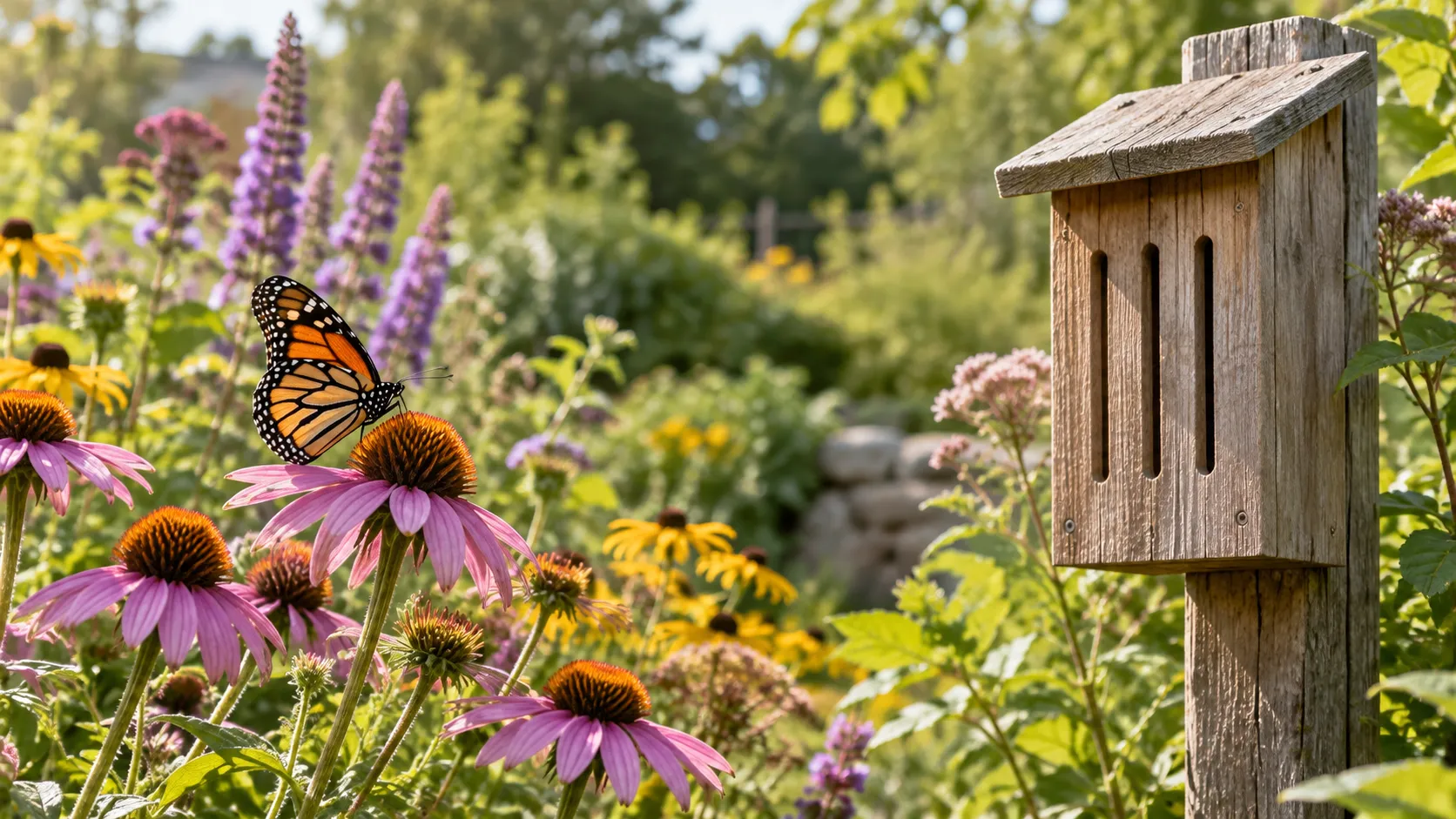
Commercial wooden butterfly houses don’t have much evidence behind them.
University studies monitored these boxes for years and found no butterflies using them. Worse, the narrow vertical slits can attract European paper wasps, which prey on butterfly caterpillars.
If you want to help butterflies, skip the wooden box. The evidence points toward native host plants, nectar sources, and shallow water features instead.
Here’s what the research shows, plus three Amazon products that actually match what butterflies need.
Do Butterfly Houses Actually Attract Butterflies?
No. Decades of monitoring by university entomology departments and wildlife agencies turned up zero evidence that butterflies use these structures.
The design is based on a misunderstanding of how butterflies survive winter.
Most butterfly species in temperate North America don’t overwinter as adults. They overwinter as eggs, caterpillars, or chrysalises tucked into leaf litter, hollow stems, or bark crevices.
Only a handful of species, like the Mourning Cloak and the Comma, overwinter as adults. And even those species shelter in natural crevices, not narrow wooden slots.
A Penn State University study monitored 40 butterfly boxes over two winters. No butterfly use was found. The Georgia Department of Natural Resources reported the same result after monitoring a box for several years.
The Hidden Risk: Butterfly Houses Can Attract Predators
Here’s the part most people miss.
A University of Kentucky study found that butterfly boxes in pollinator gardens were frequently occupied by paper wasp nests, including nests of the non native European paper wasp. These wasps hunt caterpillars, including monarch caterpillars on milkweed.
So instead of helping butterflies, a butterfly house can actually make your garden more dangerous for them.
University Extension guidance reflects this. The evidence supporting commercial butterfly houses as meaningful butterfly habitat is weak.
What Actually Works: Products That Match Butterfly Biology
Butterflies need three things a wooden box doesn’t provide:
- Host plants for caterpillars
- Nectar plants for adults
- Shallow water access
The products below address those specific needs, and our butterfly habitat guide covers the full habitat picture.
| Product | Best for | Key feature | Details |
|---|---|---|---|
| Swamp Milkweed Seeds (Asclepias incarnata) | Monarch caterpillar host plant | Asclepias incarnata | Check price on Amazon (opens in a new tab) |
| Outsidepride New England Aster Seeds | Late season adult nectar | Late summer and fall | Check price on Amazon (opens in a new tab) |
| POPETPOP Ceramic Butterfly Waterer | Shallow water and puddling | Shallow ceramic dish with landing surface | Check price on Amazon (opens in a new tab) |
1. Swamp Milkweed Seeds (Asclepias incarnata)
Best for: Providing a host plant for monarch caterpillars.
Why it fits: Monarch caterpillars feed only on milkweed. Swamp milkweed (Asclepias incarnata) is native to much of the eastern and central United States and is a recognized host plant for monarchs.
Key specifications:
- Product: 50 Swamp Milkweed Seeds
- Species: Asclepias incarnata
- Format: Seed packet
Strengths:
- Provides the specific host plant monarch caterpillars require.
- Native to much of the eastern and central U.S., making it regionally appropriate for many gardens.
- Handles moist garden areas where some other milkweed species struggle.
Limitations:
- Native status varies by region. Confirm suitability for your specific area before planting.
- Seeds need proper germination conditions and may establish slower than live plants.
Bottom line: A regionally appropriate host plant option for gardeners in the eastern and central U.S. who want to support monarch caterpillars.
Swamp Milkweed Seeds (Asclepias incarnata)
Swamp milkweed seed, a recognized monarch host plant native to much of the eastern and central United States. Handles moist garden areas where some other milkweed species struggle.
Key specifications
- Species
- Asclepias incarnata
- Format
- 50 seeds
- Region
- Eastern and central U.S.
Pros
- Provides the specific host plant monarch caterpillars require
- Regionally appropriate for much of the eastern and central U.S.
- Tolerates moist garden areas
Cons
- Native status varies by region, confirm suitability for your area
- Seeds may establish slower than live plants
2. Outsidepride New England Aster Seeds
Best for: Providing late season nectar for adult butterflies.
Why it fits: New England aster (Symphyotrichum novae-angliae) is native to much of the eastern and central United States. It blooms in late summer and fall, which makes it valuable for migrating butterflies and other pollinators that need nectar late in the season.
Key specifications:
- Product: Outsidepride New England Aster Seeds
- Species: Symphyotrichum novae-angliae
- Quantity: 1,000 seeds
Strengths:
- Provides nectar during a critical late season period.
- Native to much of the eastern and central U.S.
- Supports a wide range of pollinators beyond butterflies.
Limitations:
- Native status varies by region. Confirm suitability for your specific area before planting.
- Commercial seed may not be local ecotype, which matters for ecological restoration projects.
Bottom line: A strong late season nectar option for gardens in regions where New England aster is native.
Outsidepride New England Aster Seeds
New England aster seed, a native late bloomer that provides nectar in late summer and fall for migrating butterflies and other pollinators.
Key specifications
- Bloom time
- Late summer and fall
- Species
- Symphyotrichum novae-angliae
- Quantity
- 1,000 seeds
Pros
- Nectar during a critical late season period
- Native to much of the eastern and central U.S.
- Supports a wide range of pollinators beyond butterflies
Cons
- Native status varies by region, confirm suitability for your area
- Commercial seed may not be a local ecotype
3. POPETPOP Ceramic Butterfly Waterer
Best for: Providing shallow water access and a puddling surface for butterflies.
Why it fits: Butterflies need shallow water sources where they can drink without drowning. This ceramic dish provides a shallow basin with a landing surface, which matches what butterflies need for water access.
Key specifications:
- Product: POPETPOP Bee Water Station Ceramic Butterfly Waterer
- Material: Ceramic
- Use: Shallow water dish for bees and butterflies
Strengths:
- Shallow design reduces drowning risk compared to deeper water features.
- Provides a landing surface for butterflies and other pollinators.
- A functional alternative to a decorative butterfly house.
Limitations:
- Needs regular refilling, especially in warm weather.
- Doesn’t provide host plants or nectar. It addresses water access only.
Bottom line: A practical water feature for gardeners who want to provide shallow water access for butterflies.
POPETPOP Ceramic Butterfly Waterer
A shallow ceramic water dish with a landing surface, sized for bees and butterflies to drink without the drowning risk of a deep basin.
Key specifications
- Design
- Shallow ceramic dish with landing surface
- Material
- Ceramic
- Use
- Water access for bees and butterflies
Pros
- Shallow design reduces drowning risk
- Landing surface suits butterflies and other pollinators
- A functional alternative to a decorative butterfly house
Cons
- Needs regular refilling, especially in warm weather
- Addresses water access only, not host plants or nectar
What to Do Instead of Buying a Butterfly House
If you want to provide overwintering shelter for butterflies, natural habitat features work better than commercial boxes.
Leave fallen leaves in garden beds. Leave dead plant stems standing through winter. Keep brush piles or dense shrub areas in a corner of your yard.
These features provide the sheltered microhabitats that butterflies actually use.
Combine these natural features with native host plants and nectar sources, and you’ll provide far more meaningful habitat than a wooden butterfly house ever could.
Frequently Asked Questions
Do butterfly houses work for overwintering butterflies? No. Most butterfly species don’t overwinter as adults. The few that do prefer natural crevices in bark, leaf litter, or hollow stems over narrow wooden slots.
Are butterfly houses bad for butterflies? They can be. Research from the University of Kentucky found that butterfly boxes were frequently occupied by European paper wasps, which prey on butterfly caterpillars.
What should I buy instead of a butterfly house? Focus on native host plants like milkweed for caterpillars, native nectar plants like New England aster for adults, and shallow water features for drinking and puddling.
Do butterflies use birdhouses or bug hotels? No. Butterflies don’t use birdhouses or standard bug hotels. They rely on natural habitat features like leaf litter, dead plant stems, and dense vegetation.
Sources
- Georgia Department of Natural Resources. “Out My Backdoor: Do Butterfly Boxes Work?” by Terry W. Johnson, documenting the Penn State Entomology study of 40 boxes and the author’s own DNR monitoring.
- University of Kentucky Research News. “UK Entomologists Find Invasive Paper Wasps Preying on Monarch Butterfly Larvae,” July 16, 2020.
- Baker, A. and Potter, D., Scientific Reports. “Invasive paper wasp turns urban pollinator gardens into ecological traps for monarch butterfly larvae.”
- Penn State Extension. “Pollinator Myths.”