
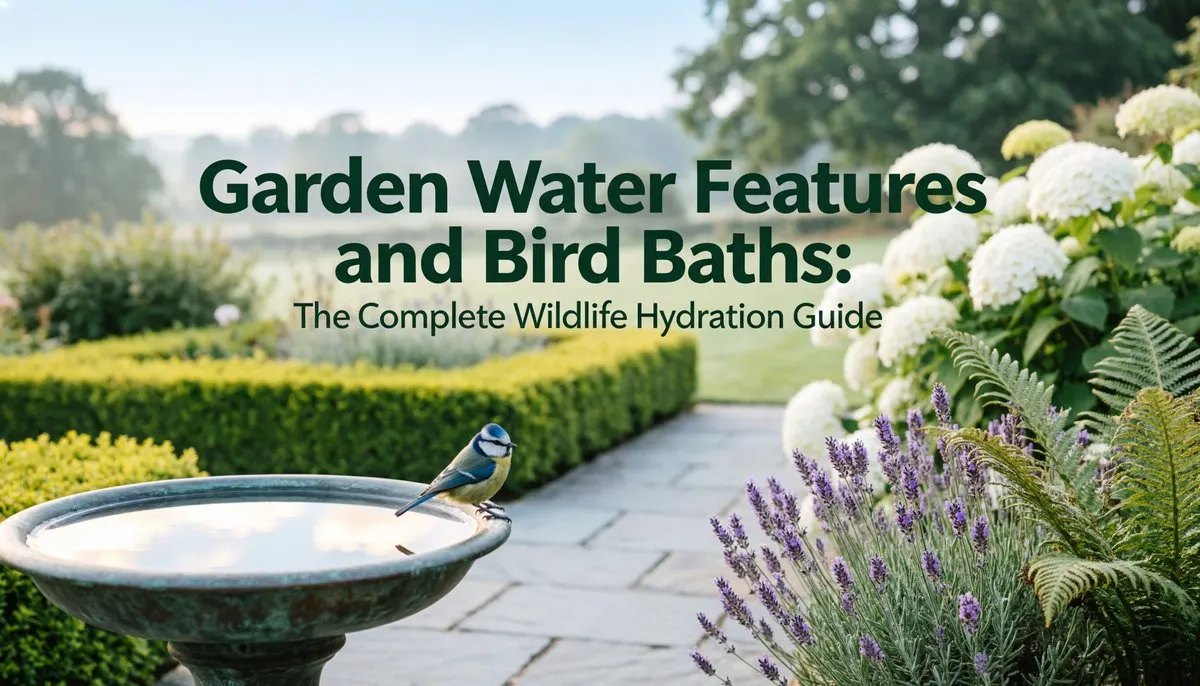
You can plant the most nectar rich border in the neighborhood and hang feeders from every branch, but without clean, accessible water, you are only meeting half of what birds and butterflies need to survive. Water features for birds and butterflies work best when they are designed around two distinct physiological requirements: birds need shallow, open, gently moving water for drinking and bathing, while butterflies need warm, mineral rich, moist substrate for puddling. This guide walks through every step of designing, installing, and maintaining water stations that serve both groups safely, year round.
| Product | Best for | Key feature | Details |
|---|---|---|---|
| POPOSOAP 6.5W Solar Fountain Pump | Constant ripples through cloud cover | 6.5W integrated panel | Check price on Amazon (opens in a new tab) |
| AISITIN 3.5W Separated Solar Pump | Shady yards via a remote sun placed panel | 3.5W separated panel | Check price on Amazon (opens in a new tab) |
| Saillong 36Ft Dripper Kit | Constant drip powered by hose pressure | Hose fed, no panel | Check price on Amazon (opens in a new tab) |
| ODSNANIE 100W Heated Bird Bath | Cold climate winter water | 100W thermostatic heater | Check price on Amazon (opens in a new tab) |
What Birds and Butterflies Actually Need From Water
Birds use water for two separate purposes. Drinking is straightforward: most small songbirds need to drink regularly throughout the day, especially in summer heat and winter cold. Bathing is more complex. Birds crouch, splash, and shake to clean feathers, remove parasites, and redistribute preen oil that keeps plumage waterproof and insulating. Cornell Lab of Ornithology notes that feather condition directly affects the ability of a bird to regulate body temperature and evade predators.
Butterflies do not bathe, and they do not drink from open pools the way birds do. Instead, they perform a behavior called puddling: pressing their proboscis, a long coiled feeding tube, into wet sand, mud, or fine gravel to extract dissolved sodium, amino acids, and minerals essential for reproduction. Extension guidance and Xerces Society resources confirm that butterflies use puddling to extract dissolved minerals. Research indicates that males puddle more frequently than females, gathering sodium and amino acids used in reproduction. A standard bird bath, even a shallow one, does not meet this need. Butterflies require capillary moisture in a granular substrate, not standing water.
Understanding this distinction is the foundation of every design decision that follows.
Step 1: Choose the Right Water Feature Type
The right water feature depends on your space, the species you want to support, and how much maintenance you can commit to. Most effective wildlife gardens combine two or more of the following.
Pedestal or basin bird bath
The simplest option. Choose a basin with a rough, unglazed interior and gently sloping sides. Concrete, natural stone, and textured resin provide the grip birds need. Avoid glazed ceramic, smooth plastic, and metal, which become slippery when wet and can overheat in direct sun.
For a full comparison of basin materials and their trade offs for durability, texture, and winter performance, see our guide to concrete, ceramic, and resin bird baths.
Ground level dish or saucer
A shallow saucer set flush with the ground mimics a natural puddle and suits ground foraging species such as towhees, juncos, and mourning doves. Surround it with low ground cover so birds feel less exposed.
Solar bird bath fountain
A solar bird bath fountain uses a small photovoltaic panel to power a submersible pump, creating gentle ripples or a low spray. The movement helps birds locate the feature from a distance, and surface agitation discourages mosquitoes from laying eggs. For a detailed comparison of current solar fountain models, battery options, and panel configurations, see our guide to the best solar powered bird bath fountains.
Bird bath dripper
A dripper releases a thin, rhythmic stream or individual droplets onto a basin surface. The sound of water hitting water is one of the strongest acoustic attractants for birds, often more effective than a full fountain. Drippers use very little water and connect to a standard hose bib or drip irrigation line.
Butterfly puddling station
A dedicated shallow tray filled with coarse sand or fine gravel, kept consistently moist, with a small amount of compost or sea salt for minerals. This is not interchangeable with a bird bath. For a full step by step build guide, see our dedicated article on how to make a butterfly puddling station.
Dual purpose combination
When designing water features for birds and butterflies, the most effective arrangement pairs a shallow basin or dripper for birds with an adjacent puddling tray for butterflies, both within the same garden bed. This serves both groups without forcing butterflies to land in water deep enough for birds.
Step 2: Site the Feature for Safety and Visibility
Placement determines whether birds actually use the feature. Audubon and Cornell both emphasize three siting principles.
Provide escape cover at a safe distance. Position the bath within roughly 6 to 10 feet of low shrubs, ornamental grasses, or a brush pile so birds can dart to shelter. Do not place it directly beneath dense canopy, where a hawk or cat can ambush without being seen.
Maintain open sightlines. Birds need a clear view in all directions while bathing. A bath in the middle of an open lawn with no nearby cover leaves birds exposed. A bath tucked into a dense thicket leaves them unable to spot approaching predators. The 6 to 10 foot compromise addresses both.
Keep water away from feeders. Place the feature at least 10 feet from seed feeders. Hull debris, spilled food, and droppings from feeders contaminate bath water and promote bacterial growth.
Level the ground. An uneven basin creates a deep end and a dry end, defeating the safe depth requirement. Use a spirit level during installation.
Step 3: Get the Depth and Footing Right
Depth is the single most important safety specification for a bird bath. Cornell recommends water no deeper than 1 inch (2.5 cm) at the edges, sloping to a maximum of 2 inches (5 cm) in the center. Small songbirds such as finches, chickadees, and wrens have short legs relative to their body size. If they cannot touch the bottom while standing, they panic, thrash, and risk soaking their down feathers, which compromises insulation.
If your existing basin is deeper than 2 inches, add a layer of flat river stones, pebbles, or a textured concrete paver to raise the bottom and create a gradual slope. This also improves footing.
For texture, choose rough, porous surfaces. Heavy duty concrete, cast stone, and unglazed resin mimic the grip of a natural streambed. Glazed ceramic, smooth plastic, and polished metal become treacherous when wet.
Avoid copper basins. Copper can leach ions when exposed to acidic water, and Extension guidance generally recommends against copper containers for wildlife water. The metal surface also heats rapidly in direct sun, which may be uncomfortable for the feet of birds.
Step 4: Add Gentle Water Movement
Still water is used for drinking, but gentle movement significantly increases the attractiveness of a feature to birds. The visual cue of shimmering ripples and the auditory cue of soft dripping or bubbling help flying birds locate the feature from a distance.
However, the type of movement matters. Audubon advises avoiding loud, noisy fountains and aggressive cascades. Excessive splashing noise may make it harder for birds to hear alarm calls from other species, a reason to favor gentle drippers and low flow bubblers over high volume fountains.
Solar fountain option
A solar bird bath fountain with a low flow nozzle creates the gentle ripples that attract birds without producing disruptive noise. When selecting one, prioritize:
- Dry run protection, which shuts the pump off if the water level drops, preventing motor burnout.
- Battery backup, which keeps the pump running during cloudy periods.
- A separate solar panel option, which allows the panel to sit in full sun while the basin remains in dappled shade.
Based on manufacturer specifications and current Amazon availability, two options stand out for distinct use cases.
POPOSOAP 6.5W Solar Fountain Pump
A 6.5W floating pump with an integrated panel, 3000mAh battery backup, dry run protection and double layer nozzles, built to keep gentle ripples moving through cloudy spells.
Key specifications
- Power
- 6.5W integrated panel
- Battery backup
- Yes, 3000mAh
- Protection
- Dry run protection
- Nozzles
- Double layer nozzles
Pros
- Battery keeps ripples going under cloud
- Dry run protection saves the motor
- Double layer nozzles shape the spray
Cons
- Integrated panel needs direct sun
- Output drops in heavy shade
AISITIN 3.5W Separated Solar Pump
A separated design with the 3.5W panel staked in sun while the pump sits in a shaded bath. Includes battery backup, eight interchangeable nozzles and three anti drift brackets.
Key specifications
- Power
- 3.5W separated panel
- Battery backup
- Yes
- Nozzles
- 8 interchangeable nozzles
- Stability
- 3 anti drift brackets
Pros
- Bath stays cool and shaded, panel in full sun
- Battery keeps ripples going during cloud
- Eight nozzles and three anti drift brackets included
Cons
- Lower wattage means reduced spray in heavy overcast
Dripper option
A bird bath dripper produces the soft, rhythmic sound of individual droplets hitting water, which is often more attractive to birds than a fountain spray. It uses minimal water and requires no electricity.
Saillong 36Ft Dripper Kit
A hose fed dripper with 36 feet of adjustable tubing, pressure regulator, curved metal spout and adjustable drip and mist head. Runs day and night in any weather, using municipal water instead of recirculated basin water.
Key specifications
- Power
- Hose fed, no panel
- Spray control
- Adjustable drip and mist head
- Battery backup
- Not applicable, water pressure driven
- Basin fit
- Any birdbath, hangs over edge
Pros
- Steady rhythmic drip warblers follow
- Works at night, in storms and in total shade
- No charging or sun needed
Cons
- Needs an outdoor hose spigot
- Uses municipal water, not recirculated
For more detail on misting systems designed specifically for butterfly hydration, see our guide to shallow misters and butterfly watering stations.
Step 5: Build a Butterfly Puddling Station
A butterfly puddling station is not a bird bath. It is a shallow tray of moist, mineral enriched substrate where butterflies land and extend their proboscis to extract dissolved nutrients. Standing water is the enemy here; butterflies can drown in even a shallow pool if they cannot find a dry foothold.
Materials
- One unglazed terracotta saucer or shallow stone dish, 14 to 18 inches across
- Coarse play sand or fine aquarium gravel, enough for a 2 inch layer
- Three to five flat stones or pieces of slate for perching
- A small handful of compost or a quarter teaspoon of natural sea salt
- Optional: a short length of drip irrigation tubing for automated moisture
Assembly
- Place the saucer in a sunny, sheltered spot near nectar rich flowers. Butterflies are cold blooded and puddle most actively when the substrate is warm, roughly 70 to 85 degrees Fahrenheit.
- Fill the dish with 2 inches of coarse sand or fine gravel.
- Press flat stones into the surface so they sit just above the sand line, providing stable perching spots.
- Sprinkle a small amount of compost or sea salt over the sand and mix lightly. This supplies the sodium and amino acids butterflies seek.
- Mist the sand until it is damp but not saturated. If using drip tubing, run it beneath the sand on a timer for a few minutes each morning.
- Refresh the sand and mineral mix every three to four weeks.
Position the station within a few feet of nectar plants such as milkweed, zinnias, coneflowers, or lantana so butterflies can feed and puddle without expending extra energy traveling between resources.
Step 6: Control Mosquitoes Without Harming Wildlife
Standing water and mosquitoes are the two concerns that stop many gardeners from adding water features. Both are manageable without resorting to chemicals that harm the wildlife you are trying to attract.
Prevention first
- Keep water moving. A dripper, solar pump, or bubbler creates surface agitation that discourages female mosquitoes from laying eggs.
- Change water frequently. Empty, scrub, and refill bird baths every two to three days in warm weather. Most container breeding mosquitoes need five to ten days of still water to complete the egg to adult cycle. Changing water every two to three days disrupts that cycle.
Bti (Mosquito Dunks) for larger features
For ponds, rain barrels, or larger water features where frequent water changes are impractical, products containing Bacillus thuringiensis subspecies israelensis (Bti) are the standard recommendation. The EPA classifies Bti as a minimum risk pesticide. At label directed rates, Bti targets only the larvae of mosquitoes, blackflies, and fungus gnats. The Cry proteins it produces activate only in the highly alkaline midgut of mosquito, blackfly, and fungus gnat larvae. Birds, butterflies, bees, fish, and mammals have acidic digestive systems that break down these proteins before they can take effect.
Use one dunk per 100 square feet of water surface. Replace every 30 days. For a small bird bath, frequent water changes are simpler and equally effective.
What to avoid
- Do not add oil to the water surface. It damages feather waterproofing.
- Do not use chemical larvicides containing methoprene or pyriproxyfen in bird baths.
- Do not rely on copper mesh or pennies as a deterrent. The concentrations needed to affect larvae are unreliable and may harm aquatic invertebrates.
For a complete cleaning schedule, algae management routine, and deeper guidance on keeping water clear, see our guide to keeping bird bath water clean and mosquito free.
Step 7: Maintain the Feature Seasonally
A neglected water feature becomes an algae slick, a mosquito nursery, or a dry basin that wildlife learns to ignore. Consistent upkeep is straightforward once it is on a routine.
| Frequency | Task |
|---|---|
| Every 2 to 3 days (warm months) | Empty, scrub with a stiff brush, rinse, refill. Use a 10 to 1 water to white vinegar solution for algae. Do not use soap or bleach. |
| Weekly | Top off evaporated water. Check pump or dripper for clogs. Remove fallen leaves and debris. |
| Monthly | Inspect solar panel and pump wiring. Clean pump intake screen. Scrub basin thoroughly. Check depth and footing stones. |
| Seasonally (spring) | Deep clean the entire feature. Check for cracks from freeze thaw cycles. Replace worn seals or tubing. |
| Seasonally (autumn) | Place leaf nets over basins near deciduous trees. Reduce pump run time as temperatures drop. |
| Winter (cold climates) | See Step 8 below. |
For a broader view of how water feature maintenance fits into the full seasonal garden calendar, see the seasonal wildlife garden maintenance checklist.
Step 8: Provide Winter Water
Many gardeners assume birds only need water in summer. Winter water is often scarcer because natural sources freeze. Birds expend significant metabolic energy melting snow internally to hydrate, so a liquid water source in freezing conditions is a genuine survival advantage.
A heated bird bath for winter uses a thermostatically controlled element, typically 50 to 100 watts, that switches on only when water temperature drops to a set threshold. This keeps water above freezing without overheating.
Choosing and using a heated bird bath safely:
- Select a unit with a fully enclosed heating element so birds never contact live wiring.
- Use a GFCI protected outdoor outlet and keep the cord clear of walkways.
- Choose a heavy duty cast aluminum, concrete, or thick resin basin. Avoid thin plastic, which can warp, and copper, which can leach ions.
- Never add antifreeze, salt, or glycerine to the water.
- Unplug and store the heated element in spring.
Based on manufacturer specifications and current Amazon availability, one option suits cold climate winter use.
ODSNANIE 100W Heated Bird Bath
A 100 watt thermostatically controlled heated bird bath with a heavy duty bowl and a five prong metal base for stability. The thermostat draws power only as water approaches freezing.
Key specifications
- Power
- 100W thermostatic heater
- Thermostat
- Runs only near freezing
- Base
- Five prong metal base
- Basin
- Heavy duty bowl
Pros
- Thermostat runs only when needed
- Heavy five prong base resists tipping
Cons
- Wind exposure increases heat loss
- Not independently tested by this publication
For a full guide to winter bird bath care, freeze protection strategies, and heated bath maintenance, see our dedicated article on winter bird bath care, heaters, and freeze protection.
Common Mistakes to Avoid
- Too deep, too slick. A glossy basin deeper than 3 inches is a hazard for small birds and useless for butterflies.
- No water movement. Still water is ignored by most birds and becomes a mosquito nursery within days.
- Placement in deep shade. Algae grows faster, water stays cold for butterflies, and birds use the feature less.
- Cleaning with soap or bleach. Residues damage feather waterproofing and can poison wildlife. Use vinegar and water or plain scrubbing.
- Removing water in autumn. This eliminates the resource during the season birds need it most.
- Skipping the puddling station. A bird bath alone does not meet butterfly hydration or mineral needs.
- Ignoring predators. A bath in open lawn with no nearby cover makes bathing birds vulnerable to hawks and cats.
Frequently Asked Questions
How deep should a bird bath be? Cornell recommends no deeper than 1 inch at the edges, sloping to a maximum of 2 inches in the center. Add stones or pebbles to raise the floor if your basin is deeper.
Do I need both a bird bath and a butterfly puddling station? If you want to support both groups, yes. Birds need open, shallow, gently moving water. Butterflies need moist, mineral rich substrate with zero standing water. They are complementary, not interchangeable.
Are mosquito dunks safe around birds and butterflies? The EPA classifies Bti as a minimum risk pesticide. At label directed rates, Bti targets only mosquito, blackfly, and fungus gnat larvae and is not shown to harm birds, butterflies, bees, or mammals.
Can I use a solar bird bath fountain in cloudy weather? Models with battery backup can continue operating during overcast periods. Without a battery, output drops significantly in low light. Choose a panel rated at 2 watts or higher and position it where it receives at least four hours of direct sun.
How often should I change the water? Every two to three days in warm weather, weekly in cool weather. More often if you see algae, debris, or droppings.
Do birds use bird baths in winter? Yes. Liquid water is often harder to find in winter than in summer. A heated bird bath or a daily warm water refill can make a meaningful difference to overwintering species.
Final Thoughts
Water is the quiet engine of a living garden. The day you add a shallow, gently moving, safe water source and a damp puddling tray beside it, the garden changes. Chickadees arrive to splash. A swallowtail lands on wet sand and unfurls its proboscis. In January, a robin sips from a steaming heated basin while snow dusts the fence.
Design for both drinkers and puddlers. Keep the water shallow, moving, and clean. Manage mosquitoes with Bti and frequent changes, not broad spectrum chemicals. Provide heat when the temperature drops. Do those things consistently, and your wildlife garden water feature will earn its place as the busiest, most watched corner of your outdoor space, every season.
Sources
- Cornell Lab of Ornithology: Providing Water for Birds - Guidance on bath depth, secure footing, and bathing behavior for backyard birds.
- Audubon Society: How to Attract Birds With Water - Principles for siting water features, escape cover, and the draw of moving water.
- Xerces Society: Pollinator Friendly Gardening - Puddling behavior and mineral uptake for butterflies and other pollinators.
- US EPA: Bti (Bacillus thuringiensis israelensis) - Minimum risk classification and targeted action against mosquito and blackfly larvae.