
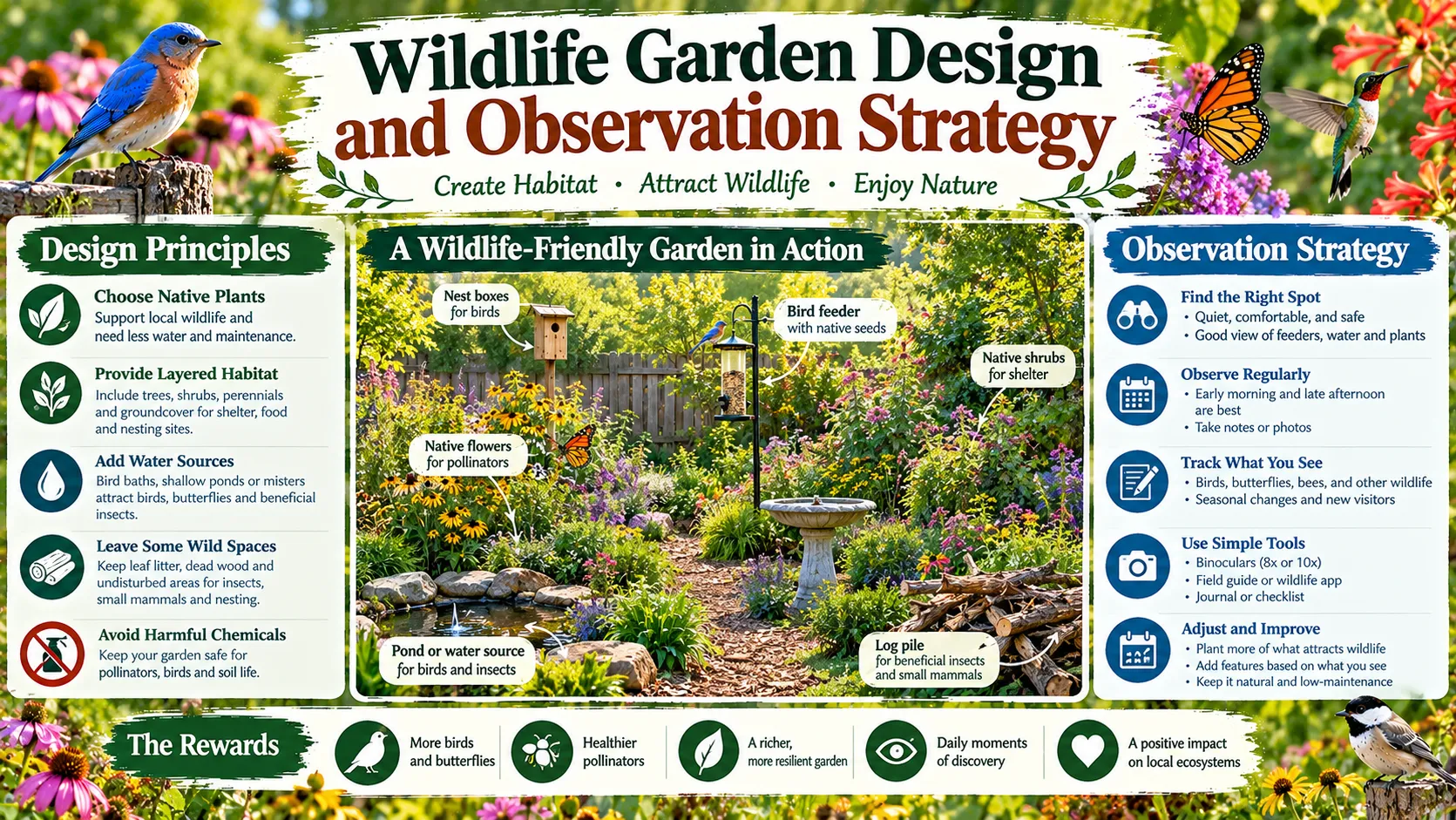
A wildlife garden is not a style of planting. It is a yard arranged around four things birds, butterflies and other backyard wildlife actually need: food, water, cover, and a place to raise young. The National Wildlife Federation built its Garden for Wildlife program around this exact framework after U.S. Forest Service researchers found that the same principles wildlife managers use on large landscapes work just as well on a quarter acre lot. Get those four elements in place, arrange them with some structure, and the rest, including where you sit to watch it all happen, follows naturally.
This guide walks through that framework: what a wildlife garden needs, how to layer it so it supports more than one species, how to design it so you can actually see the wildlife you are attracting, the hazards worth planning around from day one, and how the same approach scales from a large lot down to a balcony.
What a Wildlife Garden Actually Provides
Every productive wildlife garden, regardless of size or region, supplies the same four elements.
Food. Native plants form the base of the food web, supplying berries, nuts, seeds, nectar and the insects that birds feed their young. A well maintained feeder can supplement this but should not replace it. For a full plant by plant approach to choosing what to grow for birds and butterflies in your region, see our guide to choosing plants for birds and butterflies. For a feeder matched to each species, see our guide to choosing a feeder for each bird.
Water. Birds need clean water for drinking and bathing, while butterflies need damp, mineral rich substrate rather than open water. A shallow bird bath, a dripper, or a dedicated puddling station all count. Siting and maintaining water sources safely is its own subject; our garden water features and bird baths guide covers it in depth.
Cover. Wildlife needs places to hide from weather and predators. Dense native planting does most of this work. Evergreen shrubs, brush piles, and even a layer of fallen leaves all function as cover, and the Missouri Extension program notes that increasing vertical structure and plant diversity directly improves the habitat value of a yard.
Places to raise young. This varies by species: nest boxes and dense shrubs for birds, specific native host plants for butterfly caterpillars, undisturbed leaf litter for overwintering insects. Our butterfly habitat and lifecycle guide covers what this looks like across a full butterfly life cycle.
NWF also recommends a minimum goal of 70 percent native plants for a space to function as genuine wildlife habitat, paired with sustainable practices such as avoiding pesticides and reducing unnecessary lawn.
Layout and Layers: Structuring the Garden
A flat lawn with a border of annuals provides almost none of the four elements above. The difference between a decorative yard and a functional wildlife garden is usually structure, not plant selection alone.
Build in vertical layers. University of Florida’s IFAS Extension describes four rough layers worth including wherever space allows: a canopy of mature trees, an understory of smaller flowering trees, a shrub and herbaceous layer below that, and a ground layer of leaf litter, grasses and low perennials. Each layer supports different species and different behaviors. A chickadee forages differently in the canopy than a towhee scratching through leaf litter, and a yard with only two of the four layers leaves real gaps in what it can support. You do not need mature trees to start: even a single understory tree underplanted with shrubs and a ground layer adds meaningful structure.
Plant in islands, not rows. Clumps of mixed height vegetation, rather than single specimen plants scattered across a lawn, function as better cover and create natural edges where two habitat types meet. Extension research notes that these edges, where a shrub layer meets open ground or a woodland border meets a garden bed, are often where the most wildlife activity concentrates.
Leave structure standing. Hollow stems, a brush pile tucked in a back corner, and a section of leaves left unraked through winter all supply cover and overwintering habitat that a tidied, mulched bed does not. For the vegetation side of this layering approach in more depth, see our dedicated guide to creating canopy layers once it publishes.
Designing for Observation, Not Just Attraction
Most wildlife gardening advice stops at how to attract birds and butterflies. Just as important, and far less discussed, is whether you can actually see them once they arrive.
Put feeders and water features in view of a window or a seating area. A feeder tucked behind a shed gets visited just as often as one outside your kitchen window, but only one of them you will actually watch.
Choose a seating spot with a reason, not just a view. A bench or chair placed where several habitat elements overlap, a water feature, a flowering border, and some nearby cover, gives you more to watch in less time than a seat facing an open lawn. Position it so you are not backlit or casting a shadow across the feature you are watching.
Keep movement and noise low near viewing spots. Birds and butterflies habituate to a person who sits still in the same spot regularly far faster than to one who approaches and retreats unpredictably. If you want closer views of butterflies specifically, a close focus pair of binoculars resolves far more detail than walking closer ever will; our guide to binoculars for bird and butterfly watching compares models built for exactly this kind of close garden use alongside standard birding distances.
Plan sightlines the way you would plan a garden path. Think about where you stand or sit most often, in the kitchen, on a porch, at a desk, and orient at least one habitat feature so it’s visible from there without needing to go outside. Early morning tends to be the most active window for bird activity, so a feature visible from a breakfast table earns more actual viewing time than one in a far corner you rarely visit.
Designing Around Garden Hazards
A garden that attracts wildlife also needs to protect it. Three hazards are worth addressing from the start, before finalizing the placement of feeders, baths or seating.
Cats. A 2013 peer reviewed study published in Nature Communications estimated that free ranging domestic cats kill between 1.4 and 3.7 billion birds annually in the United States, making outdoor cats likely the single largest source of human linked bird mortality in the country. The American Bird Conservancy’s Cats Indoors program recommends keeping pet cats indoors or supervised outdoors as the most effective single step a homeowner can take. If you have a cat and want it to enjoy the outdoors safely, a catio or leash setup keeps it contained without removing it from the hazard equation entirely. If neighborhood cats are a factor you cannot directly control, keep feeders and baths at a distance from dense ground level cover where a cat could stage an ambush, which also supports the escape cover spacing already recommended in our water features guide.
Windows. The American Bird Conservancy estimates that building and window collisions kill over a billion birds annually in the United States, and most birds brought to rehabilitators after a collision were otherwise healthy. Researchers studying window strikes, including long running work by ornithologist Daniel Klem, have found that feeder placement affects collision risk: birds rarely build up enough speed to injure themselves within about three feet of the glass, while collisions rise sharply when feeders sit in the 15 to 30 foot range. The commonly cited guideline, sometimes called the “3 or 30 rule,” is to place feeders and baths either within 3 feet of a window or beyond 30 feet. Treating the glass itself with external decals, film or screening is the most effective long term fix; for the details, see our guide to preventing window strikes and garden hazards.
Chemicals. Avoid pesticides and herbicides anywhere near plants wildlife feeds on or puddles near. A guide to pest management that doesn’t harm the wildlife you’re trying to attract is also planned for this site.
Fitting the Framework to Your Yard
The four element framework scales. What changes is density and substitution, not the underlying approach.
Large yards have room for full vertical layering: mature canopy trees, a true understory, generous shrub borders, and multiple water features spread across different zones. This is also where distinct “garden rooms,” each built around a different habitat focus, work best.
Average suburban lots usually can’t fit a full canopy layer but can still manage an understory tree or two, a shrub border along a fence line, and one or two water features. Prioritize cover and layering over spreading plantings thin across the whole yard.
Small yards and balconies lose the canopy and understory layers almost entirely but can still supply food, water and some cover through container plantings, a small puddling dish, and vertical structure like trellised vines. A dedicated guide to small space and balcony wildlife gardening is planned for this site, and the same food, water, cover and nesting framework applies at any scale.
Keeping the Garden Working Year Round
A wildlife garden is not a one time installation. NWF’s sustainable gardening guidance, part of the same Habitat Essentials framework behind the four elements above, recommends a few ongoing practices: skip pesticides and herbicides, reduce lawn area where you can, leave seed heads and leaf litter through fall and winter rather than clearing them immediately, and turn off unnecessary outdoor lighting, which disrupts migrating birds and night flying insects. None of this requires a rigid schedule, but a seasonal rhythm, checking water sources before summer heat, leaving structure standing into winter, assessing plant layers each spring, keeps the garden functioning as habitat rather than just decoration. A full seasonal maintenance checklist is planned for this site.
Where to Go From Here
Once the framework is in place, the next steps are usually plant selection and water. Our complete guide to choosing plants for birds and butterflies walks through matching native species to your region and the specific wildlife you want to support, and our guide to garden water features and bird baths covers designing, siting and maintaining the water half of the equation in full detail. If butterflies specifically are the goal, our butterfly habitat and lifecycle guide covers host plants, nectar, puddling and overwintering shelter as one connected system.
A wildlife garden rewards patience more than any single purchase or plant. Get the four elements in place, give the space some structure, and position yourself to actually watch what shows up.
Sources and further reading
- Habitat Essentials - National Wildlife Federation
- Designing a Habitat Garden - UF/IFAS Gardening Solutions
- Landscaping for Wildlife - University of Missouri Extension
- Keep Cats Indoors - American Bird Conservancy
- Bird-Building Collisions - American Bird Conservancy
- Plan a Backyard Wildlife Habitat - Penn State Extension