
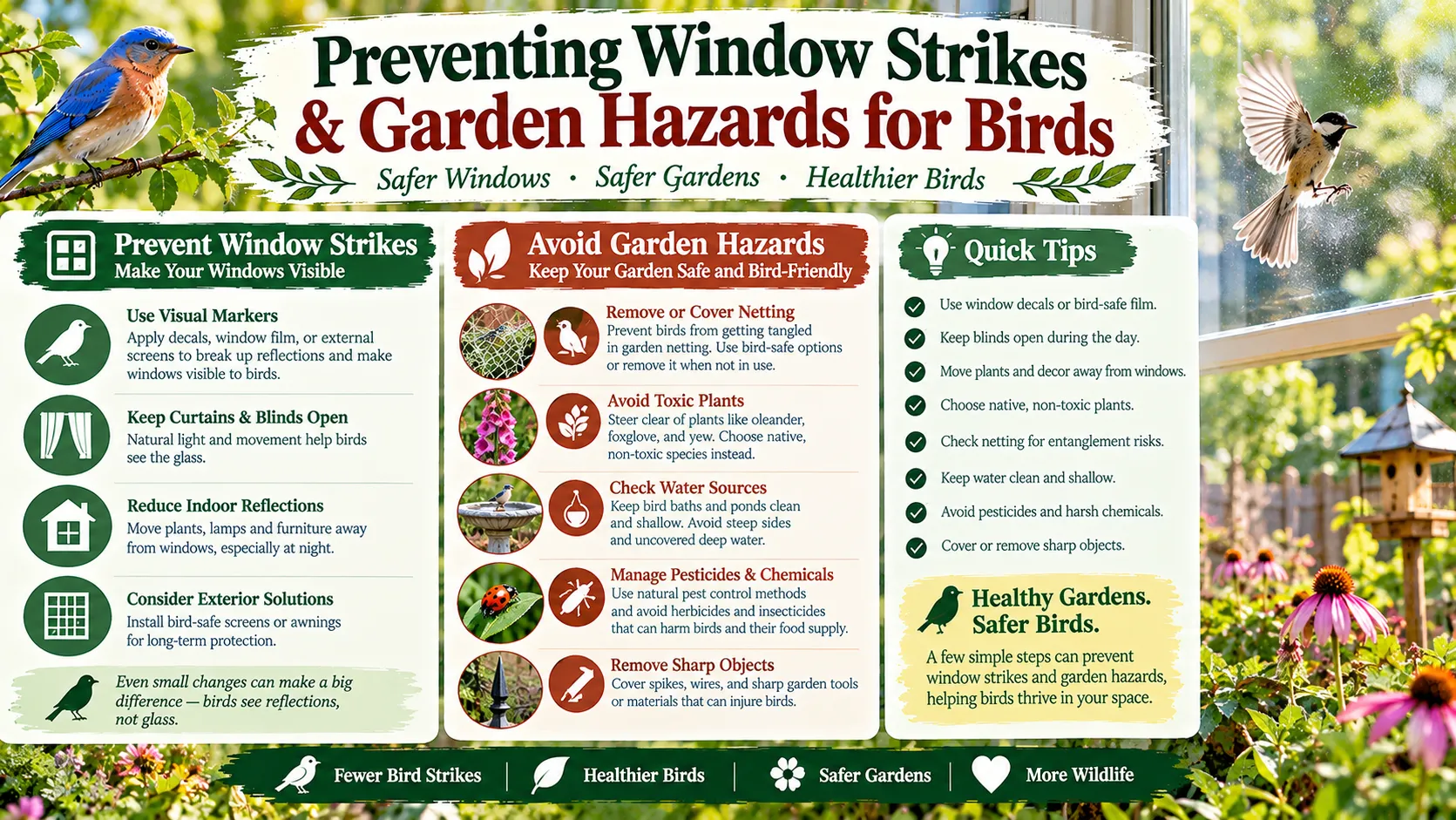
To prevent bird window strikes, mark the outside of the glass so birds can see it. Birds often cannot see clear or reflective glass as a barrier. A window can look like open sky or the trees behind you, and a bird flying fast may not register it at all. Feeder placement is less settled, and the sources disagree about the right distance.
Quick answer
Put markings on the outside of the glass, spaced close enough that birds cannot fly through the gaps. The American Bird Conservancy recommends vertical stripes no more than 4 inches apart and horizontal stripes no more than 2 inches apart, each at least 1/8 inch wide (ABC, Save Birds). For feeder distance, the evidence is mixed, and the section below explains the disagreement.
How big the problem is
A peer reviewed analysis of 23 studies estimated that between 365 and 988 million birds die each year from building collisions in the United States, with a median of about 599 million. Roughly 56 percent of those deaths happen at low rise buildings and 44 percent at residences (Loss et al., The Condor). The same paper estimates that free roaming and feral cats kill roughly four times as many birds as buildings do.
A 2024 study looked at injured birds brought to wildlife rehabilitators in the northeastern United States. About 60 percent of them died, including those that survived the initial impact (Kornreich et al., PLOS ONE). The American Bird Conservancy uses this kind of finding to say that more than one billion birds die from glass collisions each year in the United States (ABC). That figure is ABC’s estimate, not a separate count.
How to treat windows to prevent strikes
Markings work best when they cover the outside of the glass and break up the whole surface, not just one spot. ABC’s guidance covers stripe spacing and width, and it notes that irregular patterns following the same spacing will also work (ABC, Save Birds).
One decal product that ABC describes is designed for the inside of the glass. Its tests were on ordinary window glass, and the note warns it may work less well on reflective coatings (ABC). If your windows are reflective, check how a product was tested before you rely on it.
ABC’s Save Birds sheet says that windows with screens should already be safe for birds. Screens and taut netting are a practical option, especially for windows that have already caused collisions.
Feeder placement is contested
Sources disagree on this question.
One controlled study placed platform feeders at different distances from a window. Feeders 1 metre (about 3 feet) from the glass produced the fewest collisions, and none of those was fatal. The share of fatal collisions rose at 5 metres and 10 metres (Conservation Evidence). That study is small and tests only one feeder type. It supports the idea that very close feeders are safer, but it does not settle the question.
Other advice differs. A widely repeated rule says to keep feeders within 3 feet of a window or more than 30 feet away. No primary ABC or Audubon page for that rule was found, so treat it as commonly quoted rather than established. Cornell’s All About Birds guidance from 2009 says feeders placed closer than 3 feet are safest, and that about 10 feet is a good compromise (All About Birds, Cornell Lab of Ornithology). A Cornell scientist has been quoted describing a 10 foot rule as generally good. A summary of Daniel Klem’s work reports the most feeder related collisions at windows 15 to 30 feet from a feeder, with few within 3 feet.
The sources agree that feeders very close to glass do better than feeders at middle distances. They disagree about the exact threshold. Whatever distance you choose, treating the glass with markings is the step the evidence supports most clearly.
Keeping feeders clean
Feeders bring birds together, and disease spreads through droppings and contaminated seed. The USGS National Wildlife Health Center recommends cleaning feeders with a 10 percent bleach solution, rinsing well, and drying them. It also advises raking up waste seed and droppings below feeders, and storing seed in rodent proof containers (USGS NWHC).
If birds around your feeders become sick, the NWHC advises not putting feeders back up for one to two weeks, so affected birds do not gather in one place. The NWHC page was last updated in 2018, so check your state wildlife agency for current advice before you act. For the cleaning steps themselves, see our bird feeder cleaning checklist.
Cats
Keeping cats indoors protects birds at feeders and in the garden. It is the most direct way to reduce the pressure cats put on local bird populations, and it matters most near feeders, where birds gather.
Choosing feeders
Feeder style matters as well as distance. For help matching feeders to the birds you want, see our guide to the best bird feeder types for specific species. For the wider picture of feeding and nesting, read the backyard bird feeding and nesting essentials guide. Nest boxes near the house raise their own placement questions; our guide to siting and mounting nest boxes covers them. These choices sit inside a wider garden plan; for the whole layout, see our guide to planning a wildlife garden.
Quick checklist
- Put markings on the outside of the glass, with stripes spaced as ABC describes.
- Use screens or netting on windows that have had collisions.
- Check how any decal was tested before relying on it, especially on reflective glass.
- Place feeders deliberately, knowing the sources disagree on the best distance.
- Clean feeders regularly, and keep them down for one to two weeks after an outbreak, following your state wildlife agency.
- Keep cats indoors, especially near feeders.
Sources and further reading
- Preventing Glass Collisions — American Bird Conservancy
- Save Birds — American Bird Conservancy (PDF)
- Bird–building collisions in the United States: Estimates of annual mortality and species vulnerability — Loss et al., The Condor
- Rehabilitation outcomes of bird-building collision victims in the Northeastern United States — Kornreich et al., PLOS ONE
- Effects of window angling, feeder placement, and scavengers on avian mortality at plate glass — Conservation Evidence
- Salmonellosis — USGS National Wildlife Health Center