
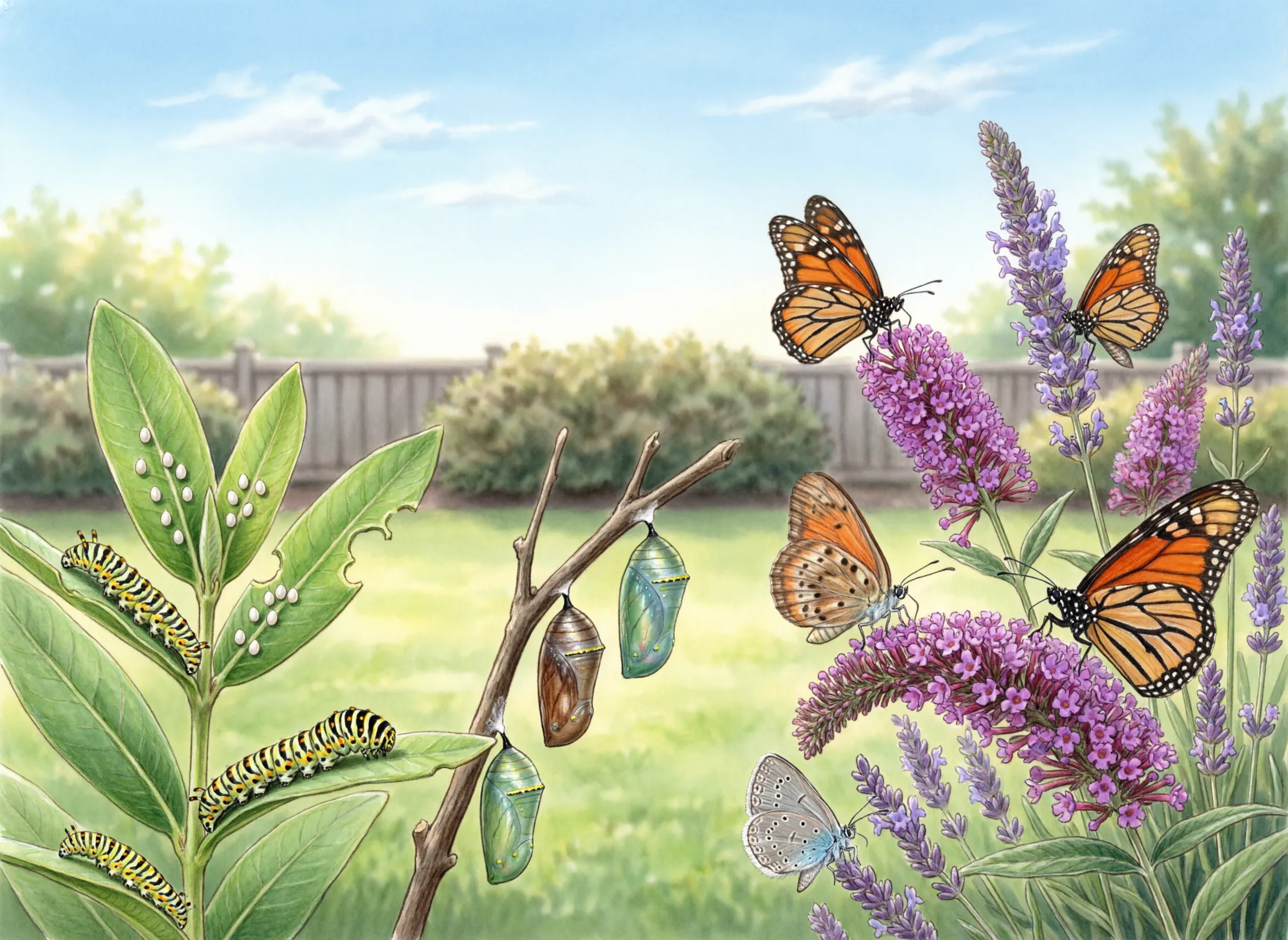
A butterfly garden is not just a collection of flowers. To sustain butterflies year round, a garden must provide four things: host plants for caterpillars to eat, structural shelter for chrysalises to form, nectar rich flowers for adults to feed on, and overwintering refuge for the next generation. Most garden guides stop at “plant some flowers.” This guide covers all four stages, plus the water, safety, and regional considerations that determine whether your garden actually sustains butterflies or merely attracts passing adults.
Each section below maps to a stage of the butterfly life cycle, so you can build a habitat that works biologically rather than one that simply looks colorful.
The Four Life Stages: What Your Garden Must Provide
Every butterfly passes through four distinct stages, and each stage has different habitat requirements. A garden that only provides nectar flowers supports adult butterflies for a few days. A garden that provides host plants, shelter, nectar, and overwintering habitat supports the entire life cycle.
| Life Stage | What the Butterfly Needs | What Your Garden Must Provide |
|---|---|---|
| Egg & Caterpillar | Species specific food plants | Native host plants, zero pesticides |
| Chrysalis | Secure, sheltered pupation site | Structural diversity: stems, shrubs, leaf litter |
| Adult | Nectar, basking warmth, mating sites | Continuous bloom native flowers, sun, basking stones |
| Overwintering | Protection from cold and predators | Leaf litter, standing stems, brush piles |
1. Egg and Caterpillar: Host Plants Are Non Negotiable
Adult female butterflies are highly selective about where they lay eggs. They will only deposit eggs on specific “host plants” whose leaves their caterpillars have evolved to eat. Monarch caterpillars feed exclusively on milkweed (Asclepias spp.). Black Swallowtail caterpillars need plants in the carrot family, such as dill, fennel, or native Zizia. Pipevine Swallowtails require pipevine (Aristolochia spp.).
Without the correct host plants, adult butterflies may visit your garden for nectar but will not stay to reproduce. This is the critical distinction between caterpillar host plants and adult nectar plants: host plants feed the next generation, while nectar plants fuel the current one. A garden that provides only nectar is a way station, not a habitat.
When planting host species, expect heavy leaf damage. Caterpillars are eating machines, and chewed leaves are a sign of success, not failure.
2. Chrysalis: Shelter for the Transformation
Once a caterpillar reaches its final growth stage, it leaves the host plant to find a secure spot to form a chrysalis. Many species travel several meters to find a sheltered location. They attach to the undersides of leaves, fence rails, shrub stems, or crevices in bark and rock.
Your garden needs structural diversity to support this stage. A perfectly manicured lawn with no vertical stems, no shrubs, and no ground cover leaves caterpillars exposed to predators and weather during their most vulnerable phase. Include a mix of plant heights, dense shrubs, and undisturbed ground areas.
3. Adult Butterfly: Nectar, Basking, and Mating
Adult butterflies need high energy nectar to fuel flight and reproduction. They also need warmth. Butterflies are ectothermic. They cannot generate their own body heat and must bask in sunlight to raise their thoracic temperature before they can fly.
Provide a succession of native nectar plants that bloom from early spring through late autumn. Include flat, dark colored stones in sunny spots to serve as basking perches. Butterflies will land on these stones, spread their wings, and absorb radiant heat.
For a detailed selection of bloom times and species, see our guide to top nectar rich flowers that attract butterflies.
4. Overwintering: The Stage Most Gardens Ignore
Most native butterflies do not migrate. They overwinter in your garden as eggs, chrysalises, or adults tucked into protective microclimates. The Xerces Society’s “Leave the Leaves” research shows that the vast majority of butterflies and moths use leaf litter for winter protection of eggs, caterpillars, chrysalises, or adults.
Traditional fall cleanup, cutting perennial stems to the ground and raking every leaf, destroys this habitat. Leave perennial stems standing until early spring, allow leaf litter to accumulate in garden beds, and maintain brush piles or rock walls for additional cover. This single practice can make the difference between a garden that supports butterflies in summer and one that sustains them year round. Read more about overwintering habitat for butterflies and beneficial insects.
Site Selection: Sun, Wind, and Basking Stones
Before choosing plants, choose the right location. Three physical factors determine whether butterflies will use your garden.
Sun. Butterflies need at least six to eight hours of direct sunlight daily to warm their flight muscles and become active. Select a site in full sun, ideally facing south or west. A partially shaded garden will limit butterfly activity significantly.
Wind. Strong winds exhaust butterflies and make it difficult to land on flowers. Position the garden near a natural windbreak, such as a dense shrub border, a fence, a stone wall, or the leeward side of your home. This creates a calmer microclimate where butterflies can forage efficiently.
Basking. Place flat, dark colored stones (slate, basalt, or dark river rocks) in the sunniest parts of the garden. These absorb solar radiation and provide warm perching surfaces where butterflies can raise their body temperature in the morning. Arrange several stones close together to create multiple basking options.
University Extension guidance consistently identifies these three factors as foundational to butterfly habitat design.
Building the Plant Palette
Host Plants vs. Nectar Plants
The most common mistake in butterfly gardening is planting only nectar flowers. Adult butterflies need nectar, but caterpillars need host plants. Without host plants, you are feeding adults but not supporting reproduction.
A functional butterfly garden includes both. Research the butterfly species in your region and identify their specific host plants. Then add a succession of nectar plants to provide continuous bloom. The distinction between caterpillar host plants and adult nectar plants is the single most important concept in butterfly habitat design.
Milkweed: Regional Species Matter
For Monarch butterflies, milkweed (Asclepias spp.) is the only genus that caterpillars can eat. Planting milkweed is non negotiable if you want to support Monarchs. However, not all milkweeds are appropriate for every region.
The Monarch Joint Venture notes that there are over 73 milkweed species native to the United States, but gardeners should plant species that occurred historically in their specific area. Planting the wrong species, or planting non native Tropical Milkweed (Asclepias curassavica) in warm climates where it does not die back in winter, can disrupt migration patterns and harbor the OE parasite (Ophryocystis elektroscirrha), which debilitates Monarch populations.
| Region | Recommended Native Milkweed Examples | Typical Conditions |
|---|---|---|
| Northeast / Midwest | Common Milkweed (A. syriaca), Swamp Milkweed (A. incarnata), Butterfly Weed (A. tuberosa) | Fields, wet soils, dry sandy soils |
| Southeast | Butterfly Weed (A. tuberosa), Whorled Milkweed (A. verticillata) | Dry to moderate soils |
| Western U.S. | Showy Milkweed (A. speciosa), Mexican Whorled Milkweed (A. fascicularis) | Semi arid, varied elevations |
| South Central | Green Antelopehorn (A. viridis), Antelopehorns (A. asperula) | Dry, rocky, calcareous soils |
| Florida | Pinewoods Milkweed (A. humistrata), Redring Milkweed (A. variegata) | Dry pinelands, wet prairies |
Verify species suitability for your specific location using USDA PLANTS or your regional University Extension service. For a deeper regional breakdown, see our guide to milkweed varieties for Monarch butterflies.
Nectar Plants for Continuous Bloom
Adult butterflies need a steady nectar corridor from spring to fall. Select regionally appropriate native plants that bloom in sequence:
- Spring: Native columbine, wild phlox, fruit tree blossoms
- Summer: Coneflowers (Echinacea), bee balm (Monarda), milkweeds, black-eyed Susans
- Autumn: Regionally native asters, goldenrod, and sedum
Fall blooming natives are especially important for migratory species like the Monarch, which must build fat reserves before migrating south. Prioritize native species over non native ornamentals; native plants have co evolved with local pollinators and provide the highest quality nectar and pollen.
Water and Puddling: Beyond the Bird Bath
Most gardeners provide water using a standard bird bath. This is unsuitable for butterflies. Butterflies cannot land safely in open, deep water and risk drowning. Instead, they engage in a behavior called puddling.
Puddling is the act of gathering at damp, mineral rich soil to extract nutrients, primarily sodium and amino acids, that are absent from a nectar only diet. The Xerces Society documents that male butterflies use these minerals for reproduction. Sodium acquired during puddling is transferred to females during mating and can improve offspring fitness.
To support puddling, create a shallow, mineral rich water source rather than a deep basin:
- Use a shallow tray, saucer, or dish.
- Fill it with a mixture of coarse sand and soil or compost.
- Add a small amount of salt, a commonly recommended starting ratio is approximately half to three quarters of a cup per gallon of sand, to boost sodium availability.
- Keep the mixture consistently moist but not saturated with standing water.
- Add a few flat rocks to provide perching surfaces.
Alternatively, shallow misters and butterfly watering stations can provide gentle, low volume water delivery that keeps wings dry. For step by step construction guidance, see our guide on how to make a butterfly puddling station.
Maintain puddling stations by replenishing moisture regularly and cleaning out debris to prevent algae growth or mosquito breeding.
Puddling is the butterfly side of a hydration plan that also serves birds. For the full range of bird baths, fountains, and drippers, see our guide to garden water features for birds and butterflies.
Garden Gear: What Helps and What Does Not
The garden retail market sells a wide range of “butterfly gear.” Not all of it is supported by evidence.
Butterfly Houses: Popular but Unsupported
Wooden butterfly houses with narrow vertical slits are widely sold as overwintering shelters. However, current university Extension guidance indicates that evidence supporting commercial butterfly houses as meaningful habitat is weak. Penn State Extension lists the claim that you need to buy bee and butterfly houses as a common pollinator myth.
There is little evidence that butterflies regularly use these structures. Instead, they seek out natural shelter: dense shrubs, tall grasses, brush piles, and the undersides of evergreen leaves. In some cases, butterfly houses become occupied by paper wasps or spiders, which can prey on butterfly larvae and pupae.
This does not mean you should never install one. Some gardeners enjoy them as decorative or observational features. But if your goal is to support butterfly survival, natural shelter is a far more effective investment. For a full evidence review, see our analysis of whether butterfly houses work.
Puddling Stations and Misters: Functional Hydration
Unlike butterfly houses, puddling stations and shallow misters solve a verified biological need. Male butterflies require sodium and minerals for reproduction, and these nutrients are not available in nectar. A simple saucer filled with sand, soil, and a pinch of salt addresses this need directly.
Shallow misters that produce a fine, low volume spray can also provide drinking water without the drowning risk of a deep basin. When selecting a mister, look for one with adjustable flow control and a low spray height suitable for a butterfly garden rather than a high pressure jet designed for a bird bath.
Pesticides: The Organic Trap
You cannot have a functioning butterfly garden if you are actively spraying it. This includes “organic” and “natural” pesticides, which can be just as lethal to caterpillars as synthetic chemicals.
The Xerces Society and EPA both emphasize that “organic” does not automatically mean harmless to wildlife. Several commonly used organic pesticides are highly toxic to caterpillars and pollinators:
| Active Ingredient | Common Use | Effect on Caterpillars and Pollinators |
|---|---|---|
| Bt (Bacillus thuringiensis) | Organic caterpillar control in vegetable gardens | Destroys the gut lining of all Lepidoptera larvae; kills Monarch and Swallowtail caterpillars indiscriminately |
| Neem oil (Azadirachtin) | Organic insect growth regulator | Disrupts molting, feeding, and reproduction in caterpillars; toxic to pollinators |
| Spinosad | Organic insecticide | Deadly to bees, butterflies, and beneficial insects when wet |
| Imidacloprid | Systemic insecticide | Absorbed into plant tissue; exuded in pollen and nectar, poisoning adult butterflies and bees |
The Xerces Society specifically warns that the organic pesticide Bacillus thuringiensis is highly toxic to monarchs and other butterflies. Never spray Bt on or near host plants.
If you encounter aphids or other pests on host plants, tolerate them. They are part of the food web that supports birds and beneficial insects. If intervention is necessary, use a strong blast of water to dislodge pests, or remove them manually. For broader strategies, see our guide to wildlife friendly pest management and protecting caterpillars from parasites and predators.
Frequently Asked Questions
How do you create a butterfly garden?
Choose a sunny, wind sheltered site with at least six to eight hours of direct sun. Plant native host plants for caterpillars and nectar plants for adults, ensuring continuous bloom from spring to fall. Add a shallow puddling station or mister for water and minerals. Leave leaf litter and standing stems for overwintering habitat. Avoid all pesticides, including organic ones like Bt, Neem oil, and Spinosad.
What is the best plant for a butterfly garden?
There is no single “best” plant because different butterfly species require different host plants. However, native milkweed (Asclepias spp.) is essential for Monarch caterpillars and is considered the most critical host plant in North America. For adult nectar, regionally appropriate native asters, goldenrod, coneflowers, and bee balm are widely recommended. The most effective approach is to plant a combination of regionally appropriate host and nectar plants.
Is it legal to have a butterfly garden?
Yes, it is legal to plant a butterfly garden in the United States. However, two considerations apply. First, some municipalities and homeowners’ associations have landscaping codes that restrict plant height or appearance; check local regulations before planting tall native species. Second, while attracting wild butterflies is unrestricted, federal and state agencies, including the USDA and U.S. Fish & Wildlife Service, regulate aspects of wildlife transport and release. Many states have specific rules prohibiting or restricting the release of captive bred butterflies to prevent disease spread and protect wild genetics. Always check local regulations and focus on attracting local, wild populations rather than purchasing and releasing insects.
When should I start my butterfly garden?
Fall is ideal for planting native perennials and sowing seeds that require cold stratification, such as milkweed. Autumn planting allows roots to establish in cool, moist soil before summer heat. Spring, after the last frost, is also suitable for planting established nursery plants or annuals. Regardless of timing, verify that the species you select are native to your specific region.
Sources
The following sources were used to verify the biological, safety, and habitat claims in this article.
1. Xerces Society for Invertebrate Conservation. Butterfly habitat, pollinator conservation, pesticide safety, overwintering habitat, and puddling behavior.
- xerces.org
- Make a Simple Water Source to Support Pollinators
- Leave the Leaves!
- Nesting & Overwintering Habitat (Publication 18-014)
- How Urban Pesticides Can Harm Monarch Butterflies
- Comparative Overview of Organic Pesticides
- Milkweeds Conservation Guide
2. Monarch Joint Venture. Monarch biology, milkweed species, regional habitat recommendations.
- monarchjointventure.org
- Milkweed FAQ
- Finding and Selecting Milkweed Seeds and Plants
- Monarch Habitat Needs
- Planting Monarch Habitat FAQ
3. Penn State Extension. Pollinator myths, including butterfly house effectiveness.
4. U.S. Environmental Protection Agency (EPA). Pesticide guidance and pollinator protection.
5. University Extension Services. Site selection, garden design, and regional planting guidance.
- Missouri Extension: Designing a Butterfly Garden
- Colorado State Extension: How to Create a Butterfly Garden Above 7,500 Feet
6. USDA PLANTS Database. Native plant distribution and status verification.