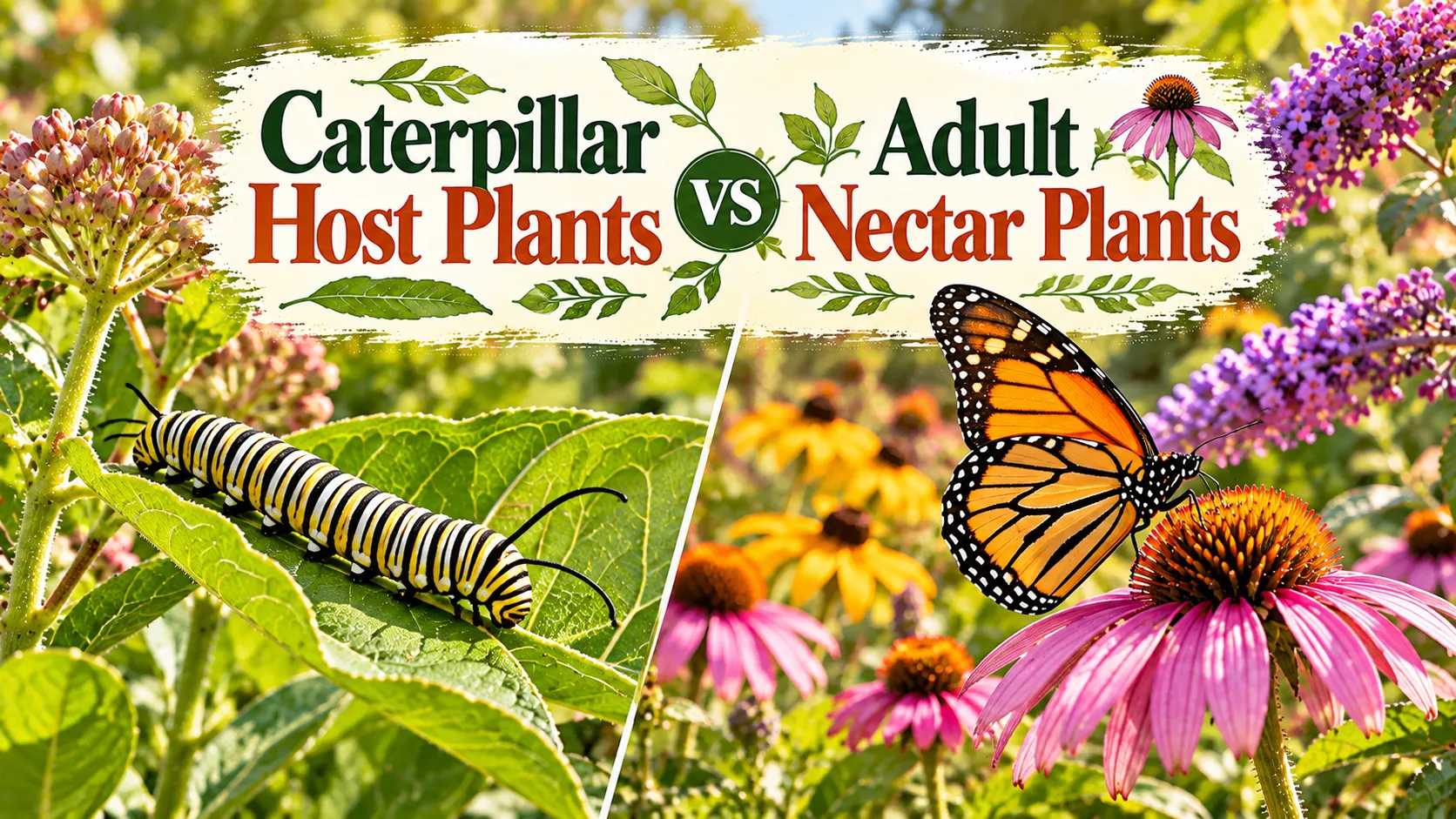
Caterpillar host plants feed developing caterpillars, while adult nectar plants provide food for butterflies through their flowers. A butterfly-friendly garden needs to account for both roles. Flowers may attract feeding adults, but they don’t necessarily provide the leaves a particular caterpillar species needs to grow.
Some plants can serve both purposes, but don’t assume every flowering plant is a caterpillar host or every host plant offers useful nectar. Choose plants according to the butterfly species you want to support and the conditions in your region.
Host Plants vs. Nectar Plants: The Main Differences
| Feature | Caterpillar host plants | Adult nectar plants |
|---|---|---|
| Main purpose | Feed developing caterpillars | Provide food for adult butterflies |
| Life stage supported | Caterpillar | Adult butterfly |
| What to look for | A documented relationship between a butterfly species and its caterpillar food plant | Flowers that provide accessible nectar for adult butterflies |
| What success can look like | Eggs or caterpillars on the plant, sometimes with chewed leaves | Butterflies visiting flowers to feed |
| How specific the relationship is | Often limited to particular plant species or groups of related plants | One flowering plant may serve several adult butterfly species |
| What to check before planting | Which local butterfly species use the plant as a host | Flowering season, flower accessibility, and regional suitability |
The simplest way to remember the difference is this: host plants help butterflies grow up; nectar plants help adult butterflies fuel their activities.
Both matter, but they meet different needs.
What Are Caterpillar Host Plants?
A host plant is a plant that a particular insect species can use for food and development during its larval stage.
For butterflies, this relationship can be quite specific. A plant that supports one caterpillar species may be unsuitable for another. Choosing plants based only on appearance, or on a broad label such as “butterfly friendly”, can leave important gaps in your garden.
Examples of butterfly host plants
Milkweed for monarch caterpillars
Monarch caterpillars feed on milkweeds. If you want to support monarchs, choosing a suitable milkweed species is an important step. Milkweeds differ in their native ranges and growing requirements, so check which species are appropriate for your location. Our guide to milkweed varieties for monarch butterflies covers regional selection.
Hackberries for question mark caterpillars
Hackberry trees are among the documented host plants of the question mark butterfly. Butterfly habitat isn’t limited to small flowering plants: trees and shrubs can also support caterpillars.
Oaks for oak hairstreak caterpillars
Oaks serve as host plants for oak hairstreak caterpillars. Keeping suitable trees in a landscape can support butterfly life stages that a flower bed alone may not accommodate.
These examples show why host-plant choices need to match the butterfly species you want to support. They aren’t a complete host-plant list.
Is leaf damage a bad sign?
Not necessarily. Caterpillars need to eat, so holes or chewed leaf edges can be evidence that a plant is serving its intended ecological role.
A host plant isn’t just a decorative plant that must remain flawless. Part of its value is providing food for developing insects. For more on helping caterpillars survive, see our guide to protecting caterpillars from parasites and predators.
That doesn’t mean every damaged plant is being eaten by caterpillars, or that severe damage should always be ignored. It simply means a few imperfect leaves aren’t automatically a sign that something has gone wrong.
What Are Adult Butterfly Nectar Plants?
Nectar plants produce flowers that adult butterflies can visit for food. Nectar supplies energy for activities such as flying and moving between feeding sites.
Flowers vary in shape, size, and accessibility. A flower that attracts one pollinator may be less useful to another, so a mix of suitable flowering plants can offer more opportunities than relying on a single variety.
Examples of flowering plants for adult butterflies
Purple coneflower (Echinacea purpurea)
Purple coneflower is a familiar flowering perennial that can contribute nectar to a pollinator garden. Check that the plant or seed packet identifies the species accurately, then confirm that it suits your region and growing conditions.
Wild bergamot (Monarda fistulosa)
Wild bergamot is a North American flowering plant used in pollinator gardens. Its flowers can provide nectar for pollinators, including butterflies. Its suitability depends on local conditions and regional plant choices.
New England aster (Symphyotrichum novae-angliae)
New England aster is worth considering when planning for late season flowers. In suitable regions, it blooms toward the end of the growing season and provides a food source for visiting butterflies and other pollinators.
These examples offer different ways to plan for adult butterflies, but they aren’t a universal planting prescription. Check each plant’s range, growing requirements, and documented value for wildlife in your area. For a season by season list, see our guide to nectar rich flowers for butterflies.
Do adult butterflies eat only nectar?
No. Nectar is an important food source for many adult butterflies, but it isn’t the only food used by every species.
Some butterflies also visit fermenting fruit, tree sap, or other nutrient rich materials. A flower filled garden can provide valuable resources without meeting every feeding need of every adult butterfly.
Can One Plant Be Both a Host Plant and a Nectar Plant?
Yes, some plants can serve both roles. The important point is to evaluate each role separately.
A plant might produce flowers that adult butterflies visit and leaves that caterpillars of a particular species can eat. Another plant might be valuable as a host but have little or no demonstrated value as a nectar source for the butterflies you’re trying to support.
Don’t classify a plant as serving both roles simply because it attracts adult butterflies or supports caterpillars.
When evaluating a plant, ask two questions:
- Host-plant question: Is this plant a documented food source for the caterpillars of a butterfly species found in my area?
- Nectar-plant question: Do adult butterflies use its flowers as a food source?
Look for evidence for each answer. If only one role is documented, describe the plant accordingly instead of assuming it performs both.
Why Your Butterfly Garden Needs Both Types
A garden can attract adult butterflies and still provide limited support for the next generation.
An adult may visit a flower for nectar, but that visit doesn’t mean the plant can feed its caterpillars. If suitable host plants are missing from the surrounding habitat, the garden may provide food for adults without offering the same support for reproduction and development.
The reverse is also true. Host plants can feed caterpillars, while suitable flowers give adult butterflies additional feeding opportunities. For how the two roles fit the rest of the life cycle, see our guide to butterfly habitat.
A useful planning goal is to provide:
- Host plants that support local caterpillar species.
- Flowering plants that offer nectar during more than one part of the growing season.
- Plants suited to your soil, sunlight, moisture, and climate.
- A garden where some leaf damage is acceptable and plants can perform their ecological functions.
You don’t need to follow a universal host-to-nectar plant ratio. Start with the butterflies you want to support, the space you have, and the plants that suit your area.
How to Choose the Right Plants for Your Region
A seed packet or nursery label may say “butterfly garden,” but that description alone doesn’t establish which caterpillars can use the plant or whether it’s native to your location. For the broader framework, see our guide to choosing plants for birds and butterflies.
Use this process before buying.
1. Identify butterflies found in your area
Start with species that occur locally rather than choosing plants for a butterfly that may not be present in your region.
Local extension services, butterfly organizations, and regional plant guides can help you identify likely species.
2. Find each species’ documented host plants
Look for host-plant information tied to the particular butterfly species. Don’t assume a plant used by one butterfly will feed every caterpillar.
If a host-plant list covers a particular county, state, or region, keep that limitation in mind when applying its recommendations elsewhere.
3. Check native range and growing conditions
A plant can be useful to pollinators and still be a poor choice for a particular garden.
Check whether it’s native to your region, whether it suits your local conditions, and whether there are relevant invasive-plant or noxious-weed concerns. “Native” is a regional description, not a guarantee that a plant belongs everywhere in the United States.
4. Plan for flowering across the season
Instead of relying on a single plant that blooms briefly, look for a combination of suitable species with different flowering periods.
Late season plants, such as New England aster in regions where it’s appropriate, can extend the availability of flowers. Choose plants based on your local growing season rather than assuming one calendar works across the country.
5. Read seed packets carefully
Before buying seeds, check the botanical name, species list, growing requirements, and regional suitability. Broad marketing terms such as “wildflower mix,” “monarch mix,” or “butterfly blend” don’t tell you everything about the plants inside.
For host plants in particular, exact species identification matters. If a listing doesn’t clearly identify the plants included, verify the contents before planting.
Four Seed Options to Consider
These options illustrate ways to build both sides of a butterfly garden: host plants and flowering plants for adult pollinators. They’re starting points, not a complete shopping list. Confirm the species, packet contents, and regional suitability before sowing.
1. Home Grown Milkweed Flower Seeds
Best for: Gardeners looking to add a milkweed option for monarch caterpillars.
Milkweed is an important host-plant group for monarch caterpillars. The key detail is the species: different milkweeds have different native ranges and growing requirements, so don’t assume every packet is appropriate for every garden. Check the botanical identities of the seeds in the packet and select a species suited to your location.
Home Grown Milkweed Flower Seeds
A milkweed seed packet for gardeners who want a host plant for monarch caterpillars. Check the species on the packet, since milkweed native ranges and growing needs differ by region.
Key specifications
- Type
- Milkweed seed packet
- Group
- Asclepias
- Use
- Monarch caterpillar host plant
Pros
- Milkweed is the host plant monarch caterpillars need
- A starting point for a host plant patch
Cons
- Confirm the species suits your region before sowing
- Seed establishment takes time
2. KVITER Purple Coneflower Seeds
Best for: Gardeners considering a flowering plant for adult pollinators.
Purple coneflower (Echinacea purpurea) is a recognizable garden perennial whose flowers can provide nectar for pollinators. Confirm the species on the packet and check whether it suits your local conditions. Treat it as a flowering-garden option rather than assuming it can replace the host plants local caterpillars require.
KVITER Purple Coneflower Seeds
Purple coneflower seed for a flowering garden. The flowers can provide nectar for pollinators, but the plant is not a substitute for the host plants local caterpillars need.
Key specifications
- Species
- Echinacea purpurea
- Type
- Flower seed packet
- Use
- Adult pollinator nectar
Pros
- Recognizable perennial for a pollinator garden
- Flowers can provide nectar
Cons
- Not a host plant for caterpillars
- Confirm the species on the packet before buying
3. Seed Needs Wild Bergamot Bee Balm Seeds
Best for: Gardeners considering wild bergamot as a flowering plant.
Wild bergamot (Monarda fistulosa) is a North American plant commonly used in pollinator gardens. Check its growing requirements and regional suitability before planting, especially if you’re gardening outside its native range. Use the botanical name to distinguish this species from other plants sold under similar common names.
Seed Needs Wild Bergamot Bee Balm Seeds
Wild bergamot seed for a pollinator garden. The flowers can provide nectar, and the plant is widely used in pollinator plantings. Check the species and regional suitability.
Key specifications
- Species
- Monarda fistulosa
- Type
- Flower seed packet
- Use
- Adult pollinator nectar
Pros
- North American plant common in pollinator gardens
- Flowers can provide nectar
Cons
- Check regional suitability outside its native range
- Confirm the botanical name, since similar common names exist
4. Outsidepride New England Aster Seeds
Best for: Gardeners in suitable regions who want to extend late season flowering.
New England aster (Symphyotrichum novae-angliae) is a late season flowering perennial that can provide resources for visiting butterflies and other pollinators. It’s worth considering when planning for the end of the growing season, provided it suits your location. Check the plant’s expected height, sunlight needs, and growing conditions before choosing a spot for it.
Outsidepride New England Aster Seeds
New England aster seed, a native late bloomer that provides nectar in late summer and fall for migrating butterflies and other pollinators.
Key specifications
- Bloom time
- Late summer and fall
- Species
- Symphyotrichum novae-angliae
- Quantity
- 1,000 seeds
Pros
- Nectar during a critical late season period
- Native to much of the eastern and central U.S.
- Supports a wide range of pollinators beyond butterflies
Cons
- Native status varies by region, confirm suitability for your area
- Commercial seed may not be a local ecotype
Before you buy: These four options don’t make a complete garden plan by themselves. A milkweed product doesn’t cover the host needs of every local butterfly, and flowering plants don’t replace the specific host plants caterpillars require. Choose plants according to their documented roles and your region.
Common Mistakes When Choosing Butterfly Plants
Mistake 1: Planting flowers but no host plants
Flowers can bring adult butterflies into a garden, but flowering plants alone may not provide food for their caterpillars. Check host-plant requirements as well as nectar value.
Mistake 2: Assuming all caterpillars eat the same plants
Host relationships vary among butterfly species. Research the caterpillars you want to support rather than treating all host plants as interchangeable.
Mistake 3: Assuming every host plant also feeds adults
A plant’s value as a caterpillar food source doesn’t establish its value as an adult nectar source. Confirm the two roles separately.
Mistake 4: Choosing a plant because the label says “butterfly friendly”
Marketing labels can be broad. Look for botanical names, documented host relationships, flowering information, and local suitability.
Mistake 5: Removing every leaf with holes
Chewed leaves can be a normal part of supporting caterpillars. Inspect the plant and identify the cause of damage before deciding whether it needs intervention.
Mistake 6: Treating a national plant list as universally suitable
The United States spans many climates and ecological regions. A plant appropriate for one area may not be native or well suited to another. Local guidance matters.
Frequently Asked Questions
Are host plants more important than nectar plants?
Neither role replaces the other. Host plants support caterpillar development, while nectar plants provide food for many adult butterflies. The right balance depends on local butterfly species, available space, and the habitat you can create.
Can I attract butterflies without host plants?
You may attract adult butterflies to flowers without providing all the plants their caterpillars need. If your goal is to support more of the butterfly life cycle, include documented host plants alongside flowering plants.
Do all butterflies use milkweed?
No. Milkweed is especially important for monarch caterpillars, but different butterfly species use different host plants. Research the species found in your area rather than relying on milkweed as a universal host plant.
Should I remove caterpillars that eat my plants?
Not automatically. If your goal is to support butterflies, caterpillar feeding may be exactly what you want your host plants to enable. If damage is severe or the insect is unidentified, identify the cause before taking action.
How many host plants do I need?
There is no single number that suits every garden. Consider the butterfly species you want to support, your space, and how much of the appropriate host plant you can grow. Start with suitable species and expand as your garden and experience allow.
Are native plants always the best choice?
Native plants are a valuable starting point because they can support relationships with local wildlife. Suitability still depends on the specific plant and region. Confirm native range, growing conditions, and local invasive-plant guidance rather than treating a plant as appropriate everywhere.
The Bottom Line
A butterfly garden does more than attract adults to flowers. It also provides the plants caterpillars need to feed and develop.
Choose host plants for the caterpillars you want to support, then add suitable flowering plants for adult butterflies. Verify each plant’s role, prioritize regional suitability, and plan for flowers across the growing season where possible.
You don’t need a garden full of dozens of species to start. Focus on thoughtful plant choices that match the butterflies in your area, and remember that a few chewed leaves can be part of a healthy butterfly habitat.
Sources
The following references support the plant-role explanations, species examples, and regional-selection advice in this article.
-
Monarch Joint Venture, Monarch Habitat
https://monarchjointventure.org/monarch-biology/monarch-habitat
-
NC State Extension, Question Mark Butterfly
-
Butterflies and Moths of North America, Question Mark
https://www.butterfliesandmoths.org/species/Polygonia-interrogationis
-
Butterflies and Moths of North America, Oak Hairstreak
https://www.butterfliesandmoths.org/species/Satyrium-favonius
-
Penn State Extension, Butterfly Larval Host Plant List
Note: This list is specific to York County, Pennsylvania.
-
Narango, D. L., Tallamy, D. W., and Shropshire, K. J. (2020), Complex relationships between plants and Lepidoptera across the United States
-
Xerces Society, Native Plant Nursery and Seed Directory
https://www.xerces.org/pollinator-conservation/native-plant-nursery-and-seed-directory
-
USDA NRCS, Common Milkweed Plant Guide
https://plants.usda.gov/DocumentLibrary/plantguide/pdf/cs_assy.pdf
-
Kew Science, Monarda fistulosa
https://powo.science.kew.org/taxon/urn%3Alsid%3Aipni.org%3Anames%3A452042-1
-
NC State Extension, New England Aster
https://plants.ces.ncsu.edu/plants/symphyotrichum-novae-angliae/
-
Seed Needs, Wild Bergamot Bee Balm Seeds
https://www.seedneeds.com/products/wild-bergamot-bee-balm-seeds-for-planting
-
Outsidepride, New England Aster Seeds
https://www.outsidepride.com/seed/flower-seed/aster/aster-new-england-wildflower-seed.html
-
University of Minnesota Extension, Creating a Butterfly Garden
-
Penn State Extension, Rain Garden Plants: New England Aster
https://extension.psu.edu/rain-garden-plants-new-england-aster