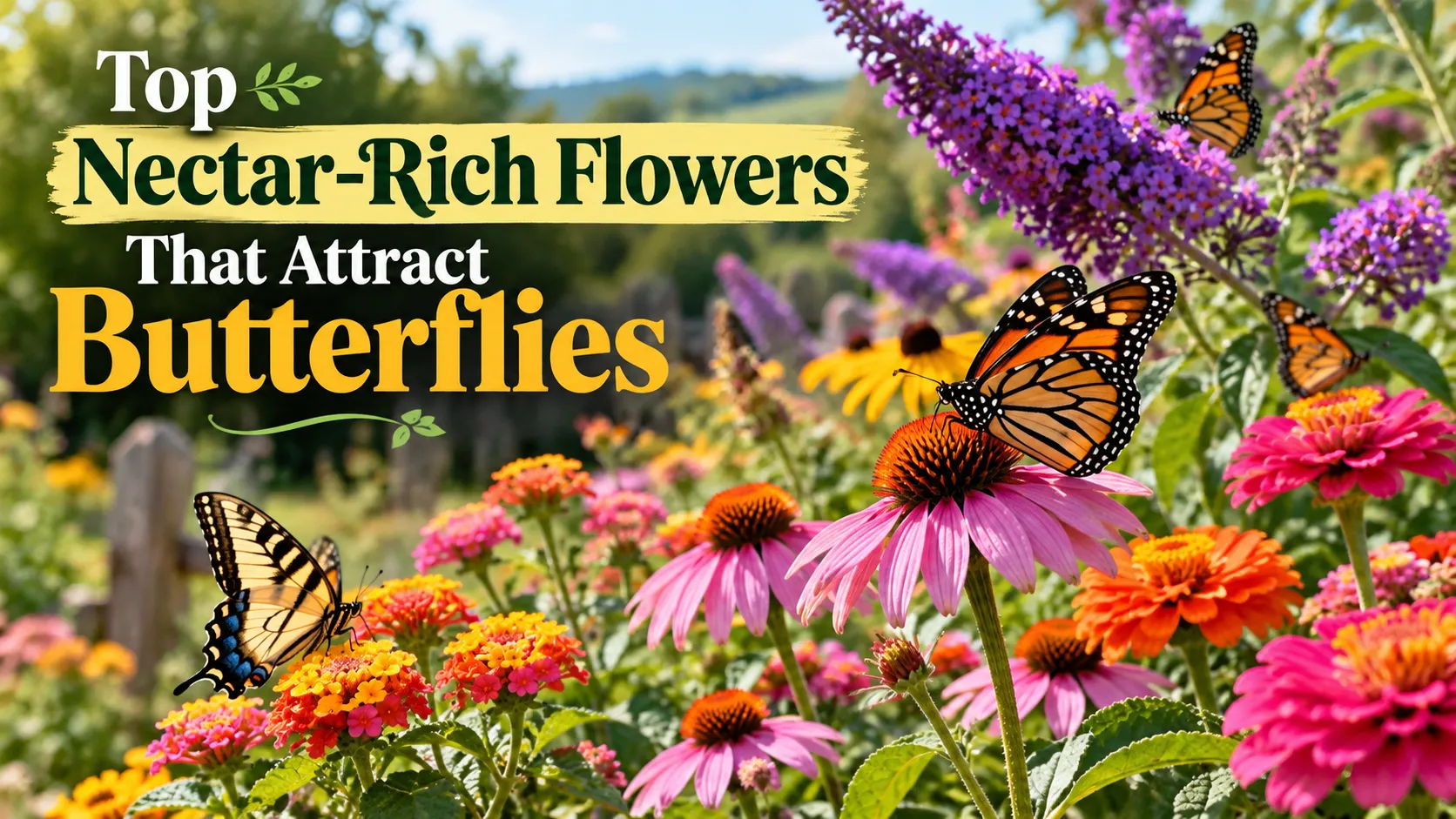
Think of a butterfly garden as a relay. Early trees and shrubs open the season, meadow perennials carry the summer, and asters and goldenrods finish in fall. This guide walks through the flowers that attract butterflies in each window, using plants with documented butterfly use. It notes where each one is native and flags popular “butterfly plants” worth checking before you buy.
Bloom times shift with latitude and elevation, so the same plant can flower weeks apart in different parts of the country. Treat the windows below as a sequence rather than fixed dates.
What makes a good butterfly nectar flower
Flower shape matters. Penn State Extension notes that butterflies generally favor flat topped or clustered flowers with short tubes, often in purple, red, yellow, orange or pink. Small butterflies tend to use small flowers, while larger species can use bigger blooms, according to UF/IFAS Extension.
Single flowers are usually a safer choice than doubles. The University of Minnesota Extension advises avoiding double flowered varieties, which are often bred for showiness rather than nectar, and Alabama Extension gives similar advice.
Cultivars are a mixed picture. In a Penn State trial summarized by the Maryland Department of Natural Resources, the straight species drew more pollinator visits than its cultivar about half the time. Some selections did better, though. At Mt. Cuba Center, the garden phlox ‘Jeana’, a selection found growing wild near Nashville, recorded far more butterfly visits than the other phlox in its trial. A reasonable rule is to favor straight species or lightly selected forms, and to be wary of heavily bred hybrids and double flowers.
Early spring nectar: trees and shrubs open the season
Few perennials bloom early, so woody plants do much of the work in spring.
Wild plum (Prunus americana) flowers in white clusters before its leaves appear. The Lady Bird Johnson Wildflower Center lists its native range as southern New Hampshire west to Manitoba and Montana, and south to the Florida Panhandle, Arkansas, Kansas and New Mexico. In Missouri, the spring azure butterfly nectars at wild plum, and its flight period closely tracks the plum’s bloom.
Serviceberries (Amelanchier species) produce early white flowers that Penn State Extension describes as a nectar source for butterflies and bees. Serviceberry species vary by region, so choose one native to your area.
Golden Alexanders (Zizia aurea) is a low perennial with flat yellow flower clusters. The Wildflower Center lists it as attracting butterflies, native from Quebec and Saskatchewan south to New England, Florida and Texas, with blooms from spring into summer. It also hosts black swallowtail caterpillars.
New Jersey tea (Ceanothus americanus) is a small shrub that the Missouri Department of Conservation lists among the spring azure’s nectar plants. Check whether it is native where you live before planting.
Not every early butterfly needs flowers. Mourning cloaks, among the first butterflies seen in spring, rarely visit flowers and prefer sap flows. For monarchs, the Monarch Joint Venture describes spring nectar, roughly late March through early June, as fuel for the northward migration.
Early to midsummer: perennials for butterflies
Many of the classic butterfly perennials bloom in this window.
Butterfly weed (Asclepias tuberosa) carries bright orange flower clusters from late spring into late summer. The Wildflower Center lists it as a nectar source and a host for monarchs, queens and gray hairstreaks, native across most of the lower 48 states except the far Northwest. It can take two or three years to flower from seed.
Wild bergamot (Monarda fistulosa) has lavender, tubular flowers from early summer into fall. The USDA reports that butterflies, bees and hummingbirds use it for nectar, and that it grows from Quebec to British Columbia and south to Georgia, Louisiana and Arizona. It spreads by rhizomes, so give it room. Cultivar results differ by trial: the straight species outdrew ‘Claire Grace’ for pollinators overall in Penn State’s study, while Mt. Cuba’s trial found ‘Claire Grace’ favored by butterflies and moths.
Purple coneflower (Echinacea purpurea) is native to parts of the central and eastern United States, according to the USDA plant guide, and blooms in early to midsummer. Expect modest butterfly traffic, though. In Mt. Cuba Center’s coneflower trial, butterflies made up only about five percent of insect visitors.
Black eyed Susan (Rudbeckia hirta) occurs throughout the United States in several regional varieties. It attracts adult butterflies and hosts the caterpillars of the silvery checkerspot and bordered patch. It is short lived, and the USDA notes it can become weedy in some settings.
Garden phlox (Phlox paniculata) brings fragrant clusters in mid to late summer. In Mt. Cuba’s trial, the selection ‘Jeana’ attracted the most butterflies, most often eastern tiger swallowtails. Check whether garden phlox is native in your area.
Buttonbush (Cephalanthus occidentalis) suits wet ground. This shrub blooms through summer, and the Wildflower Center lists it as a nectar source for butterflies, native across much of the eastern US and in parts of Arizona and California.
Late summer to fall: nectar for migrating butterflies
For monarchs, the Monarch Joint Venture places the fall nectar window at roughly mid August through late October, when nectar fuels migration and winter survival. It also notes that during fall migration, nectar plants matter more to adult monarchs than milkweed.
New England aster (Symphyotrichum novae-angliae) is known for attracting butterflies and moths and providing autumn nectar. Its USDA range runs from Quebec to Alberta and south to North Carolina, Alabama, Arkansas, Kansas, Colorado, Wyoming and New Mexico. In the Penn State trial, the compact cultivar ‘Purple Dome’ drew fewer pollinator visits than the straight species, according to the Maryland DNR summary.
Goldenrods, blazing stars and ironweeds are large groups with many regional species. In the USDA and Xerces Society monarch plant list for the Southern Plains, gray goldenrod and dotted blazing star earn the highest monarch rating, and Baldwin’s ironweed rates highly too. Choose species native to your area rather than a single “best” one.
Blue mistflower (Conoclinium coelestinum) and frostweed (Verbesina virginica) are strong late choices in the South. Both rate very highly for monarchs in the Southern Plains list. Frostweed tolerates part shade and is native from Pennsylvania west to central Texas and south to Florida.
Researchers still debate how much late season nectar shapes monarch numbers. Cornell scientists have suggested that losses during fall migration, including scarce autumn nectar, may contribute to the decline. A tagging study reported by The Wildlife Society did not support that migration hypothesis. Either way, fall flowers feed the butterflies still flying late in the season.
Butterfly nectar plants by season
| Window | What to plant |
|---|---|
| Early spring | Wild plum, serviceberry, golden Alexanders, New Jersey tea. Trees and shrubs help before many perennials bloom. |
| Early to midsummer | Butterfly weed, wild bergamot, purple coneflower, black eyed Susan, garden phlox, buttonbush for wet sites. Favor single flowers and straight species. |
| Late summer to fall | New England aster, local goldenrods, blazing stars and ironweeds, plus blue mistflower and frostweed in the South. Key fuel for migrating monarchs. |
The Monarch Joint Venture suggests aiming for at least three species blooming in each period, a useful target for any butterfly garden.
Adapting the list to your region
Native ranges vary widely, and the plants above lean toward the eastern and central United States. Use a regional list to fill gaps:
- The Xerces Society publishes monarch nectar plant guides by region, including California, the Great Basin, the Southwest, the Rocky Mountains and the Northwest.
- In Florida, the UF/IFAS butterfly gardening guide includes tables of state appropriate nectar plants.
- In Kansas, Oklahoma and Texas, the Southern Plains list rates plants by monarch value and bloom month.
Before buying, confirm a plant is native to your county with your state Extension service or a regional native plant society.
Where and how to plant
Placement matters too. Cornell Cooperative Extension lists full sun, shelter from wind and a water source as the basic needs of a butterfly garden. Plant in groups rather than single specimens, which Penn State notes work better for butterflies than scattered plants, and group similar colors together where you can.
The University of Minnesota Extension advises avoiding broad spectrum pesticides in a butterfly garden. When buying plants, ask whether they were treated with systemic insecticides. A 2012 Xerces Society article notes that neonicotinoids can move into a plant’s nectar and pollen, and the Society recommends asking nurseries before you buy.
Popular flowers to check before planting
Butterfly bush (Buddleja davidii) is still listed as a nectar shrub by some Extension services, but it has naturalized in many parts of the country. In Oregon it is a quarantined noxious weed, and only approved low seed varieties may be sold. It is also on Washington’s noxious weed list. Native shrubs such as buttonbush or New Jersey tea are safer choices.
Common lantana (Lantana camara, now often called L. strigocamara) is a top category invasive plant in Florida. UF/IFAS does not recommend it anywhere in the state, though it has assessed some sterile cultivars as acceptable. All parts of the plant are poisonous if eaten. Native alternatives include Lantana involucrata and L. depressa in Florida, and L. urticoides, which the Southern Plains list rates highly for monarchs.
Verbena bonariensis, the tall purple top vervain, self seeds readily. The California Invasive Plant Council lists it as at high risk of becoming invasive, and it has naturalized in 27 California counties.
Sedum ‘Autumn Joy’ often appears on butterfly lists, but butterfly specific evidence for it is lacking either way. Late blooming natives such as asters are a better supported choice for fall.
Double flowered varieties of any plant can make nectar harder to reach. Choose single flowers where you have the option.
Nectar is only one part of butterfly habitat
Nectar feeds adult butterflies, but caterpillars need specific host plants to eat. UF/IFAS Extension explains that most adults are flexible nectar feeders while caterpillars depend on particular plants. Some adults barely use flowers at all and feed on sap, rotting fruit or dung instead. Some butterflies also visit damp ground for minerals, and you can offer that with a simple butterfly puddling area.
For host plants, shelter and overwintering habitat alongside your nectar flowers, see the complete butterfly habitat guide.
Annuals that can extend the season
These annuals are not native to most of the United States, but they can fill gaps while perennials establish. Extension writers in Florida and North Carolina describe Mexican sunflower (Tithonia rotundifolia) as attracting butterflies from midsummer to frost, and it handles heat and drought. Don’t confuse it with Tithonia diversifolia, a different plant.
Zinnias are another common annual pick. Following the flower shape guidance above, choose single, open centered types.
Sources and further reading
- Gardening for Butterflies (Penn State Extension)
- Creating a Butterfly Garden (University of Minnesota Extension)
- Butterfly Gardening in Florida, WEC 22 (UF/IFAS Extension)
- Gardening to Attract Butterflies (Cornell Cooperative Extension Rockland County)
- Monarch Nectar Plant Guides (Xerces Society)
- Plant Recommendations for Monarch Butterflies: Southern Plains (USDA NRCS and Xerces Society)
- Habitat Needs (Monarch Joint Venture)
- Spotlight on Phlox (Mt. Cuba Center)
- The Cultivar Question (Maryland Department of Natural Resources)
- Spring Azure (Missouri Department of Conservation)
- Plant Guide: Wild Bergamot (USDA NRCS)
- Plant Guide: New England Aster (USDA NRCS)
- Plant Guide: Black Eyed Susan (USDA NRCS)
- Weeds: Butterfly Bush (WSU HortSense)
- Lantana (UF/IFAS Gardening Solutions)
- Verbena bonariensis Profile (Cal-IPC)
- Recommendations to Protect Pollinators from Neonicotinoids (Xerces Society)