
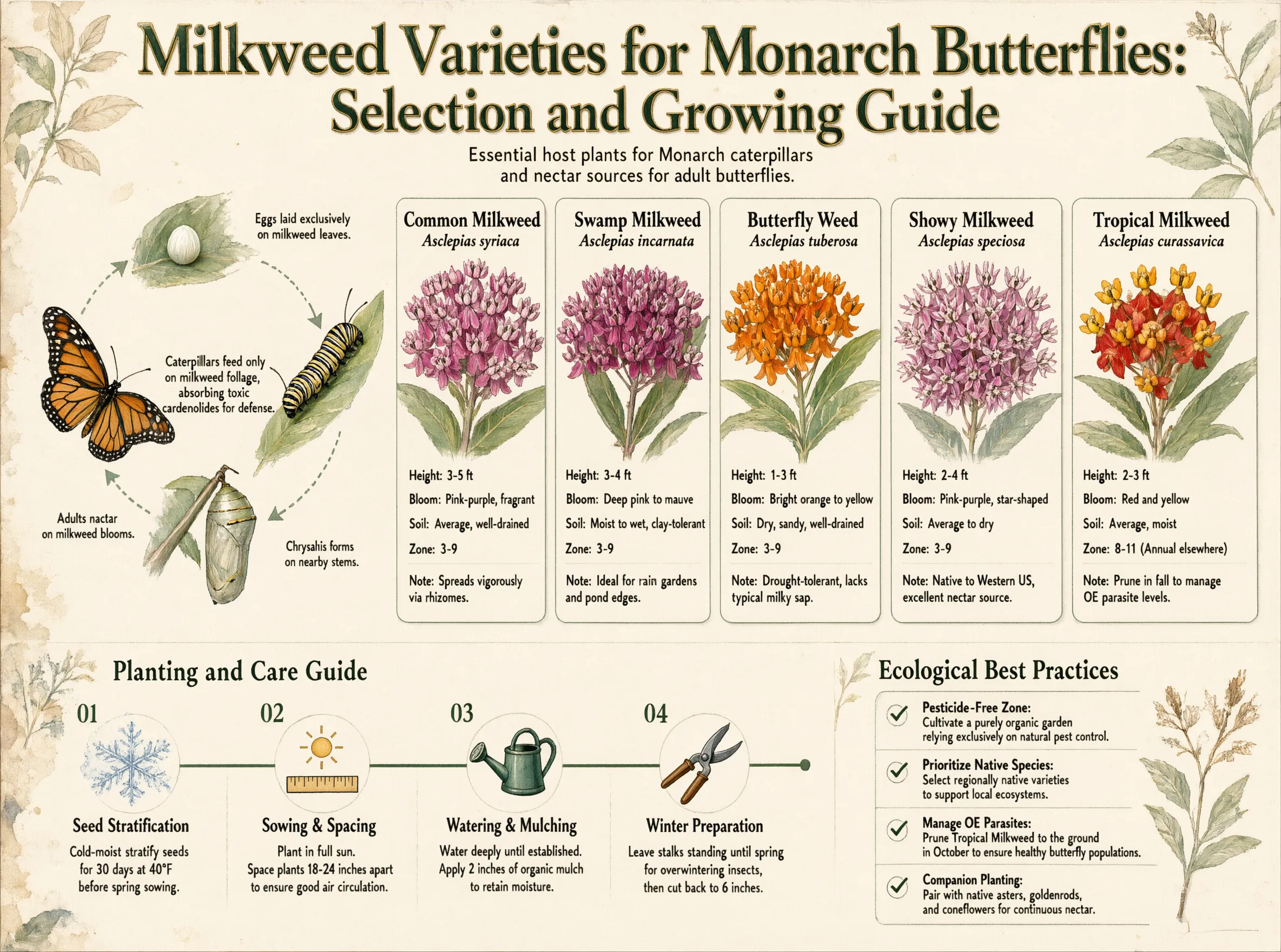
The best milkweed for monarchs is not a single universal plant, but a straight species native milkweed matched precisely to your local ecoregion. Monarch caterpillars are obligate feeders, meaning they survive exclusively on milkweed foliage. Planting the wrong species, or a heavily cultivated ornamental variety, can fail to support local monarch populations. In the case of tropical milkweed in warm climates, it can actively harm them by amplifying deadly parasites.
This guide cuts through generic gardening advice to provide a regionally accurate selection of milkweed seeds and plants. It is based on biological requirements defined by the Monarch Joint Venture, the Xerces Society, and USDA native plant databases, ensuring your garden serves as a safe, effective part of your overall butterfly habitat.
Quick Comparison: Best Milkweed Seeds and Plants for Monarchs
| Product | Best for | Key feature | Details |
|---|---|---|---|
| Home Grown Swamp Rose Milkweed | Wet soils and rain gardens | Consistently moist to wet | Check price on Amazon (opens in a new tab) |
| Sow Right Seeds Butterfly Milkweed | Dry, sandy, and well drained soils | Dry, sandy, well drained | Check price on Amazon (opens in a new tab) |
| Survival Garden Seeds Common Milkweed | Large meadows and prairie restorations | Spreads by underground rhizomes | Check price on Amazon (opens in a new tab) |
| Sherwoods Seeds Narrowleaf Milkweed | California and Western native habitats | Dry, drought tolerant western native | Check price on Amazon (opens in a new tab) |
| Seed Needs Milkweed Variety Pack | Beginners testing microclimates | Four to five native species | Check price on Amazon (opens in a new tab) |
| Clovers Garden Live Butterfly Milkweed | Instant habitat from live plants, with pesticide caveats | Two live plants, four inch pots | Check price on Amazon (opens in a new tab) |
How We Chose
How to Choose the Right Milkweed for Your Region
A foundational rule of pollinator conservation is that milkweed is regional. A species thriving in the moist soils of the Southeast will likely perish in the arid Southwest, and vice versa. The geographic framework recommended by the Monarch Joint Venture relies on USDA Forest Service Level III ecoregions, which group areas by shared geology, climate, and native vegetation.
When choosing milkweed varieties, conservation organizations like the Xerces Society recommend prioritizing straight species natives over ornamental cultivars (nativars). While research into how selective breeding affects milkweed chemistry is ongoing, there is a concern that cultivars bred for unusual traits may alter the natural concentration of cardiac glycosides (cardenolides), the essential toxins monarch caterpillars sequester for predator defense. Sticking to straight native species ensures the plant retains its natural ecological profile.
Below is a synthesized guide to native species by major region. Always verify the native status of a plant for your specific county using the USDA PLANTS database or your local university extension service before purchasing.
| Region | Recommended Native Milkweed Species | Key Ecological Characteristics |
|---|---|---|
| Midwest & Northeast | Asclepias syriaca (Common), A. incarnata (Swamp), A. tuberosa (Butterfly Weed), A. exaltata (Poke), A. verticillata (Whorled) | Adaptable to prairie, woodland edge, and wetland habitats. Common milkweed spreads via rhizomes; butterfly weed prefers dry, sandy soils. |
| Southeast | Asclepias humistrata (Pinewoods), A. perennis (Aquatic), A. viridis (Green Antelope Horn), A. variegata (White), A. tuberosa | Adapted to pine flatwoods, sandhills, wet marshes, and open woodland edges. |
| South Central | Asclepias viridis (Green Antelope Horn), A. asperula (Antelope Horns), A. oenotheroides (Zizotes), A. latifolia (Broadleaf) | Suited for diverse habitats ranging from dry Texas grasslands to river bottoms. |
| West (Intermountain/PNW) | Asclepias speciosa (Showy), A. latifolia (Broadleaf), A. fascicularis (Narrowleaf) | Drought tolerant species adapted to the Great Basin, mountainous regions, and drier parts of the Pacific Northwest. |
| California | Asclepias fascicularis (Narrowleaf), A. erosa (Desert), A. californica (California), A. cordifolia (Heartleaf) | High diversity supporting both resident and migratory western monarch populations in varied microclimates. |
The Tropical Milkweed and OE Parasite Warning
A critical question for new gardeners is: Where should you not plant milkweed? The most significant ecological risk in monarch gardening comes from Tropical Milkweed (Asclepias curassavica).
While native to Central and South America, tropical milkweed is widely sold in the U.S. In colder climates, it behaves as an annual and dies back with the first frost. However, in mild winter climates (USDA Zones 8 and higher, including the southern U.S. and California), it remains evergreen year round.
This persistent growth creates a severe biological hazard. It encourages resident monarchs to bypass their natural reproductive diapause and breed continuously through the winter. More critically, it allows the protozoan parasite Ophryocystis elektroscirrha (OE) to accumulate on the plant’s foliage. Infected monarchs deposit microscopic OE spores on milkweed leaves. When subsequent generations of caterpillars feed on the same evergreen plant, they ingest a concentrated, compounding load of spores.
Research from the Monarch Joint Venture and the Xerces Society confirms that monarchs breeding on persistent tropical milkweed exhibit significantly higher rates of debilitating OE infection. This causes wing deformities, reduced flight endurance, and lower survival rates during migration.
Mitigation Strategy: If you already have tropical milkweed in a mild winter zone, the Xerces Society recommends cutting all stems down to the ground between early October and February. Repeat this process whenever new growth appears until spring, destroying the contaminated biomass and breaking the parasite’s transmission cycle. The safest long term solution is to replace it entirely with regionally appropriate native species that naturally die back in the winter.
In Depth Product Reviews
The following recommendations are selected based on strict evidence based criteria: regional nativity, straight species genetics, seed viability, and current Amazon.com availability.
1. Best for Wet Soils & Rain Gardens: Home Grown Swamp Rose Milkweed
Why it fits: Swamp milkweed is uniquely adapted to consistently moist or wet soils, making it an excellent monarch host plant for rain gardens, stream banks, and low lying areas where other milkweeds would rot. It produces fragrant pink flower clusters that are highly attractive to adult nectar feeding butterflies.
Key Specifications: 50 heirloom, non GMO seeds per pack.
Strengths: Excellent germination rates; does not spread aggressively via rhizomes like common milkweed; highly attractive to pollinators.
Limitations: Requires consistent moisture to thrive; will struggle or die in dry, drought prone soils without supplemental irrigation.
Bottom Line: A highly reliable choice for gardeners with wet soil conditions or those building dedicated pollinator rain gardens in the Midwest, Northeast, or Southeast.
Home Grown Swamp Rose Milkweed
Swamp milkweed adapted to consistently moist or wet soils, a strong monarch host plant for rain gardens, stream banks, and low lying areas where other milkweeds would rot. Fragrant pink flower clusters feed adult butterflies.
Key specifications
- Soil
- Consistently moist to wet
- Species
- Asclepias incarnata
- Region
- Midwest, Northeast, Southeast, South Central
- Format
- 50 heirloom, non GMO seeds
Pros
- Adapted to wet and rain garden soils
- Does not spread aggressively by rhizomes
- Fragrant pink clusters attract pollinators
Cons
- Needs consistent moisture, struggles in dry soils without irrigation
2. Best for Dry, Sandy & Well Drained Soils: Sow Right Seeds Butterfly Milkweed
Why it fits: Also known as Butterfly Weed, this species is uniquely adapted to dry, sandy, or gravelly soils. Unlike most milkweeds, it lacks the characteristic milky sap, but it remains a highly effective host plant for monarch caterpillars.
Key Specifications: Heirloom, non GMO seed packet.
Strengths: Exceptional drought tolerance once established; vibrant orange blooms are highly visible to adult monarchs; non rhizomatous, so it stays in a tidy clump.
Limitations: Slow to establish from seed; highly sensitive to root disturbance, making transplanting live plants of this species difficult (seeds are preferred).
Bottom Line: The most reliable native option for xeric gardens, sunny borders, and well drained sandy soils across the eastern and central United States.
Sow Right Seeds Butterfly Milkweed
Butterfly weed adapted to dry, sandy, or gravelly soils. It lacks the milky sap of most milkweeds but remains an effective monarch host plant with vivid orange blooms.
Key specifications
- Soil
- Dry, sandy, well drained
- Species
- Asclepias tuberosa
- Region
- Widespread across the Midwest, East, and South
- Format
- Heirloom, non GMO seed packet
Pros
- Drought tolerant once established
- Vibrant orange blooms are easy for adult monarchs to find
- Non rhizomatous, so it stays in a tidy clump
Cons
- Slow to establish from seed
- Sensitive to root disturbance, so seeds are preferred over transplants
3. Best for Large Meadows & Prairie Restorations: Survival Garden Seeds Common Milkweed
Why it fits: Common milkweed is the historical backbone of the midwestern prairie and a primary driver of eastern monarch population recovery. It is highly vigorous and supports massive numbers of caterpillars.
Key Specifications: 3 packs (150+ total seeds), heirloom, non GMO.
Strengths: Highly adaptable to average soils; robust growth; provides abundant foliage for large scale habitat restoration.
Limitations: Spreads aggressively via underground rhizomes. It is not suitable for small, manicured flower beds, as it will outcompete neighboring plants.
Bottom Line: Ideal for landowners, community gardens, or large backyard meadows where aggressive spreading is an asset, not a liability.
Survival Garden Seeds Common Milkweed
Common milkweed, the backbone of the midwestern prairie and a major host plant for eastern monarchs. Vigorous growth provides abundant foliage for large scale habitat.
Key specifications
- Growth
- Spreads by underground rhizomes
- Species
- Asclepias syriaca
- Region
- Midwest, Northeast
- Format
- 3 packs, 150 plus seeds
Pros
- Adaptable to average soils
- Robust growth supports many caterpillars
- Suited to large scale restoration
Cons
- Spreads aggressively by rhizomes
- Not suited to small manicured beds
4. Best for California & Western Regions: Sherwoods Seeds Narrowleaf Milkweed
Why it fits: Narrowleaf milkweed is the primary host plant for the western monarch population. It is uniquely adapted to the dry, Mediterranean climate of California and the Pacific Northwest.
Key Specifications: Premium heirloom seed packet.
Strengths: Highly drought tolerant; narrow leaves are preferred by western monarchs; naturally dies back in winter, preventing OE parasite buildup.
Limitations: Not suitable for humid, high rainfall eastern climates where it may succumb to fungal issues.
Bottom Line: The scientifically supported choice for gardeners in California, Oregon, Washington, and the Intermountain West.
Sherwoods Seeds Narrowleaf Milkweed
Narrowleaf milkweed, the primary host plant for western monarchs, adapted to the dry Mediterranean climate of California and the Pacific Northwest.
Key specifications
- Climate
- Dry, drought tolerant western native
- Species
- Asclepias fascicularis
- Region
- California, Pacific Northwest, West
- Format
- Premium heirloom seed packet
Pros
- Highly drought tolerant
- Narrow leaves preferred by western monarchs
- Dies back naturally in winter, limiting OE buildup
Cons
- Not suited to humid, high rainfall eastern climates
5. Best Multi Region Variety Pack: Seed Needs Milkweed Seeds
Why it fits: For beginners unsure of their garden’s microclimates, this pack provides multiple seed packets of different native varieties, allowing gardeners to test which species thrives in their specific soil and light conditions.
Key Specifications: 4 to 5 distinct heirloom, non GMO seed packets (varies slightly by listing update).
Strengths: Cost effective way to experiment; covers a range of moisture preferences (dry to wet).
Limitations: Gardeners must research which of the included species are actually native to their specific county and be prepared to remove or relocate any that are not.
Bottom Line: A practical starting point for new habitat gardeners willing to do the necessary regional research to filter the results.
Seed Needs Milkweed Variety Pack
A multi packet mix of native milkweed species so new gardeners can test which species thrives in their soil and light. Includes common, swamp, butterfly, and showy milkweed among others.
Key specifications
- Contents
- Four to five native species
- Species
- Mixed, including A. tuberosa, A. incarnata, A. syriaca, A. speciosa
- Region
- Check local nativity by county
- Format
- Individual seed packets
Pros
- Cost effective way to experiment
- Covers dry to wet moisture preferences
Cons
- You must check which included species are native to your county
- Remove or relocate any that are not
6. Best Live Plant Option: Clovers Garden Asclepias Tuberosa (With Caveats)
Why it fits: For readers who want to bypass the 30 to 90 day seed stratification process, this offers two live 4 to 8 inch plants.
Key Specifications: Two live plants in 4 inch pots.
Strengths: Immediate presence in the garden; bypasses seed germination uncertainty.
Limitations: Critical Safety Warning: Commercial nurseries frequently treat plants with systemic neonicotinoid pesticides to survive shipping and retail display. These chemicals persist in the plant’s tissue and are lethal to monarch caterpillars.
Bottom Line: If you purchase live plants, assume they are toxic. Remove all existing foliage immediately upon arrival, plant them, and allow them to grow out entirely new, untreated leaves for at least one full season before allowing monarchs to use them. For absolute safety, seeds are always the superior choice.
Clovers Garden Live Butterfly Milkweed
Two live butterfly weed plants in four inch pots for gardeners who want to skip seed stratification. Treat nursery plants with caution, since they may carry systemic pesticide residue.
Key specifications
- Format
- Two live plants, four inch pots
- Species
- Asclepias tuberosa
- Soil
- Dry, well drained
- Region
- Widespread
Pros
- Immediate presence in the garden
- Skips seed germination and stratification
Cons
- Nursery plants may carry systemic neonicotinoid residue that harms caterpillars
- Remove existing foliage and let untreated growth establish before monarchs use it
When Should You Plant Milkweed for Monarchs? (Germination & Growing Requirements)
Understanding when you should plant milkweed for monarchs depends on your chosen method: seeds or live plants.
Most native milkweed seeds possess a natural dormancy mechanism that prevents them from germinating prematurely. To achieve high germination rates, you must simulate winter conditions through a process called Cold Moist Stratification (CMS).
- Mix the seeds with a damp medium (sand, vermiculite, or a damp paper towel).
- Place the mixture in a sealed plastic bag and store it in a refrigerator (40 to 41°F) for 30 to 90 days.
- After stratification, sow the seeds in well draining potting mix and provide at least 3 hours of direct sunlight daily to prevent weak, leggy growth.
Alternatively, the simplest method is direct sowing outdoors in the late fall. This allows nature to perform the cold stratification over the winter, with seeds naturally germinating in the spring. Once established, native milkweeds are generally low maintenance, drought tolerant perennials that require minimal watering beyond their first growing season.
Creating a Holistic Monarch Habitat
Planting a monarch host plant is only half the equation. Adult monarchs require a continuous supply of nectar to fuel their breeding and long distance migration. A complete habitat integrates native nectar sources (such as purple and yellow Asteraceae family flowers like goldenrod, asters, and coneflowers) that bloom sequentially from spring through fall.
Furthermore, spatial arrangement matters. Pollinator conservation groups recommend planting milkweed in distinct clumps or blocks rather than scattering single plants, making them easier for searching females to locate. Ensuring adequate spacing (about 3 to 5 feet) around individual milkweed clumps also gives caterpillars room to forage and makes the plants more visible to egg laying females, while a diverse garden ensures a continuous nectar supply.
Finally, strict pesticide avoidance is critical. Never use systemic insecticides, as they render the entire plant toxic to caterpillars. For pest management, rely on Integrated Pest Management (IPM) principles, such as manually removing aphids with a strong spray of water or introducing beneficial predatory insects. Even with abundant host plants and clean nectar, caterpillars still fall to parasitoid wasps, tachinid flies, and everyday predators, so protecting caterpillars from parasites and predators is part of keeping a milkweed patch productive.
Frequently Asked Questions
What variety of milkweed is best for monarchs?
The best variety is a straight species native milkweed that naturally occurs in your specific county or ecoregion. For example, Asclepias syriaca is ideal for the Midwest, while Asclepias fascicularis is best for California.
Will monarchs lay eggs on milkweed?
Monarchs will attempt to lay eggs on many milkweed species, including non native tropical milkweed. However, they strongly prefer native species that provide the correct chemical profile (cardiac glycosides) necessary for caterpillar survival and predator defense.
Where can I learn more about supporting caterpillars?
For detailed guidance on the specific needs of larval stages versus adult butterflies, refer to the guide on monarch host plants versus nectar sources.
How do I protect monarchs from diseases and predators?
Avoiding tropical milkweed in warm climates is the primary defense against the OE parasite. For broader habitat protection strategies, review the resource on protecting caterpillars from parasites and predators.
Sources
- Monarch Joint Venture. Regional milkweed guidance, monarch habitat needs, and milkweed selection by ecoregion.
- Xerces Society for Invertebrate Conservation. Milkweed conservation, native plant selection, the tropical milkweed and OE parasite guidance, and pollinator pesticide safety.
- USDA PLANTS Database. Native plant distribution and status verification by county.
- University Extension Services. Cold moist stratification and native seed germination guidance.