
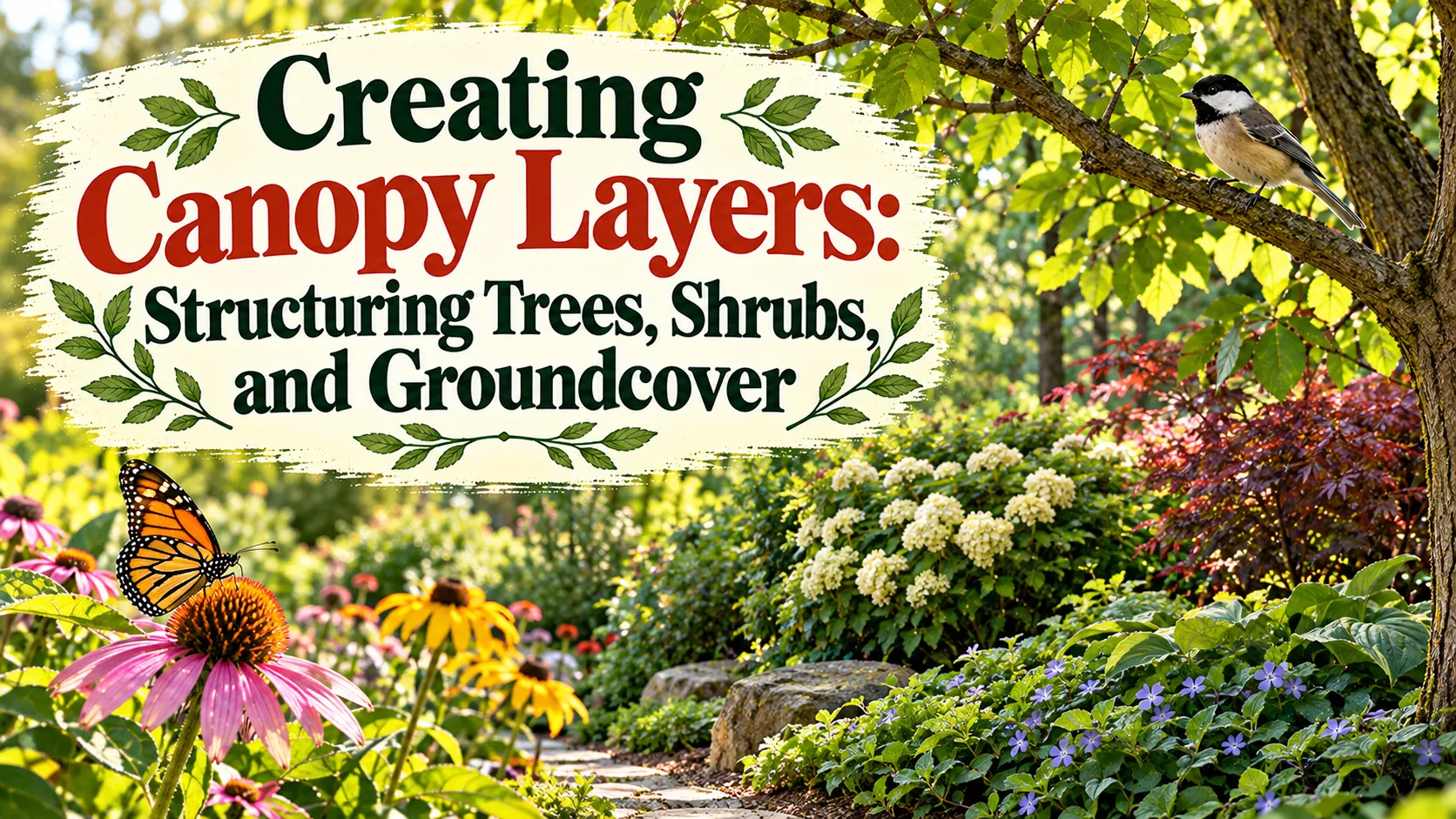
Walk through a woodland edge and you notice the arrangement without thinking: tall trees shade a tier of smaller trees, which shade shrubs, which shade low plants and a leaf covered floor. That is not accidental. Wild Ones describes it as building habitat “just like in nature”, and the wildlife in your yard evolved alongside exactly that structure.
This page explains what each layer does for birds and butterflies, how to add layers to a yard that already has some plantings, and how to adapt the framework when space is limited. For the wider garden design framework this sits inside, see our guide to planning a wildlife friendly garden.
Why structure matters
The National Wildlife Federation’s habitat essentials framework describes what wildlife needs as four things: food, water, cover, and places to raise young. Vertical plant layers address three of those four directly.
Virginia DWR puts it plainly: good habitat structure is the single most important ingredient, and a missing layer removes the wildlife that depends on it. A yard with only a lawn and a tree, however large that tree is, lacks the middle and lower layers entirely. That gap is not just a design consideration; it removes nesting sites, food sources, and cover that specific animals rely on at specific times of year.
The NWF recommends aiming for around 70% native plants across the yard. That is not a requirement for an immediate full redesign; it is a useful goal to work toward over time as you add each layer.
The layers, top to bottom
Canopy
The canopy is the tallest layer, anchored by large native trees. Virginia DWR highlights white oak, black cherry, and black gum as powerhouse species, not because they are the only choices, but because they support an exceptionally large number of insects, which in turn feed birds and the caterpillars that birds bring to nestlings. Evergreen trees in the canopy (eastern white pine is a common example) provide cover when deciduous trees are bare in winter.
Not every yard can hold a mature canopy tree. If you have one already, structure the rest of the garden around it. If you do not, the understory layer can carry much of the structural load on its own.
Understory and midstory
Small native trees fill the middle space between the canopy and the shrubs. Wild Ones lists flowering dogwood, serviceberry, redbud, sassafras, and native magnolias as examples. Many of these bloom in early spring before canopy trees leaf out, offer berries or seeds in late summer and fall, and bring nesting habitat closer to the ground than a large tree does.
In a yard without room for a canopy tree, one or two understory trees can serve as the primary structural element. Most top out at 15 to 25 feet, fitting under utility lines and along fence lines where a full canopy tree would not.
Shrub layer
Below the understory trees, clusters of native shrubs provide the densest cover in the garden and some of the most reliable food. Virginia DWR mentions elderberry, native viburnums, beautyberry, chokeberry, pepperbush, and New Jersey tea as examples suited to a range of light and moisture conditions. Planted in masses rather than as isolated specimens, they create the thicket like cover that many birds use for nesting and refuge.
A group of three to five shrubs of the same species provides meaningfully more shelter than the same number of plants spaced individually across a border.
Herbaceous layer
Below the shrubs, perennials, native grasses, and sedges form the herbaceous layer. This is where most nectar plants live, and where many butterfly host plants fit. Wild Ones describes this layer as building the transition between the shrub layer and the ground, extending the garden’s structural complexity and providing a second season of food, seed heads through fall and winter, after the berry crop from the shrub layer ends.
Specific plant choices for this layer depend on your region and the conditions in your yard. See the related pages on native perennials for year round wildlife and butterfly nectar flowers for plant level guidance.
Ground and leaf layer
Leaf litter is the layer most often removed and the one most worth keeping. Virginia DWR’s habitat guidance identifies the ground layer as essential for overwintering insects and for the birds that forage for them in early spring. Our guide to overwintering habitat in fallen leaves covers what it shelters and how to manage it through winter. Leaving leaves in place under shrubs and trees, or raking them to a border area rather than bagging them, addresses the ground layer at no cost.
What each layer does for wildlife
The layers work together more than they work independently. A caterpillar feeding on an oak leaf may pupate in the leaf litter below, emerge as a moth, and be caught mid flight by a bird perched in the understory. Virginia DWR’s framework describes structure as the element that allows these connections to happen; remove a layer and you interrupt the chain.
Broadly, the layers divide along these functions:
- Canopy: long lived nesting sites, elevated foraging for aerial insects, a structural anchor for the whole garden
- Understory: early bloom, berries and seeds in late summer and fall, nesting habitat at a range of heights
- Shrubs: dense cover and refuge, significant berry and seed crops, host plants for some moth species
- Herbaceous: nectar sources, butterfly host plants, seed heads that carry food into winter
- Ground and leaf layer: overwintering insects, ground level foraging for birds, moisture retention
Wild Ones notes that native plants across every layer support more insects than non native alternatives, because many insects are specialists that co evolved with particular plant genera. Local native plant communities, not generic regional lists, are the best reference for what is native in your specific area and what your local wildlife depends on.
Building layers gradually
Few yards start from scratch, and the practical question is usually how to add layers to what is already there.
Start by identifying what you have. A mature shade tree with a lawn underneath has a canopy but no middle or lower layers. A mixed shrub border without trees has the shrub layer but lacks the upper structure. An established perennial bed has the herbaceous layer but nothing above it.
From there, add the most structurally significant missing layer first. In most cases, that means a native tree, canopy if space allows, understory if it does not, because trees take the longest to establish and provide the most durable structure once they do. Shrub masses and herbaceous plantings can follow over subsequent seasons.
Adding structure in tight spaces
Where a tree will not fit, vines can extend vertical structure along a fence or wall. Wild Ones points to trumpet honeysuckle (Lonicera sempervirens), crossvine, passionflower, and Virginia creeper as native vines that add height and host plant function without the footprint of a tree. They do not replace the structural and food value of a canopy tree, but in a small or already built yard they extend the layered effect vertically without demanding additional ground space.
Understory trees are the other option for tight spaces: a serviceberry or redbud can establish the midstory layer in a narrow side yard or under utility lines where a large canopy tree would not fit.
Plant choices by layer
This page focuses on structure, what the layers are and why they matter for birds and butterflies. For specific plant recommendations by layer, see the related pages on plants for birds and butterflies, berry producing shrubs, native perennials, and nectar flowers. Native status and regional fit vary considerably; check your local Cooperative Extension resources or state native plant society alongside any general list.
Layers checklist
| Layer | What it provides | Simple starting point |
|---|---|---|
| Canopy (large native tree) | Nesting sites, insect food, structural anchor | Keep an existing mature tree, or plant one keystone species such as white oak or black cherry |
| Understory (small native tree) | Early bloom, berries and seeds, mid height structure | Add a serviceberry, flowering dogwood, or redbud |
| Shrubs (native, clustered) | Dense cover, berry and seed crops | Group 3 to 5 plants of one species rather than spacing them individually |
| Herbaceous (perennials, grasses) | Nectar, butterfly host plants, winter seed heads | Add host plants and late season perennials that hold their seed heads |
| Ground and leaf layer | Overwintering insects, ground foraging for birds | Leave leaves under trees and shrubs instead of removing them |
A garden with all five layers in place has the structural foundation that most of your local birds and butterflies need year round.